Damen Shipyards Cape Town (DSCT) has delivered the third Multi-Mission Inshore Patrol Vessel (MMIPV), Adam Kok (P1573), at Naval Base Durban for the South African Navy. The delivery milestone represents the culmination of a strategic initiative by the South African Navy to enhance South Africa’s maritime security while advancing local shipbuilding capabilities and driving industrial development.
In a handover ceremony attended by senior South African Naval officials, local government representatives, industry partners, dignitaries, and other key stakeholders.
Sefale Montsi, Director at Damen Shipyards Cape Town, explained that the delivery of P1573 represents far more than the delivery of a vessel – it marks the fulfilment of a promise.
“From the outset, our commitment was clear: to support the South African Navy, empower the local shipbuilding industry, and enhance maritime security. With this delivery, we are proud to have honored that commitment.”
A model for collaboration: DSCT, the Navy, and ARMSCOR
The delivery of P1573 followed a formal handover in Simon’s Town in March 2025, where the vessel passed stringent technical and quality inspections. The project was driven by close collaboration between DSCT, the South African Navy, and ARMSCOR, aligning with the Department of Defense’s broader strategy to modernize and expand fleet capabilities.
“This project has exemplified the power of collaboration – within DSCT, across our supplier base, and most importantly, with our partners in the Navy and ARMSCOR,” explained Montsi. “Everyone involved has reason to be proud.”
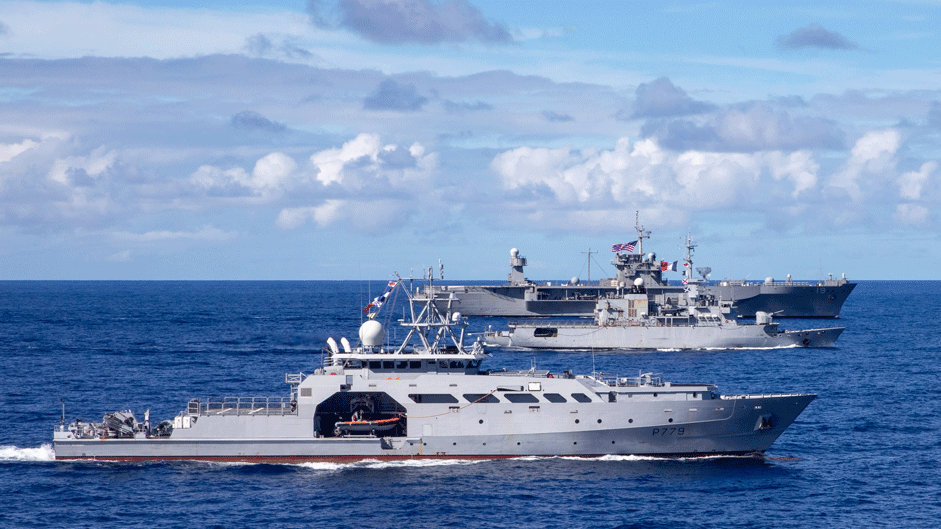
French offshore patrol vessel Auguste Bénébig (P779), front, the Floréal-class frigate Vendémiaire (F-734), center, and the U.S. 7th Fleet flagship USS Blue Ridge (LCC 19), back, conduct a maneuvering exercise during Croix du Sud in the Coral Sea, May 1, 2025. Blue Ridge and the 7th Fleet staff conduct regular Indo-Pacific patrols to deter aggression, strengthen alliances and partnerships, and advance future warfighting capabilities. (U.S. Navy photo by Mass Communication Specialist 1st Class Ryan M. Breeden)
U.S. 7th Fleet flagship USS Blue Ridge (LCC 19) participated in the 11th iteration of Exercise Croix du Sud in the Coral Sea near New Caledonia, May 1, 2025.
Croix du Sud, a French term meaning Southern Cross, is a 14-day biennial joint multinational military training exercise organized and led by the French Armed Forces in New Caledonia (FANC), focusing on Humanitarian Assistance Disaster Response (HADR) operations, crisis events and interoperability.
This year’s iteration hosted approximately 2,000 participants, 13 aircraft, five ships from 18 different countries. In addition to the U.S. military and France, the other participating countries included Australia, Brunei, Canada, Fiji, Germany, Indonesia, Japan, Malaysia, the Netherlands, Papua New Guinea, Peru, the Philippines, Singapore, Tonga, the United Kingdom, and Vanuatu.
“The U.S. and France are Pacific nations, and our navies routinely operate together to preserve a secure and prosperous Indo-Pacific,” said Vice Adm. Fred Kacher, commander, U.S. 7th Fleet. “The U.S. 7th Fleet’s participation in Croix du Sud is testament to our longstanding alliance with France and our shared commitment to advancing our combined warfighting capabilities in this theater.”
U.S. 7th Fleet staff, embarked aboard Blue Ridge, commands the U.S. Navy’s largest forward-deployed fleet with the primary mission of providing operational control and planning for its forces in the Western Pacific and Indian Oceans, while also promoting regional stability and maritime security through engagements with allied and partners.
During Croix du Sud, Blue Ridge operated with the French Floréal-class frigate FS Vendémiaire (F734), offshore patrol vessel FS Auguste Bénébig (P779), and one MH-60S. Together, they conducted combined surface action group operations, maritime domain awareness operations, helicopter cross-deck operations, combined command and control capabilities, and information sharing.
“Croix du Sud has strengthened over the years with the participation of so many nations,” said Cmdr. Sébastien, Chief of Command Joint Task Force. “When it comes to HADR, there is a role for everyone in this kind of operation. We have many earthquakes and cyclones in this area every year, so this exercise is extremely realistic and important for the region.”
The U.S. Navy and France’s Marine Nationale routinely build upon their longstanding defense relationship in the Indo-Pacific. In January 2025, Charles de Gaulle Strike Group conducted bilateral interoperability training during La Perouse with USS Savannah (LCS 28) in Southeast Asia and Pacific Stellar with the Vinson Carrier Strike Group in the Philippine Sea. The events were part of their Indo-Pacific deployment Clemenceau 25.
The head of the U.K. Royal Navy Admiral Ben Key has been removed from his duties while under investigation over allegations of misconduct, according to media reports.
`The Ministry of Defence didn’t give any further details on the matter he is being investigated for, according to the reports.
But the ministry’s statement follows a report in the Sun that Key was suspected of having an affair with a female subordinate.
Earlier this week, the ministry issued a statement saying Key had “stepped back due to private reasons,” according to a report in the Financial Times. The FT cited people familiar with the matter saying Key’s move was not related to the government’s strategic defense review, expected to be published soon.
Key was due to retire from his position this summer, after serving as the head of the Royal Navy since 2021. This means the search for his successor was already under way.
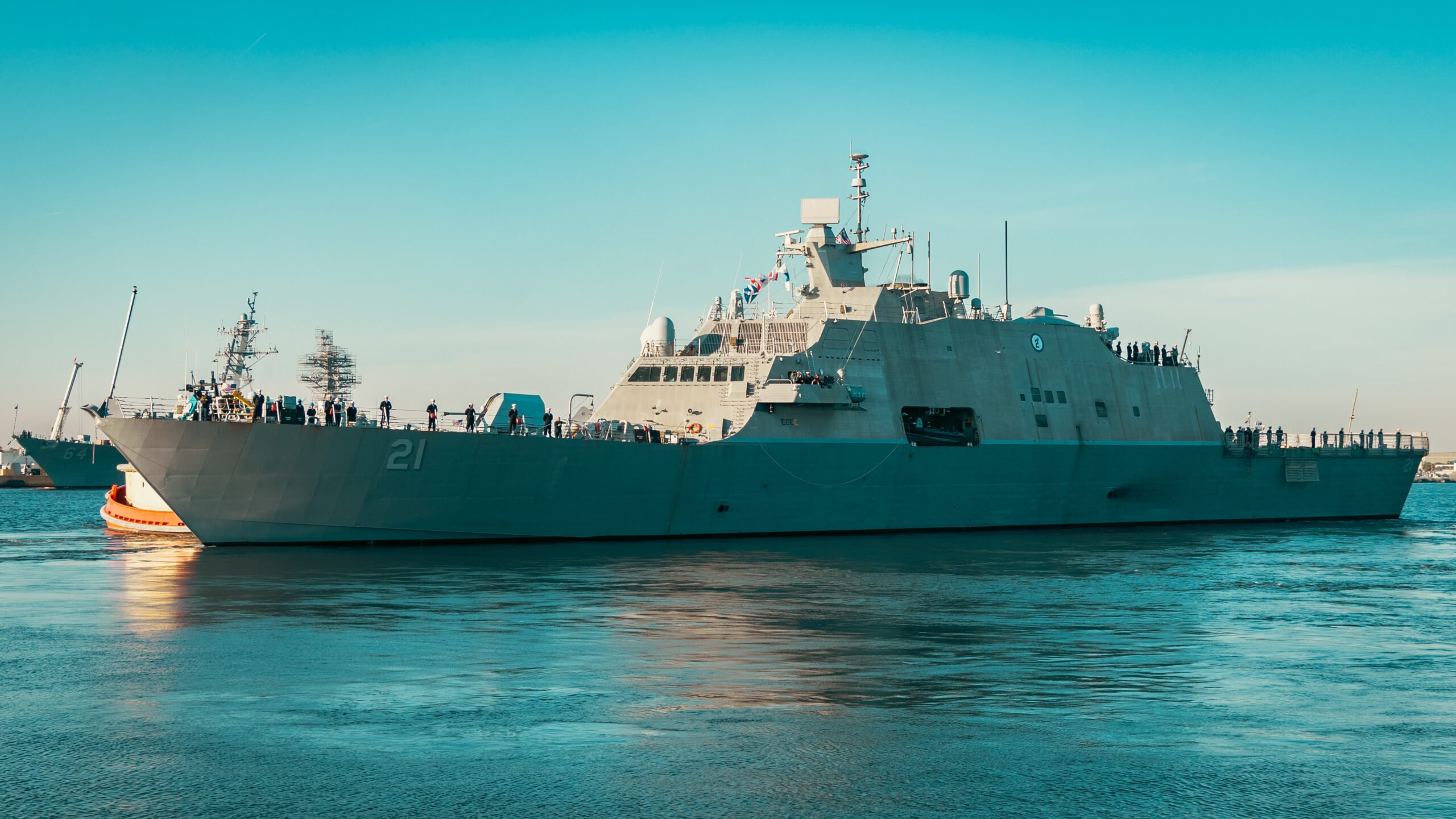
Freedom-class littoral combat ship USS Minneapolis-Saint Paul (LCS-21) departs Naval Station Mayport for her maiden deployment, Mar. 26, 2025. US Navy Photo
USS Minneapolis-Saint Paul (LCS-21) interdicted a drug smuggling vessel in early May, with assistance from the U.S. Coast Guard.
Minneapolis-Saint Paul left at the end of March for its maiden deployment, heading to U.S. Southern Command, where its primary mission focuses on counter-illicit drug trafficking, according to a Navy release from the deployment. The Littoral Combat Ship, with a Coast Guard Law Enforcement Detachment embarked, has been part of the Joint Interagency Task Force South during its deployment.
Maritime patrol aircraft alert Minneapolis-Saint Paul’s crew about the suspected drug smuggling vessel. The LCS headed to the target and then launched a helicopter from Helicopter Strike Squadron (HSM) 50, which is embarked on the ship, according to the Navy release.
The helicopter crew observed the vessel’s crew jettisoning packages, prompting sailors aboard Minneapolis-Saint Paul to launch a rigid-hull inflatable boat with the embarked LEDET aboard.
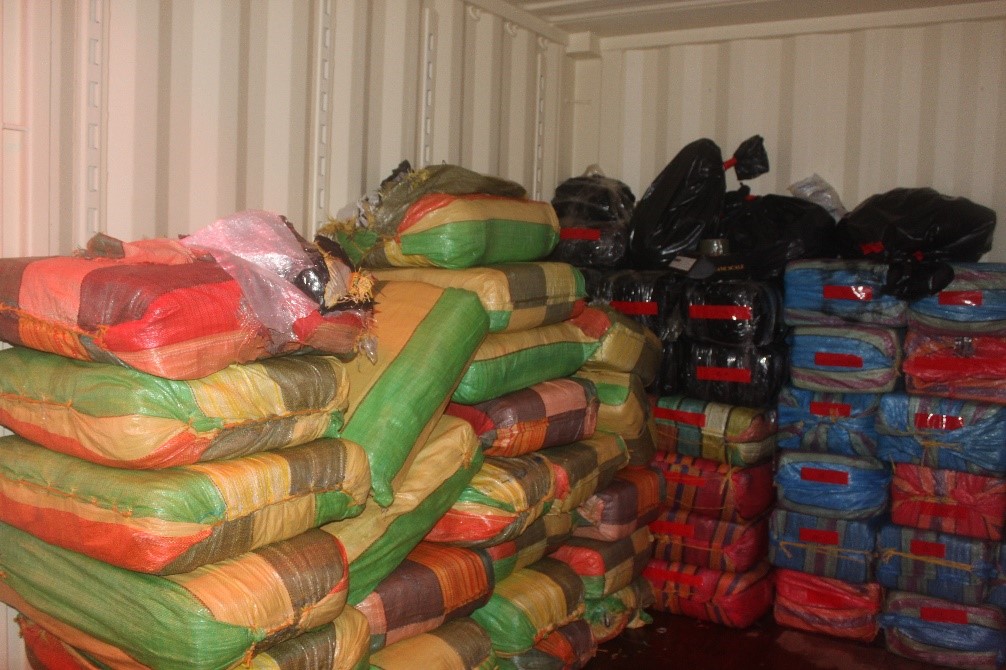
The boarding team found 22 bales of alleged cocaine, according to the release.
USS Minneapolis-Saint Paul (LCS 21) and embarked U.S. Coast Guard Law Enforcement Detachment (LEDET) 406, seize approximately 1716 lbs. of marijuana while conducting counter-narcotics operations, April 13, 2025. US Navy Photo
“USS Minneapolis-Saint Paul is delivering decisive blows against transnational criminal organizations,” Rear Adm. Carlos Sardiello, commander of U.S. Naval Forces Southern Command/U.S. 4th Fleet, said in the release. “These interdictions send a clear message: We are vigilant, and illicit trafficking will be interdicted to protect our homeland as well as our regional partners from this threat.”
The next day, U.S. Coast Guard Cutter Venturous’ (WMEC-625) crew offloaded about 5,300 pounds of cocaine and marijuana at the Coast Guard base in Miami Beach. The combined value of the drugs was about $14.1 million, according to a May 2 Coast Guard release.
The marijuana and cocaine were from four interdictions in the Caribbean Sea. The Coast Guard attributes the interdictions to USCGC Diligence (WMEC-616) and HNLMS Groningen (P843), a ship in the Royal Netherlands’ Navy with an embarked LEDET. It was not clear if Minneapolis-Saint Paul’s interdiction was included, although the Joint Interagency Task Force-South was part of the four interdictions.
However, it was likely at least part of one of the interdictions. In mid-April, the LCS interdicted two vessels and confiscated 580 kilograms of cocaine and 1,125 kilograms of marijuana.
“Stopping harmful and illicit narcotics from reaching our shores and entering our communities is a team effort,” Venturous Commanding Officer Cmdr. Karen Kutkiewicz said in the release. “It takes the combined efforts of our joint force DoD, DHS, and international partners to combat transnational criminal organizations.”
The Philippine Navy guided-missile frigate BRP Antonio Luna participates in a joint maritime exercise with Royal Australian Navy ships, April 2025.US Indo-Pacific Command
The Philippines signed a status of visiting forces agreement with New Zealand last month, regulating the deployment of troops for joint military exercises.
The agreement marks a significant milestone after New Zealand joined the Philippines and other countries in 2024 for multilateral maritime drills in the South China Sea.
The deal aligns with New Zealand’s support for freedom of navigation and overflight on the high seas. For the Philippines, it adds to its widening network of security partners.
This latest deal with New Zealand adds to the Philippines’ wide network of security partners. It is the fourth such deal by the Philippines to allow foreign troops to operate in the country, adding to the 2024 reciprocal access agreement with Japan, 2012 status of visiting forces agreement with Australia, and the 1999 visiting forces agreement with the United States
The three existing agreements with these countries are also part of the so-called “squad”, a minilateral grouping that seeks to maintain a free and open Indo-Pacific region. The Philippines is expected to sign a similar agreement with Canada by mid-2025, while France has also proposed a deal.
Its expanding bilateral security cooperation further reinforces what the Lowy Institute’s 2024 Asia Power Index regards as the Philippines’ strongest advantage.
The Philippines has relied on defence cooperation to enhance capabilities, demonstrate resolve, and serve as force multipliers to deter Chinese threats.
These agreements are important for the Philippines given China’s consistent maritime threats, the latest being the unfurling of a Chinese flag on Sandy Cay in the South China Sea.
Long outgunned and outspent by China, the Philippines cannot match Chinese maritime capabilities despite its long-term commitment to upgrade its forces. The Association of Southeast Asian Nations (ASEAN) has offered only limited diplomatic support to the Philippines, and the United States alliance is regarded as uncertain under its new administration.
So, the Philippines has relied on defence cooperation to enhance capabilities, demonstrate resolve, and serve as force multipliers to deter Chinese threats. China routinely condemns what it calls, “bloc politics along ideological lines and ganging up to form anti-China cliques,” but Beijing’s continued threats only strengthen other countries’ resolve.
The Philippines’ bilateral security arrangements also reflect its frustration over multilateral procedures. Its long-standing ties with ASEAN have not efficiently addressed increasing maritime tensions.
In the aftermath of the Scarborough Shoal standoff in 2012, ASEAN did not produce a joint statement that would have reflected its collective role in regional security.
ASEAN also failed to reinforce the 2016 arbitration ruling filed by the Philippines under the United Nations Convention on the Law of the Sea, which declared China’s maritime claims and activities to be illegal.
Manila will continue to focus on bilateral defence cooperation with states that have converging security interests.
ASEAN has been unreliable amidst China’s harassment, collisions, and blockade during the Philippines’ resupply missions to the [stranded tank landing ship] BRP Sierra Madre on Second Thomas Shoal.
Meanwhile, progress in the negotiations for a code of conduct between ASEAN and China has been painstakingly slow. The Philippines’ frustration became evident when President Ferdinand Marcos Jr expressed concern that ASEAN could not agree on many things, even, “the definition of a concept as basic as ‘self-restraint’ does not yet enjoy consensus”.
While ASEAN has organised a joint military drill in 2023, it has not yet followed it up with another collective exercise.
As the Philippines calls and waits for multilateral organisation to speak out and do more, it will continue to focus on bilateral defence cooperation with states that have converging security interests. This is especially important as uncertainty clouds its military alliance with the United States under President Donald Trump.
Given his focus on trade tariffs and penchant for transactional diplomacy, Trump may view tensions in the South China Sea as less important in his defence and foreign policy priorities.
The Marcos administration foresees Trump may demand concessions from the Philippines for its security, in the same manner that he wants Taiwan to pay for US protection.
Repetitive affirmations from Washington of an “ironclad commitment” haven’t allayed Manila’s concern. But so long as the Philippines continues to confront maritime threats, it will seek more defence ties with friends.