OPINION | With New Zealand the latest to join, the Philippines is building a network of defence partners amid South China Sea tensions

OPINION | With New Zealand the latest to join, the Philippines is building a network of defence partners amid South China Sea tensions

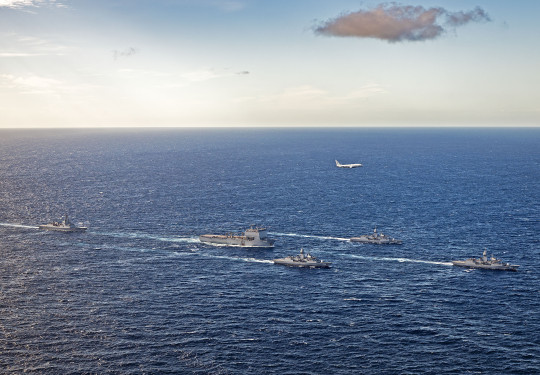
The Philippine Navy guided-missile frigate BRP Antonio Luna participates in a joint maritime exercise with Royal Australian Navy ships, April 2025.US Indo-Pacific Command

Andrea Chloe Wong

The Philippines signed a status of visiting forces agreement with New Zealand last month, regulating the deployment of troops for joint military exercises.

The agreement marks a significant milestone after New Zealand joined the Philippines and other countries in 2024 for multilateral maritime drills in the South China Sea.

The deal aligns with New Zealand’s support for freedom of navigation and overflight on the high seas. For the Philippines, it adds to its widening network of security partners.

This latest deal with New Zealand adds to the Philippines’ wide network of security partners. It is the fourth such deal by the Philippines to allow foreign troops to operate in the country, adding to the 2024 reciprocal access agreement with Japan, 2012 status of visiting forces agreement with Australia, and the 1999 visiting forces agreement with the United States

The three existing agreements with these countries are also part of the so-called “squad”, a minilateral grouping that seeks to maintain a free and open Indo-Pacific region. The Philippines is expected to sign a similar agreement with Canada by mid-2025, while France has also proposed a deal.

Its expanding bilateral security cooperation further reinforces what the Lowy Institute’s 2024 Asia Power Index regards as the Philippines’ strongest advantage.

The Philippines has relied on defence cooperation to enhance capabilities, demonstrate resolve, and serve as force multipliers to deter Chinese threats.

These agreements are important for the Philippines given China’s consistent maritime threats, the latest being the unfurling of a Chinese flag on Sandy Cay in the South China Sea.

Long outgunned and outspent by China, the Philippines cannot match Chinese maritime capabilities despite its long-term commitment to upgrade its forces. The Association of Southeast Asian Nations (ASEAN) has offered only limited diplomatic support to the Philippines, and the United States alliance is regarded as uncertain under its new administration.

So, the Philippines has relied on defence cooperation to enhance capabilities, demonstrate resolve, and serve as force multipliers to deter Chinese threats. China routinely condemns what it calls, “bloc politics along ideological lines and ganging up to form anti-China cliques,” but Beijing’s continued threats only strengthen other countries’ resolve.

The Philippines’ bilateral security arrangements also reflect its frustration over multilateral procedures. Its long-standing ties with ASEAN have not efficiently addressed increasing maritime tensions.

In the aftermath of the Scarborough Shoal standoff in 2012, ASEAN did not produce a joint statement that would have reflected its collective role in regional security.

ASEAN also failed to reinforce the 2016 arbitration ruling filed by the Philippines under the United Nations Convention on the Law of the Sea, which declared China’s maritime claims and activities to be illegal.

Manila will continue to focus on bilateral defence cooperation with states that have converging security interests.

ASEAN has been unreliable amidst China’s harassment, collisions, and blockade during the Philippines’ resupply missions to the [stranded tank landing ship] BRP Sierra Madre on Second Thomas Shoal.

Meanwhile, progress in the negotiations for a code of conduct between ASEAN and China has been painstakingly slow. The Philippines’ frustration became evident when President Ferdinand Marcos Jr expressed concern that ASEAN could not agree on many things, even, “the definition of a concept as basic as ‘self-restraint’ does not yet enjoy consensus”.

While ASEAN has organised a joint military drill in 2023, it has not yet followed it up with another collective exercise.

As the Philippines calls and waits for multilateral organisation to speak out and do more, it will continue to focus on bilateral defence cooperation with states that have converging security interests. This is especially important as uncertainty clouds its military alliance with the United States under President Donald Trump.

Given his focus on trade tariffs and penchant for transactional diplomacy, Trump may view tensions in the South China Sea as less important in his defence and foreign policy priorities.

The Marcos administration foresees Trump may demand concessions from the Philippines for its security, in the same manner that he wants Taiwan to pay for US protection.

Repetitive affirmations from Washington of an “ironclad commitment” haven’t allayed Manila’s concern. But so long as the Philippines continues to confront maritime threats, it will seek more defence ties with friends.

This story originally appeared on The Interpreter, published by the Lowy Institute for International Policy.

HMNZS Te Kaha tops up for the mission ahead

Commander Andy Grant, Executive Officer HMNZS Te Kaha, gives an insight into the complexities of refuelling while on task in the Arabian Gulf.

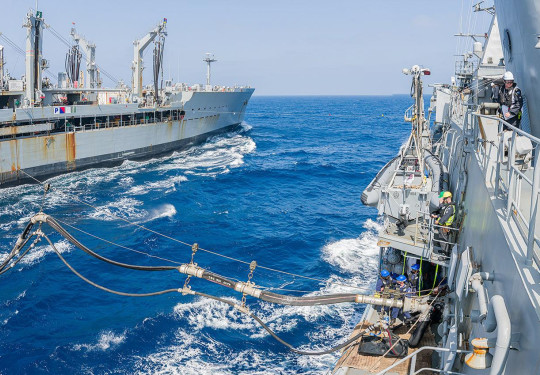
Two large grey ships sail across blue seas only 45m away from each other. They are connected by lines and fuels pipes.

13 May, 2025

We have a RAS tomorrow.

It’s a frequent topic of conversation aboard HMNZS Te Kaha today. It stands for Replenishment At Sea and we pronounce it as ‘Razz’. It’s how we refuel at sea.

Down in the darkened Operations Room, an Electronic Warfare specialist moves away from the dimly glowing screens and studies a well-thumbed copy of Jane’s Fighting Ships. Editions of this book have been in print for more than 100 years, with the images and details of every warship in the world, and it’s one of the few we still have in hard copy.

He finds the page for USNS Guadalupe. It’s a Henry J Kaiser class replenishment oiler, 206 metres in length, commissioned in 1992. This will be our floating gas station. We sent our fuel order by signal several days ago, and have received a reply detailing Guadalupe as our tanker and a designated rendezvous.

Meanwhile, in the Charthouse, the Navigator (Navs) has found the online Allied Tactical Publication that gives detailed information on where the refuelling facilities are onboard Guadalupe, what fuels, she has, and the methods for transfer. We need 20 cubic metres of aviation fuel, and 70 cubic metres of ship fuel.

In the Machinery Control Room, the engineers are looking through the fuelling schematics and recalling all the pipework, tanks and valves in between. To make the transfer straightforward they will need to transfer fuel to other tanks, so they can take the new fuel into a tank with sufficient capacity…and perhaps a little more.

In his tiny office, the Chief Bosun’s Mate (the Buffer) ponders the evolution team and puts names to each position – ensuring that there is suitable experience and supervision in all areas. This is critical work. When things go wrong, it happens quickly, and the consequences can be dire for our people, the ship, and the environment.

The Commanding Officer (CO), Navs and I have an initial brief in the Commanding Officer’s cabin, to go over the main aspects of the RAS. We’re looking at participants, forecast conditions and the general line-up of their fuel-supply position with our fuel-receive position.

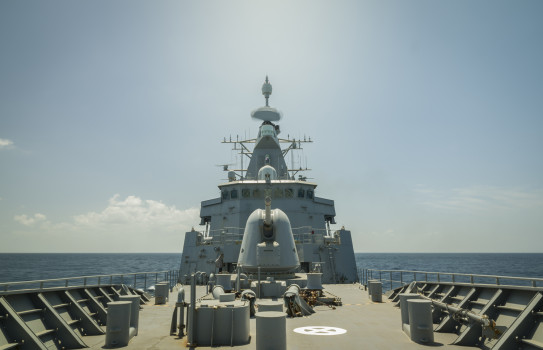
Royal New Zealand Navy frigate, HMNZS Te Kaha is photographed from the bow, showing the large grey 5inch gun and the bridge. On the horizon, some fluffy clouds linger otherwise the conditions are calm and sunn.y

HMNZS Te Kaha on patrol.

From here, we can work-out the finer details of the manoeuvre to drive a 3,600-tonne frigate to a position 45 metres abreast of a 41,000 tonne tanker and hold it there for two hours.

We all come together for a formal RAS Brief later in the day. After an overview, each area gives a detailed brief on their specific role. Navs and Comms look after the manoeuvre. The Buffer handles seamanship. The ship’s Marine Engineer looks after fuelling. The Weapons Engineer takes equipment preparations and any relevant defects.

As the Executive Officer (XO), I review ‘Overall Safety, Risks and Mitigations’. Questions are asked, the ‘Safe Sailor’ policy is recited and the team step away knowing that all is in hand for tomorrow morning.

For the last two days we’d been tracking Gaudalupe’s location, and you would think that the actual rendezvous would seem mundane. But there’s still a little bit of magic when the tanker is sighted in the morning, steaming up over the horizon.

After a couple of hiccups with radio comms, an American voice comes though the speaker clearly – passing a coded message to take charge of us for the RAS, and assigning us an initial station one nautical mile on the Tanker’s beam. We move there promptly. Taking up your ‘assigned station’ is a manoeuvre that all navies judge each other’s performance on. We don’t want to let ourselves and our ship down.

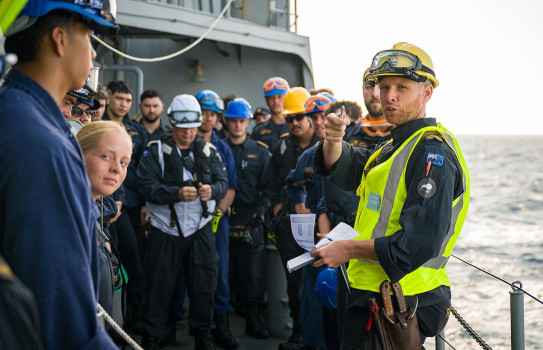
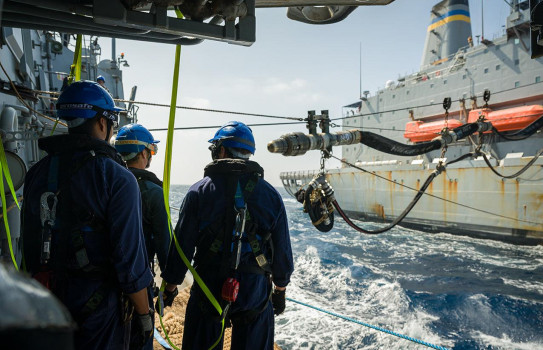
Once in station we have a clear view of the Guadalupe. Like us, she wears some rust streaks from time at sea, but the overall impression is that she is big and purposeful. It is time to pipe RAS Special Sea Dutymen over the main broadcast system. This is the call that goes throughout the ship to send personnel to their assigned stations for the RAS. Personnel start to stream out onto the upper-deck, many with the coloured vests that indicate their role. They wear hard-hats and have protective goggles, safeguards in case the fuelling system springs a leak under pressure.

Some Navy personnel wear coloured vests that indicate their role, other wear regular Navy uniform while most wear hard-hats and have protective goggles on their helmets as they talk through their plan.

A final briefing to Te Kaha’s RAS party as the ship prepares to come alongside Guadalupe.

The final ropes are laid-out and preparations made. We constrain our electronic transmissions to ensure we don’t radiate our people on the deck; or unwittingly, interfere with any electronic systems in Guadalupe.

On the bridge the Assistant Officer of the Watch is taking in all the reports from around the Ship and ticking-off the RAS Preparations checklist. ‘Aft Steering’ call in. This is a team of two that are situated in a machinery compartment right on top of the ships’ rudder. They are there to take immediate actions to regain steering if something goes wrong with steering from the bridge. When you are 45m from another ship, every second counts.

With all preparations made, Guadalupe orders us into ‘waiting station’. Just as it sounds, this is the station close-astern of the tanker where we get lined-up before making the final run-in to the alongside refuelling position. The Officer of the Watch takes the ship to waiting station, before handing the ship over to the CO. It is a short wait before the ship is called in to RAS.

The manoeuvre we use is called a fast back-down. Basically, we line up behind the tanker with a 45-metre offset to starboard, then accelerate to maximum speed. We then do a dramatic speed reduction to decelerate to be in just the right spot with our speed perfectly matched with the tanker.

It goes well and the CO only needs to make some minor adjustments to get us in place. We can now see the faces of our counterparts in Guadalupe. There are some friendly waves and we recognise our opposite numbers by the colours of the vests that they wear.

While this is happening, I give the Buffer the thumbs-up and there are three blasts on a whistle from Te Kaha, with a two-blast response from Guadalupe.

A loud bang, and two projectiles stream out from Te Kaha carrying thin lines across to Guadalupe. They entangled in some of Guadalupe’s cranes and rigging, but the deck team over there have seen this all before. They quickly wrangle the lines out of the rigging and into the hands of their deck teams below.

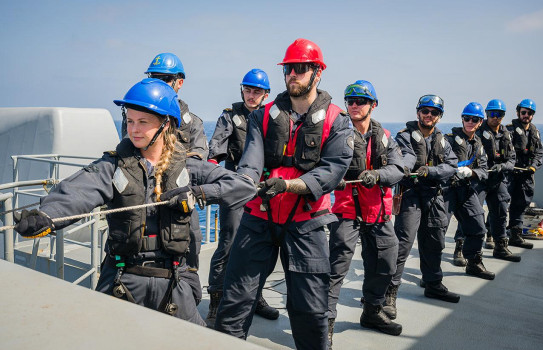
RAS party

The RAS team aboard Te Kaha take up the passing of the lines that will ultimately support the fueling lines between the two ships.

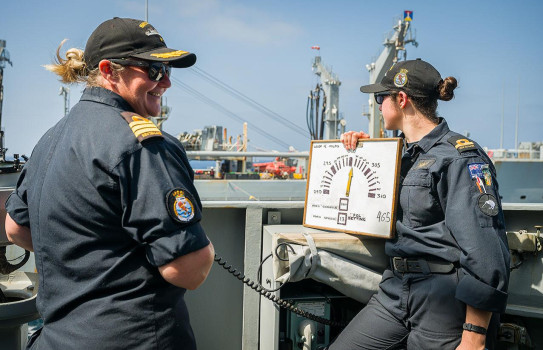
‘Batman’ steps up. Not the caped crusader, but a person on each ship that uses coloured bats to signal and synchronise the passing of the lines. First the thin initial lines, then increasingly thicker lines until the final steel spanwire is passed that will carry the fuelling hose and probe connector.

Our Batman is the ship’s Master at Arms, the Naval Policewoman. She is situated above the RAS point in plain view, and she and her counterpart in Guadalupe exchange signals that choreograph the lines that join the ships together. Up forward, just ahead of the Bridge a ‘Distance Line’ is passed with a telephone line. The Distance Line has coloured flags every six metres. When hauled taught between the ships, it provides a ready-reference to measure distance apart.

With the spanwire across and connected, Guadalupe tensions the wire, before sending the probe down the spanwire to finally connect into Te Kaha’s probe receiver. It mates perfectly first time and we are ready to receive the Ship Fuel. Under the main hoseline, a smaller hose carries the Aviation Fuel. This is manually connected up by the engineers and fuel begins to flow.

Sailors on HMNZS Te Kaha (left) oversea the probe moving down the spanwire from USNS Guadalupe (right) as both ships sail alongside each other.

The ship fuel line and the smaller aviation fuel line are pulled across for Guadalupe.

The pressure is off a bit, but the vigilance and the focus remains. Thirty minutes have now passed and Te Kaha is ‘in the groove’, only needing minor adjustments of speed and heading to remain within three to four metres of the ideal position. Navs takes over from the CO, to give her a break from concentration. Reports on the fuelling progress suggest there is another 45 minutes to go.

It passes quickly. ‘Stop pumping’ is called and you can see the hoses flatten as they lose pressure and drain the last of the fuel. The fuelling rig is decoupled and retracted by Guadalupe, as coordinated by the Batman.

The distance line is the last to go and with the ‘bitter end’ finally dropped into the sea, Te Kaha is unleashed and moves away from Guadalupe. Cautiously at first, before the order is given to increase speed and continue to veer away. Personnel below decks can hear the turbos spool up on the engines, and know that we are breaking away. The ship heels over as we continue our high-speed turn, making a majestic sweep to pass astern of Guadalupe to head off in search of our next drug-runner. In the various areas, notes are being made. What went well? What went wrong, and what can we do better?

From the bridge we exchange final comms with our American friend.

“Fair winds and following seas… see you next time.”

CO Bridgewing

CDR Fiona Jameson, Commanding Officer Te Kaha, monitors progress and calls for course and speed adjustments if necessary.

The Sichuan—the first Type 076 new-generation amphibious assault ship—was launched in Shanghai in December.

It is the first such ship in any navy to be equipped with an electromagnetic catapult, which in this image is hidden by the long shed.

RNZAF joins in on Australian submarine-hunting exercise

P-8A Poseidon crews from Royal New Zealand Air Force No. 5 Squadron have been hunting submarines off the western coast of Australia in a recent major marine warfare exercise.

20250406ran8552143 0045

12 May, 2025

“We were participating in the Royal Australian Navy’s Anti-Submarine Warfare exercise, acting as the fixed wing asset tasked with finding the enemy submarine,” Air Warfare Specialist Corporal Ryan Vincent said.

Also involved in the exercise were Royal Australian Navy vessels HMAS Hobart, HMAS Choules and four Anzac class frigates – Warramunga, Stuart, Toowoomba and Arunta – who at various times acted as either friendly or enemy forces for the submarine, HMAS Farncomb.

“With their embarked helicopters it creates quite a complicated warfare environment we don’t really get too often. The amount of communication and coordination that is occurring in order to find the target safely and effectively is impossible to simulate.”

CPL Vincent is one of two acoustics operators on the P-8A, who interpret data from sonobuoys dropped from the aircraft into the ocean that the crew uses to track the submarine. 

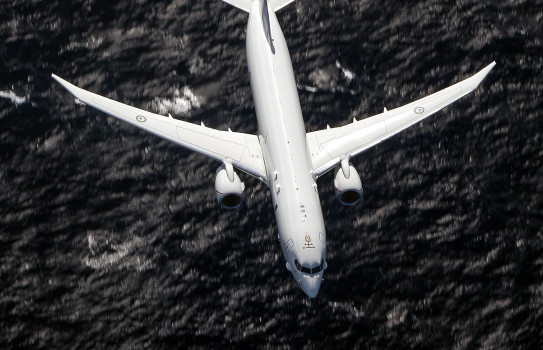
Top down view of a RNZAF P-8A Poseidon, a large grey aircraft with a single jet on each wing. It flies over a dark ocean on exercise.

A RNZAF P-8A Poseidon has been hunting submarines off the western coast of Australia in a recent major marine warfare exercise.

“We can also hear it as a ping, which does sound quite cool. We’ve got a couple of different sonobuoys, one of which sends out a signal and we hear a return ping when it’s acquired the target. It sounds like how you hear it in the movies.”

It was useful having our Australian allies close by to be able to have the opportunity to train with them and their capabilities, CPL Vincent said.

“There is a lot of flying in a live warfare scenario that you don’t really get in the simulator, which is tightly controlled. In the real world, everything is a little bit more unpredictable, some things might fail, some things might be lost – you might be right on top of the contact, but not be able to hear it.

“It’s real life so you’re constantly manoeuvring, you’re hearing the sonobuoys go out and it does create a very dynamic atmosphere.”

Internal communications were at a high tempo during the training, with information continually being passed to the Tactical Coordinator, CPL Vincent said.

“The exercise flying does get quite intense, but we are good at following our standard operating procedures. It’s quite high energy because contact with the target can be quite fleeting, so we need to make sure we’re prepared and start tracking it when we need to.

“These targets are really good at evading us, but it’s good for our training,” he said.

Indian Navy Sent to North Arabian Sea to Deter Pakistan, Say Officials

Aaron-Matthew Lariosa – May 11, 2025 7:55 PM

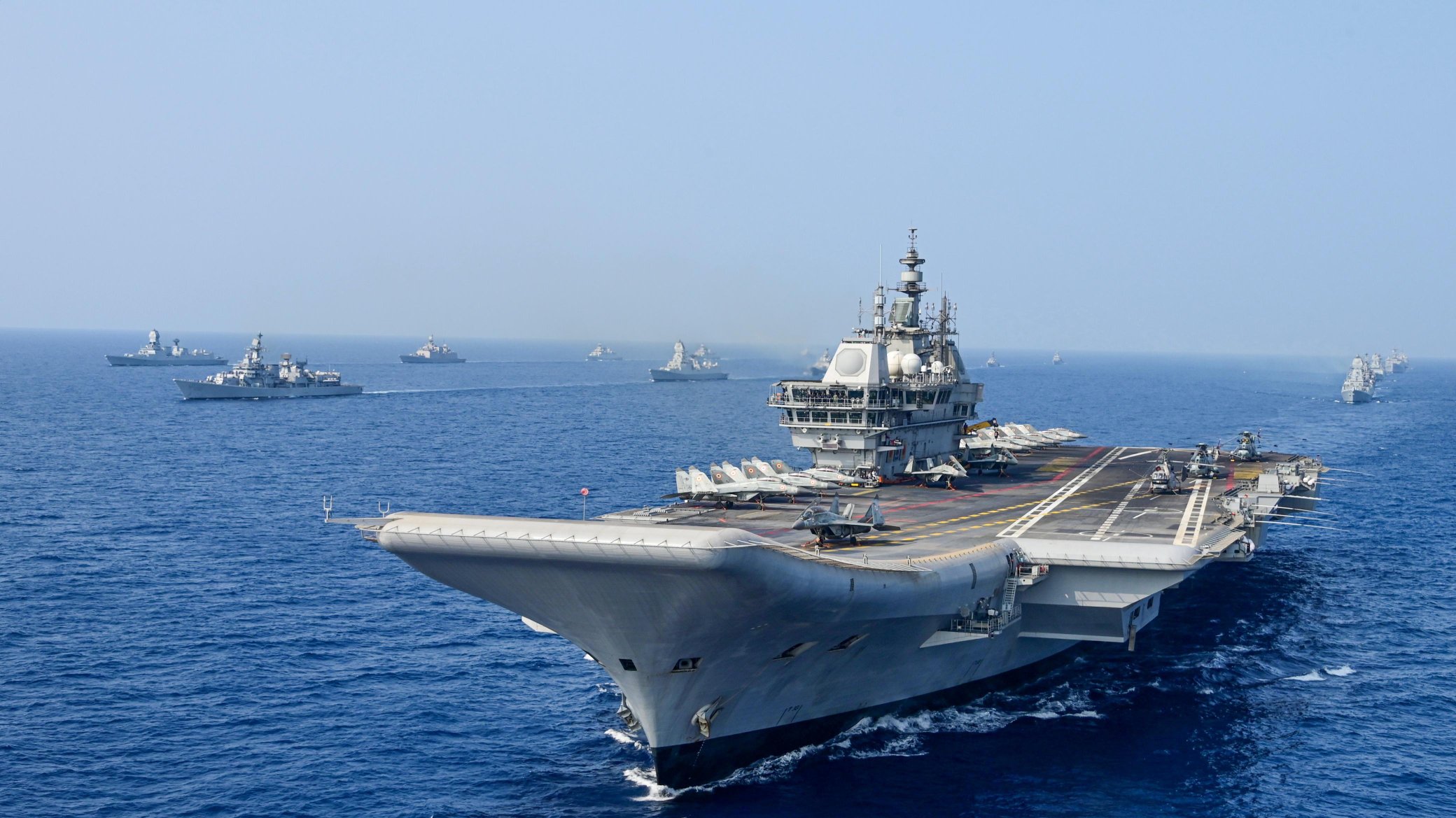
Indian Navy ships underway in the North Arabian Sea. Indian Navy Photo

The Indian Navy massed naval forces in the Northern Arabian Sea and sent a carrier battle group, surface combatants, submarines and naval aviation to keep their Pakistani adversaries in a “defensive position,” officials said this week. .

“The Indian Navy remained forward deployed in the Northern Arabian Sea in a dissuasive and deterrent posture, with full readiness and capacity to strike select targets at sea, and on land, compelling Pakistani Naval and air units to be in a defensive posture, inside harbours or very close to their coast,” reads a release from the service.

New Delhi said that its naval forces were “immediately deployed to sea with full combat readiness” three weeks ago after an organization linked to internationally-recognized terrorist group Lashkar-e-Taiba killed 26 tourists in Kashmir, a mountainous disputed territory that has been disputed between India and Pakistan. Indian Navy photographs from the days after the attacks depicted Visakhapatnam-class destroyers and Talwar-class frigates launching BrahMos supersonic cruise missiles. According to the service, the navy conducted these long-range precision strike drills within 96 hours of the Pahalgam attack.

Both the Indian and Pakistani navies sent out notifications for a number of competing exercises within their respective exclusive economic zones.

While the Indian Navy confirmed its forces did not directly participate in the initial round of Operation Sindoor attacks on nine Lashkar-e-Taiba and Jaish-e-Mohammed sites and follow-on preemptive strikes on Pakistani air defenses and air bases, the service attributed to an “escalation control mechanism” that called for coordinated “applications of force” with the Indian Army and Air Force.

Among the capabilities employed in the strikes are BrahMos cruise missiles. Originally derived from the Russian P-800 Oniks, the Indian Mach 2.8 missile can be launched by land-based launchers, naval vessels and fighter aircraft. A single missile can be carried under the SU-30MKI’s center line pylon. Videos have emerged of BrahMos boosters and remains following the strikes from Indian states bordering Pakistan.

“Along with kinetic actions by the Army and the Air Force, the overwhelming operational edge of Indian Navy at sea, contributed towards Pakistan’s urgent request for a ceasefire yesterday,” according to the Navy release.

With an increasingly modern Pakistani Navy and new threats from Chinese warships and spy ships scouring the Indian Ocean Region, New Delhi invested in its naval forces and uses them to counter old and new threats. The Indian Navy took the lead in the country’s approach to the Red Sea and anti-piracy efforts. The service’s carrier battle groups also frequently drilled with France and Italy.

A press conference from the Pakistani Armed Forces claimed that their naval forces tracked the movements of the Indian aircraft carrier INS Vikrant (R11) in the Northern Arabian Sea.

While the ceasefire has held despite reports of violations from both nations, Indian forces have reiterated their readiness to respond to any further escalation.

“The Indian Navy remains deployed at sea in a credible deterrent posture, to respond decisively to any inimical action by Pakistan, or Pakistan based terrorist,” reads the release.

Related

JCs Royal New Zealand Navy Ships and New Zealand Defence, Also other World Defence Updates

Ships and Defence News Past and Present

Skip to content ↓