Wings of history, wings of victory: Which aircraft were seen on the VE Day 80 flypast

5th May 2025 at 4:40pm
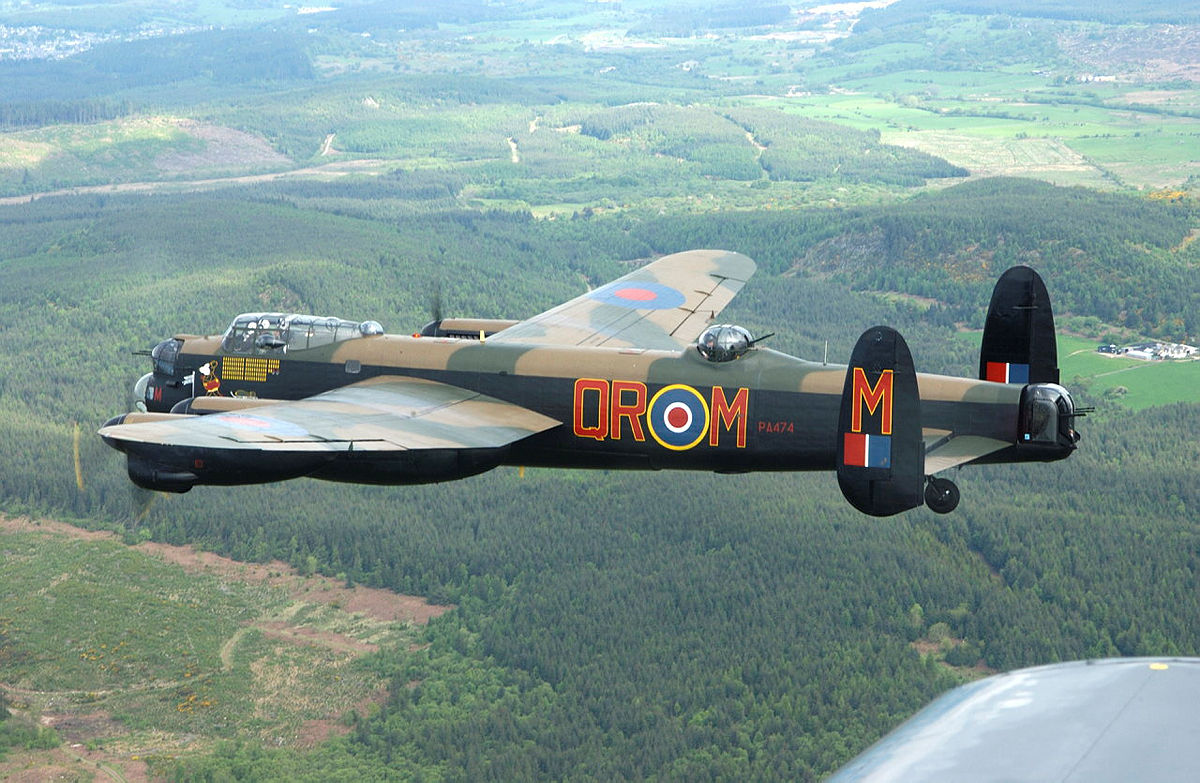
The Avro Lancaster symbolises the sacrifices made by RAF personnel during the Second World War
The Avro Lancaster symbolises the sacrifices made by RAF personnel during the Second World War (Picture: MOD)

A spectacular flypast has taken place as part of the 80th anniversary commemorations for Victory in Europe Day, marking the end of the war in Europe in 1945.

More than 1,300 personnel from the Armed Forces, uniformed services and youth organisations marched through central London, retracing a historic route from Parliament Square to Buckingham Palace.

After they arrived at the palace, their eyes turned to the skies for a five-minute flypast by 23 military aircraft.

The flypast brought together some of the RAF’s most iconic aircraft – from the Lancaster bomber of the Battle of Britain Memorial Flight to modern frontline fighters like the Typhoon and F-35B Lightning.
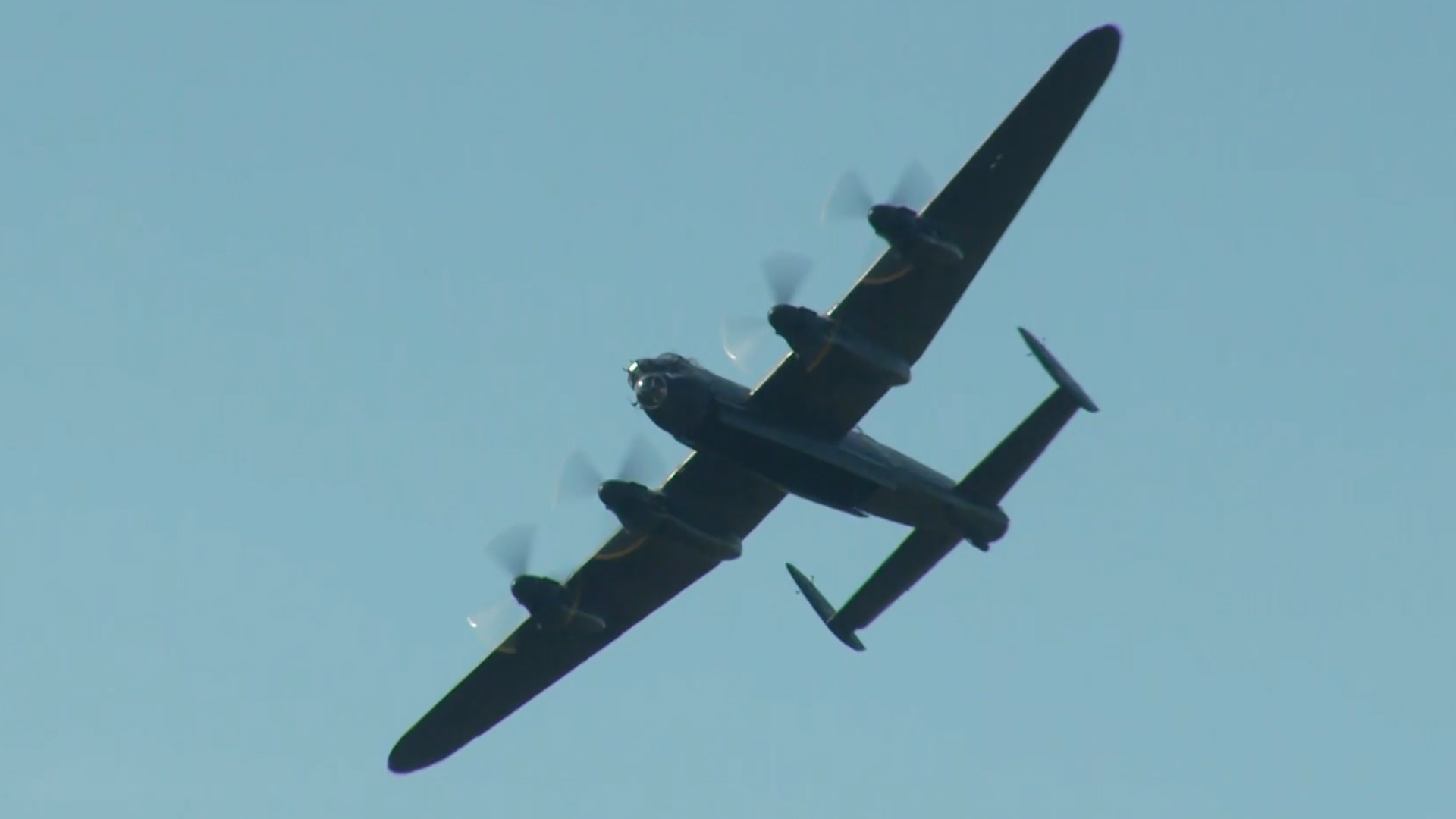
The iconic Lancaster aircraft from BBMF will lead the flypast

Leading the way

The first aircraft was the Avro Lancaster bomber, one of only two still flying anywhere in the world, which took off from RAF Waddington.

Operated by the Battle of Britain Memorial Flight, it symbolises the RAF’s role in the Second World War and the sacrifices made by Bomber Command.

Its deep engine note is instantly recognisable, and the aircraft also serves as a powerful reminder of the crews who never returned from their missions over Europe.
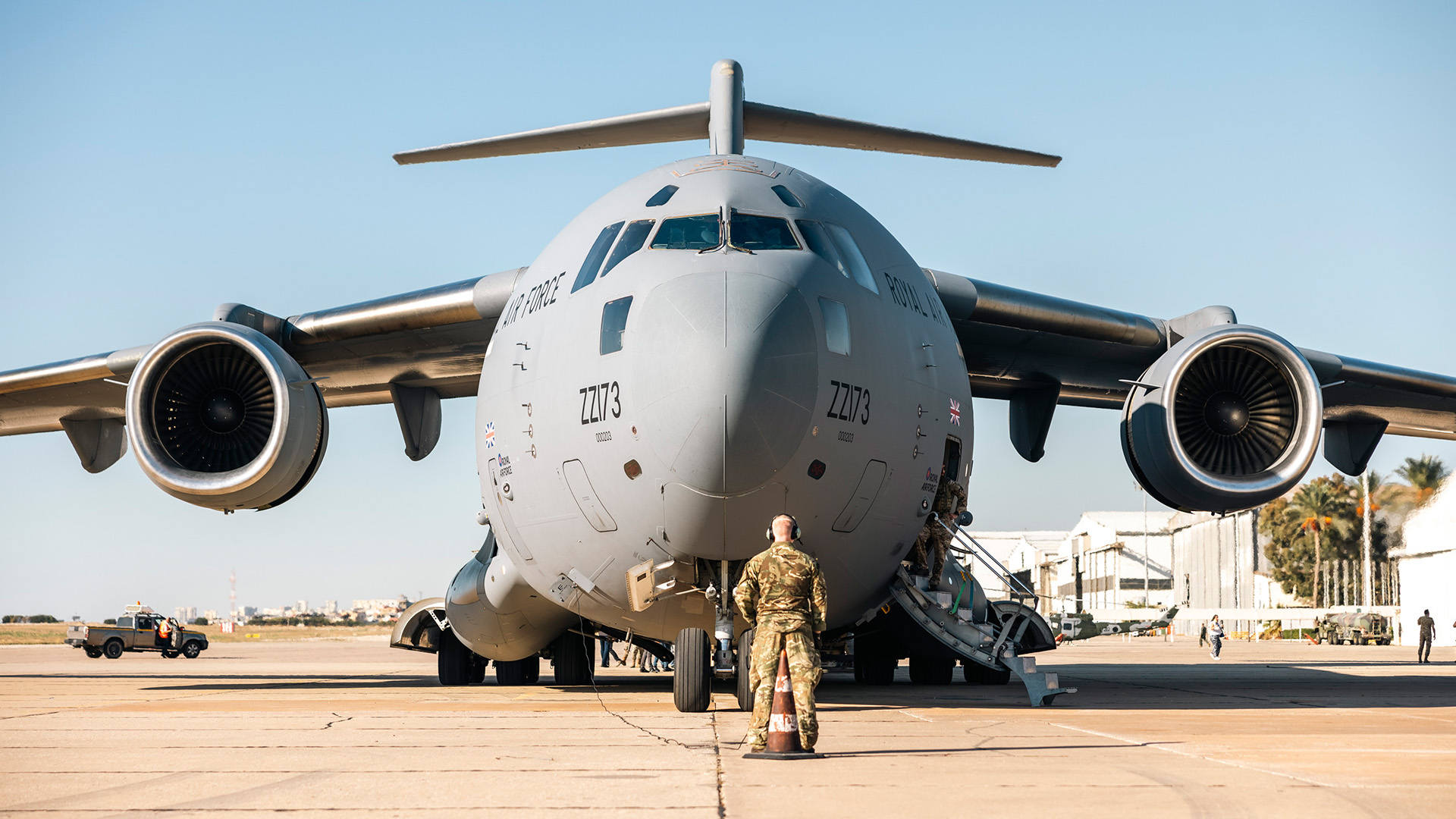
RAF Globemaster delivers aid to Lebanon
The Globemaster on an aid delivery mission in Lebanon (Picture: RAF)

Modern might

Next, the Avro Lancaster was followed by the workhorses of the modern RAF.

The Voyager, the RAF’s largest aircraft, flew past the iconic palace in central London. The aircraft doubles as both an air-to-air refueller and a transport aircraft.

After that, the A400M Atlas flew past the spectators who lined the Mall. The A400M Atlas is a tactical airlifter capable of low-level flight and short-strip landings, which is regularly used on operations around the globe.

Behind them, the C-17 Globemaster thundered past. Known for its size and flexibility, it has become a staple of British military logistics, including in Afghanistan and disaster relief efforts.
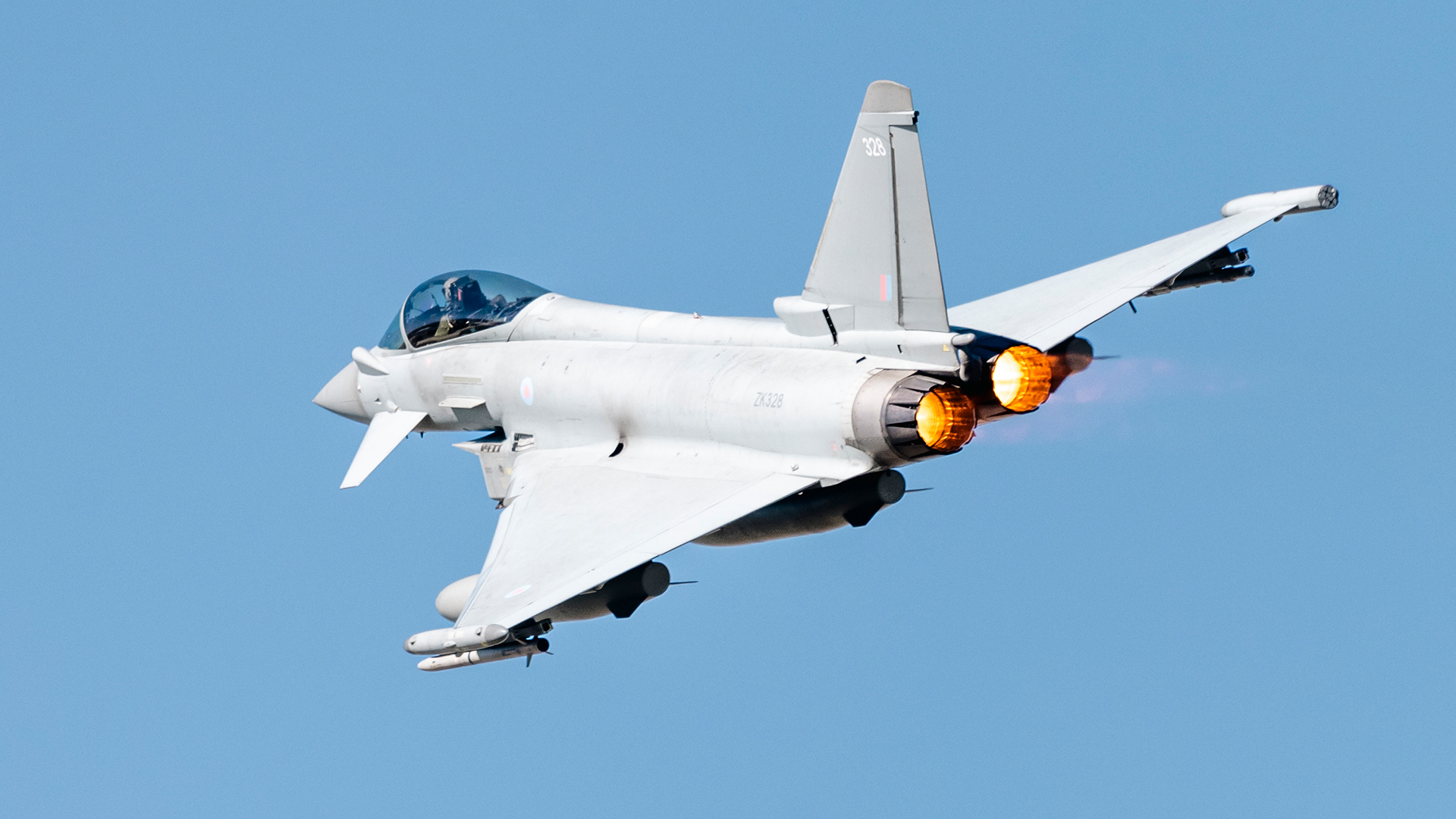
	RAF Typhoon
No flypast is complete without the RAF Typhoon (Picture: RAF)

Intelligence and strike power

The fourth wave brought aircraft at the cutting edge of intelligence and air defence.

A P-8 Poseidon maritime patrol aircraft soared above the dignitaries and the Royal family. The P-8 Poseidon is equipped for submarine hunting and surveillance.

Two Typhoon FGR4s, Britain’s frontline multi-role fighters, a Rivet Joint, used for electronic surveillance, and two F-35B Lightnings – the UK’s newest fast jets – flew next.
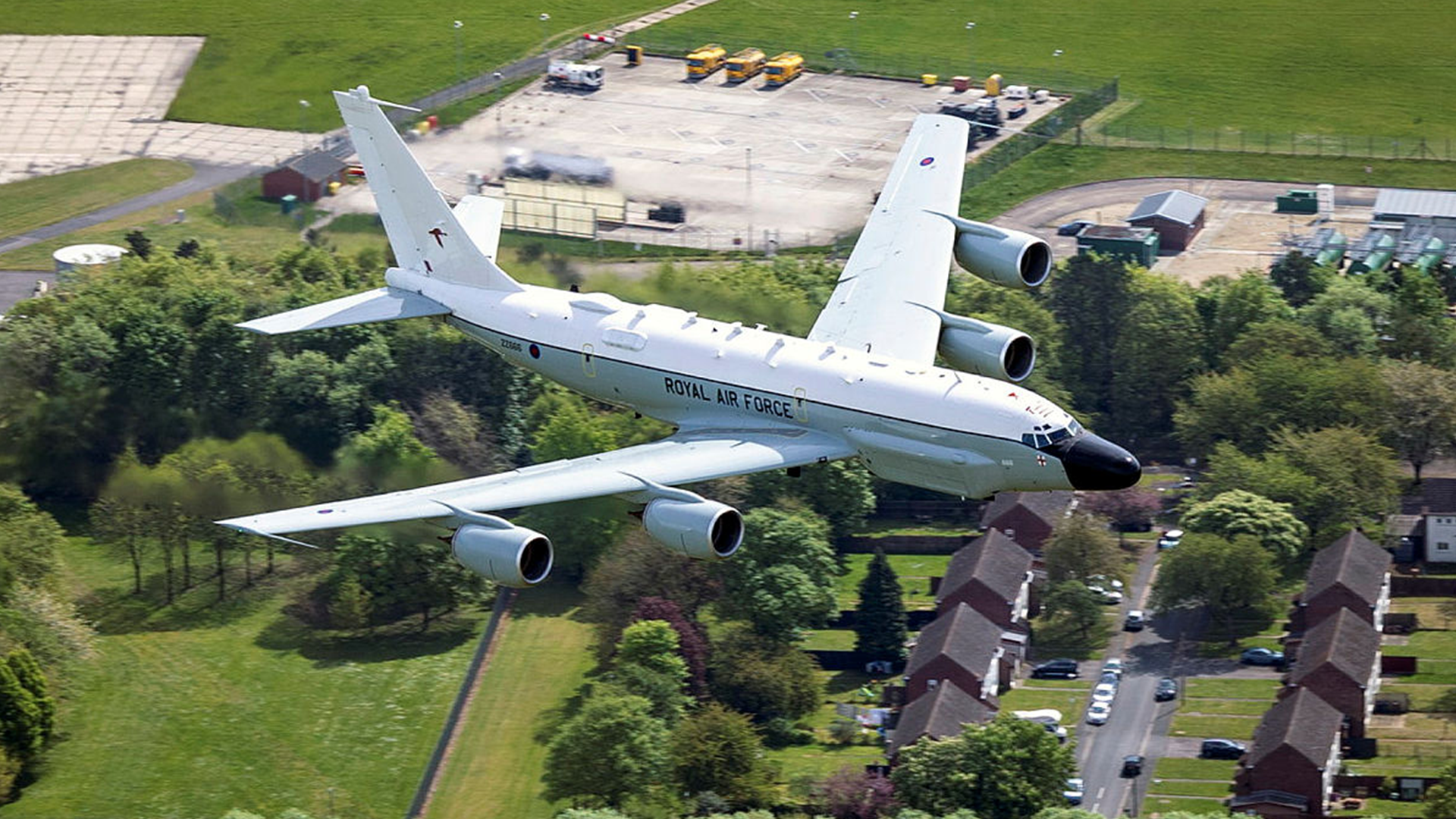
Rivet Joint aircraft in the air
The Rivet Joint aircraft will be in the fifth wave (Picture: MOD)

A classic finish

The flypast had a spectacular climax as nine Red Arrows flew in tight formation in Hawk jets, accompanied by four more F-35B Lightnings.

A national service of remembrance will take place at Westminster Abbey on Thursday 8 May.

Red arrows piercing the sky
The Red Arrows piercing their way through the sky (Picture: RAF)

NZ Defence Force receives operating funding boost

Minister of Defence Judith Collins has announced a large investment in New Zealand Defence Force operating funding ahead of Budget 2025.

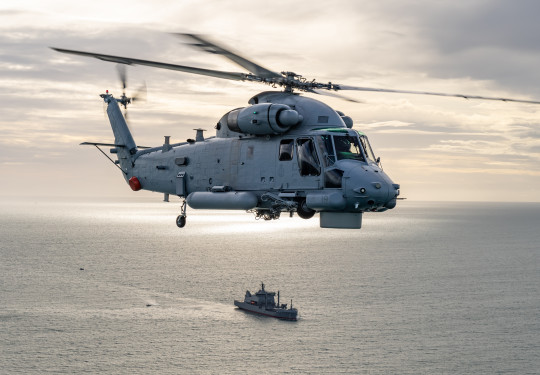
A SH-2G(I) Seasprite Helicopter helicopter hovers over HMNZS Aotearoa
SH-2G(I) Seasprite Helicopter helicopter hovers over HMNZS Aotearoa. 05 May, 2025. 

05 May, 2025

The New Zealand Defence Force will receive a $957 million increase over the next four years to fund essential operational activity.

Defence Minister Judith Collins made the announcement at RNZAF Base Auckland yesterday.

She also announced the replacement of the Defence Force’s maritime helicopters, the Seasprite SH2-G(I), estimated at $2 billion.  The replacement of the maritime helicopters is one of the projects contained in the recently released Defence Capability Plan.

The $957 million will target Defence Force missions, people, estate maintenance and international engagement, equating to $239 million a year, she says.

“Our personnel are being called upon to go more places, more often and for longer to play New Zealand’s part in contributing to global security. This funding will enable them to do that.”

Chief of Defence Force Air Marshal Tony Davies says there is no doubt the global security environment is changing and the Defence Force needs to step up in contributing to global security.

“Annually this will include $150 million for Navy, Air Force and Army for direct operating and logistics costs, and some increases in our military personnel numbers,” he said.

“This funding will enable the NZDF to sail, fly, patrol and train more often.

“It will assist with rebuilding combat capability through additional field exercises, increasing military personnel numbers, and will mean mission critical systems and capabilities are maintained and available to respond to security threats and other operational tasks as needed.”

Other activities include funding for international deployments ($20 million), a refreshed system of military allowances ($30 million) and funding for civilian staff pay increases ($8 million).

An annual investment of $26 million is earmarked for critical estate maintenance to improve accommodation, working and training conditions for Defence Force personnel.

“$957 million over four years is a welcome uplift in operational funding which reflects the value that the Government sees in the NZDF and its people and enables us to increasingly step up both domestically and internationally.”

Budget 2025 also recognises the Defence Force’s $30 million saving being proposed through the Workplace Savings Programme.

Read the official release from the Beehive here. 

HMNZS Taupo aids in rescue after yacht grounding

The crew of HMNZS Taupo have assisted in a stormy night rescue of two yachties forced to abandon ship near Rangitoto Island in Auckland this morning.

01 May, 2025

Inshore patrol vessel Taupo, on a training exercise and crew evaluation in the Hauraki Gulf, picked up a mayday call relayed from Auckland Maritime Radio regarding a yacht running aground on the western side of the island.

Taupo’s Commanding Officer, Lieutenant Toby Mara, was called to the bridge shortly before 5am and quickly made the decision to respond.

“Conditions from the west were pretty rough, with winds around 25 to 30 knots. But we were within our limits to put our seaboat in the water.”

A Port of Auckland pilot vessel, also in the vicinity, was first on the scene.

“Just as we were launching our sea boat, the two crewmembers abandoned their vessel into their dinghy. They were taken aboard the pilot vessel and the dinghy taken under tow.”

With the pilot vessel required for commercial shipping duties, the crewmembers and towed dinghy were transferred to Taupo’s seaboat.

“There was no moonlight to assist as it was raining and there was full cloud cover. A lot of this was done using the heat signature sensor on our cameras and the seaboat’s spotlight.”

The crew were dry but understandably shaken up after what had happened, he said.

“Then the North Shore Rescue Coast Guard vessel came on station, and they were happy to take the crew and their dinghy to shore.”

He says it was a ‘no-brainer’ to respond to the call.

“We were within our safety limits and everyone was well trained. When someone’s in the water, you go and get them.”

Royal Australian Navy’s ninth Evolved Cape-class patrol boat hits the water

Royal Australian Navy's ninth Evolved Cape-class patrol boat hits the water

ADV Cape Spencer – Australia

Austal Australia has successfully launched the future ADV Cape Spencer, the ninth Evolved Cape-class patrol boat ordered by the Royal Australian Navy (RAN).

Upon completion, the aluminium monohulled newbuild will have an LOA of 57.8 metres, a beam of 10.3 metres, a draught of approximately three metres, and accommodation for 32 crewmembers and other personnel.

Austal said the Evolved Capes were built with a number of enhancements over the baseline Cape-class patrol boats, improving operational capability and crew capacity compared to the vessels already operated by the navy and Australian Border Force.

Like their baseline Cape-class sisters, the Evolved Cape-class boats were built for sustained operations lasting a maximum of 28 days or covering a range of 4,000 nautical miles in conditions up to Sea State four. They will also retain the baseline Cape-class boats’ standard armament of two pintle-mounted 12.7mm machine guns.

The Evolved Cape-class patrol boat project, which initially comprised only six 58-metre aluminium monohull patrol boats for the RAN from May 2020, was extended by two vessels in Ap

Professionals boost the Navy Reserve Force

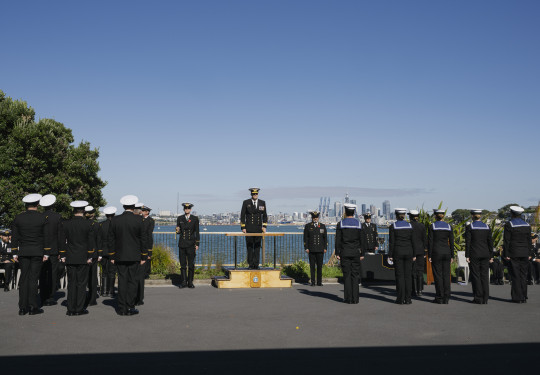
The Royal New Zealand Navy has welcomed 14 sailors and officers to its Navy Reserve Force following a graduation ceremony this month.

20250413 NZDF K1071142 025

30 April, 2025

Camaraderie, a chance to give back and a desire for challenge inspired the latest cohort of New Zealanders to join the Naval Reserve Force.

On 13 April, nine sailors and five officers graduated from their 10-month Naval Reserve Common Training (NRCT) course in a ceremony hosted at the Museum of the Royal New Zealand Navy in Devonport.

They will now post to Naval Reserve units closest to their homes to undertake trade training and promotion courses.

NRCT provides almost identical training to Regular Force personnel but is delivered part-time, with graduates balancing their training with work and study commitments, as well as being away from family.

The graduates had to complete two nine-day-long training blocks at Devonport Naval Base and Tamaki Leadership Centre in Whangaparaoa, as well as four training weekends. Officers had two additional training blocks and two more training weekends for leadership training.

Dev photo
Nora photo
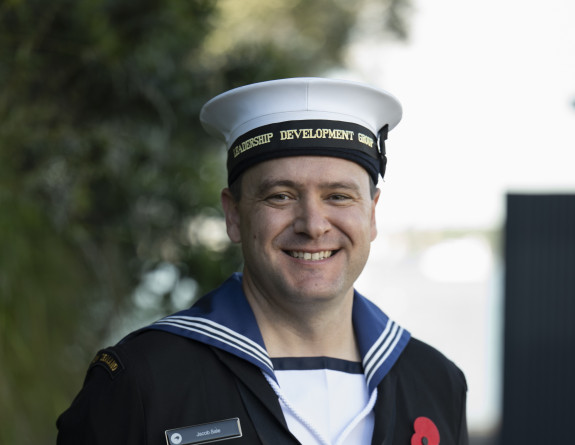
Jacob photo

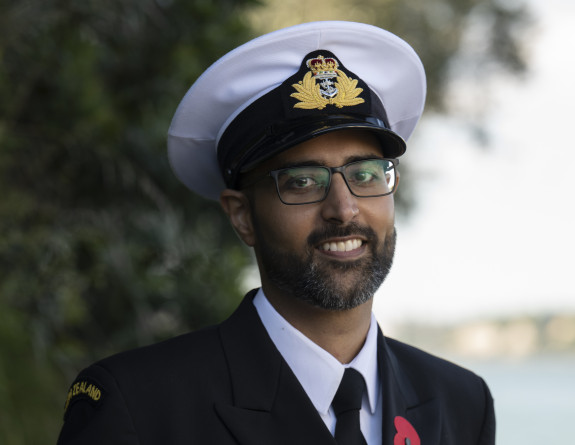
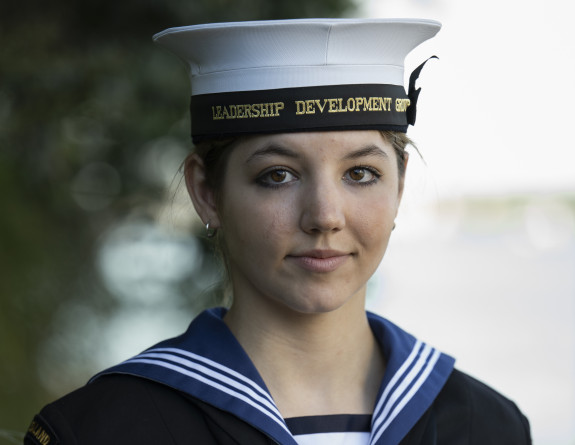
Left to right: Sub Lieutenant Vinayak Dev, Ordinary Maritime Trade Operator Nora Paicu and Ordinary Maritime Trade Operator Jacob Sale.

Fitting it all in was a challenge for Sub Lieutenant Vinayak Dev, a psychologist from Auckland studying for his Doctor of Philosophy (PhD) in Health Psychology.

“It was also challenging to miss important family events whilst being away for the residential aspects of the NRCT,” he says.

“However, in overcoming these challenges, I have become more resilient, improved my time management skills, become more efficient at completing tasks at work, and have further strengthened my relationships with my family members, supervisors at university, and colleagues at work.”

He is the first Navy Reserve psychologist to graduate from NRCT.

“I wanted to give something back for all New Zealand has given me over the years,” he says.

“This has helped develop attributes I aspire to – leadership, physical and mental fitness, resilience, courage, perseverance, camaraderie, integrity, and a strong sense of personal meaning, purpose and conviction in life.”

Ordinary Maritime Trade Operator Nora Paicu was inspired to join after a experiencing a Sir Peter Blake expedition in HMNZS Canterbury to the sub-Antarctic islands in 2023 while a student at Colomba College in Dunedin. She also completed a School to Seas experience with the Navy that year.

“Meeting the commanding officer of HMNZS Canterbury and witnessing the camaraderie of the crew showcased the Navy’s inclusive culture and unique way of life that supports New Zealand.

“I was deeply impressed by the positive impact they make, from supporting conservation efforts to serving New Zealand communities.”

She is undertaking a triple degree in law, management, and agricultural innovation at the University of Otago, and is thinking of joining the Navy full time.

Ordinary Maritime Trade Operator Jacob Sale works in a civilian role at the Naval Supply Depot in Devonport.

“I saw the great work our uniform staff do daily and wanted to be a part of it. I wanted to challenge myself, develop new skills and serve my country.”

He says a highlight was being with a diverse group of people from different backgrounds, all with a common goal of serving.

Another was a sea-riding experience aboard HMNZS Canterbury for the graduates.

“It was an immersive and insightful view of being able to see life on a Navy ship and how departments operate and a first-hand look at naval life.”

His advice to others is: “come and join us.

“It gives you a sense of purpose and pride you can get nowhere else.”

JCs Royal New Zealand Navy Ships and New Zealand Defence, Also other World Defence Updates

Ships and Defence News Past and Present

Skip to content ↓