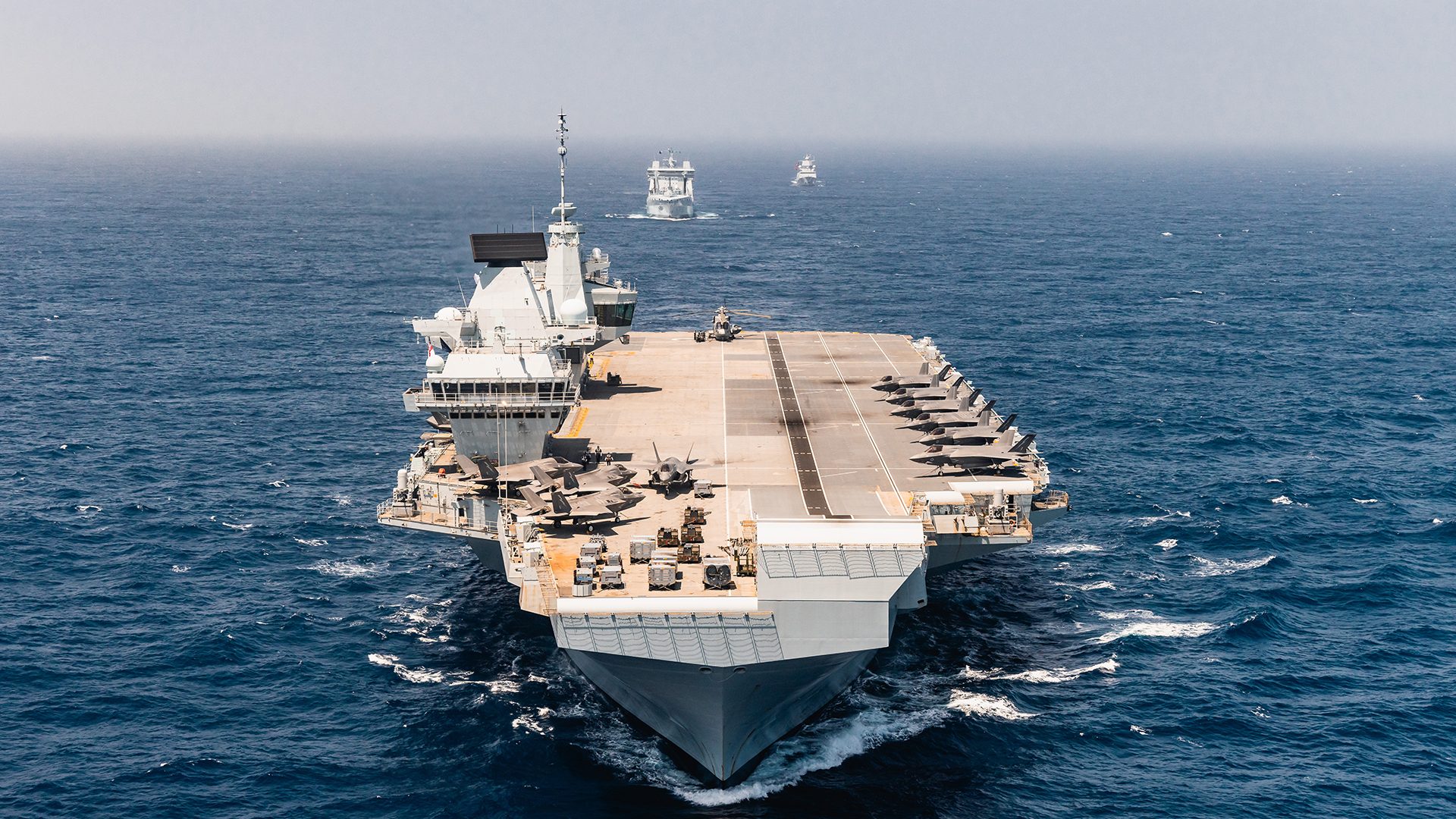
The CSG25 deployment will traverse the globe, conducting several exercises and operations (Picture: MOD)
HMS Prince of Wales has led Carrier Strike Group 25 to the Mediterranean after it set sail last week.
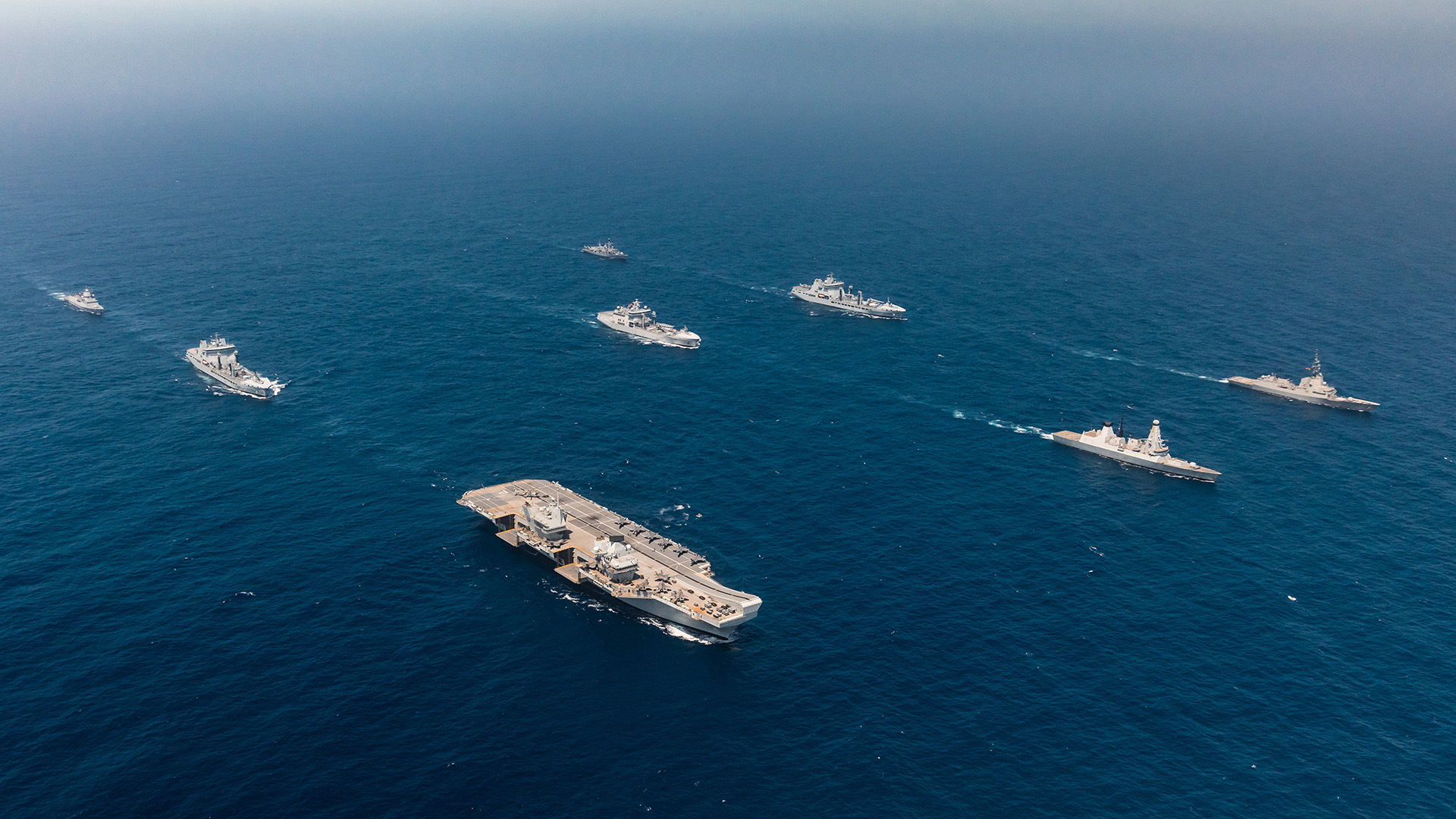
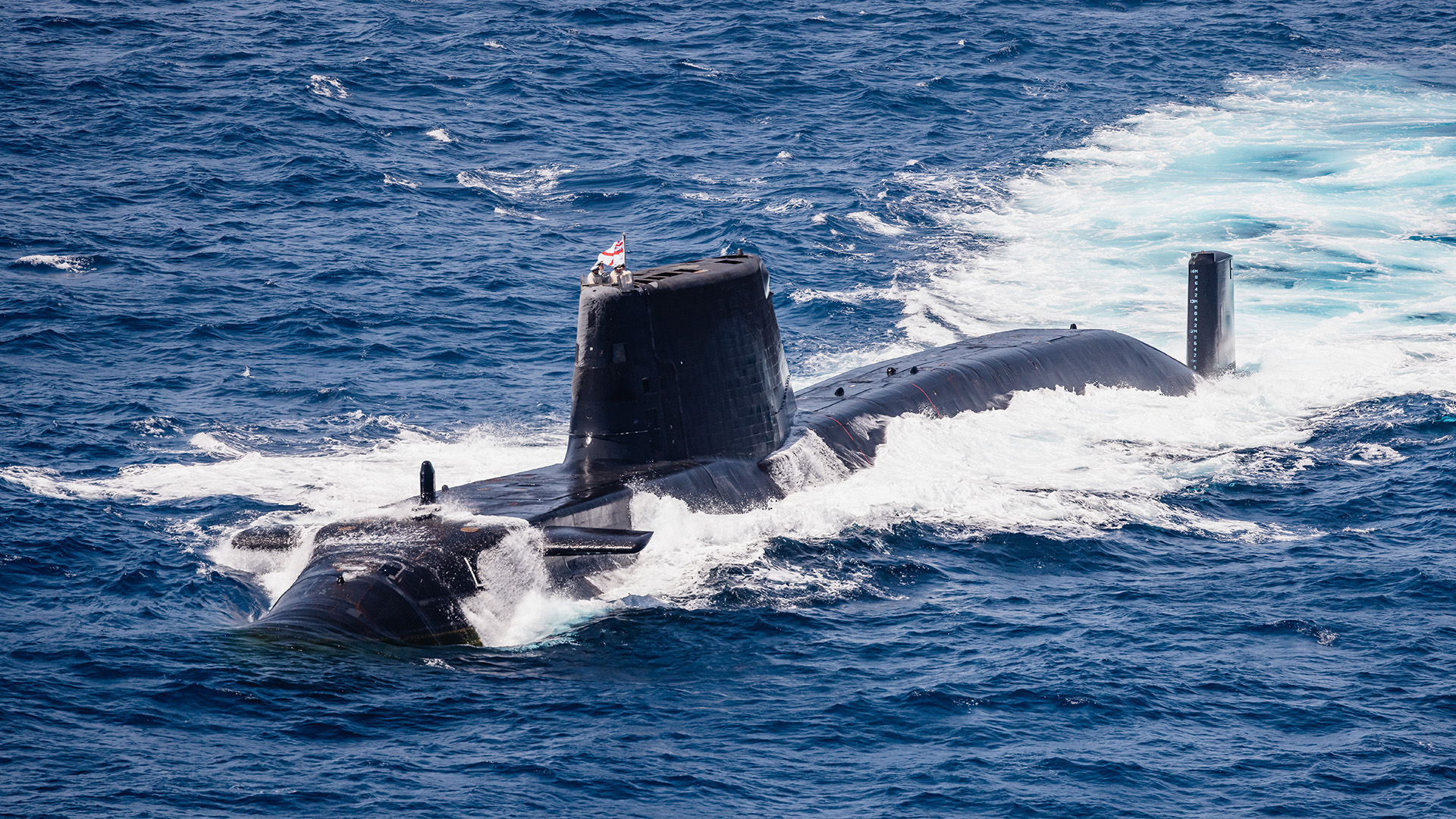
The 65,000-tonne aircraft carrier, along with most of her strike group – which includes the submarine HMS Astute, Type 45 destroyer HMS Dauntless, Type 23 frigate HMS Richmond, and Royal Fleet Auxiliary vessels RFA Tideforce and Tidespring – has now passed the Strait of Gibraltar.
Spanish frigate Méndez Núñez, Norwegian ships HNoMS Maud and HNoMS Roald Amundsen joined the other vessels to form an impressive formation.
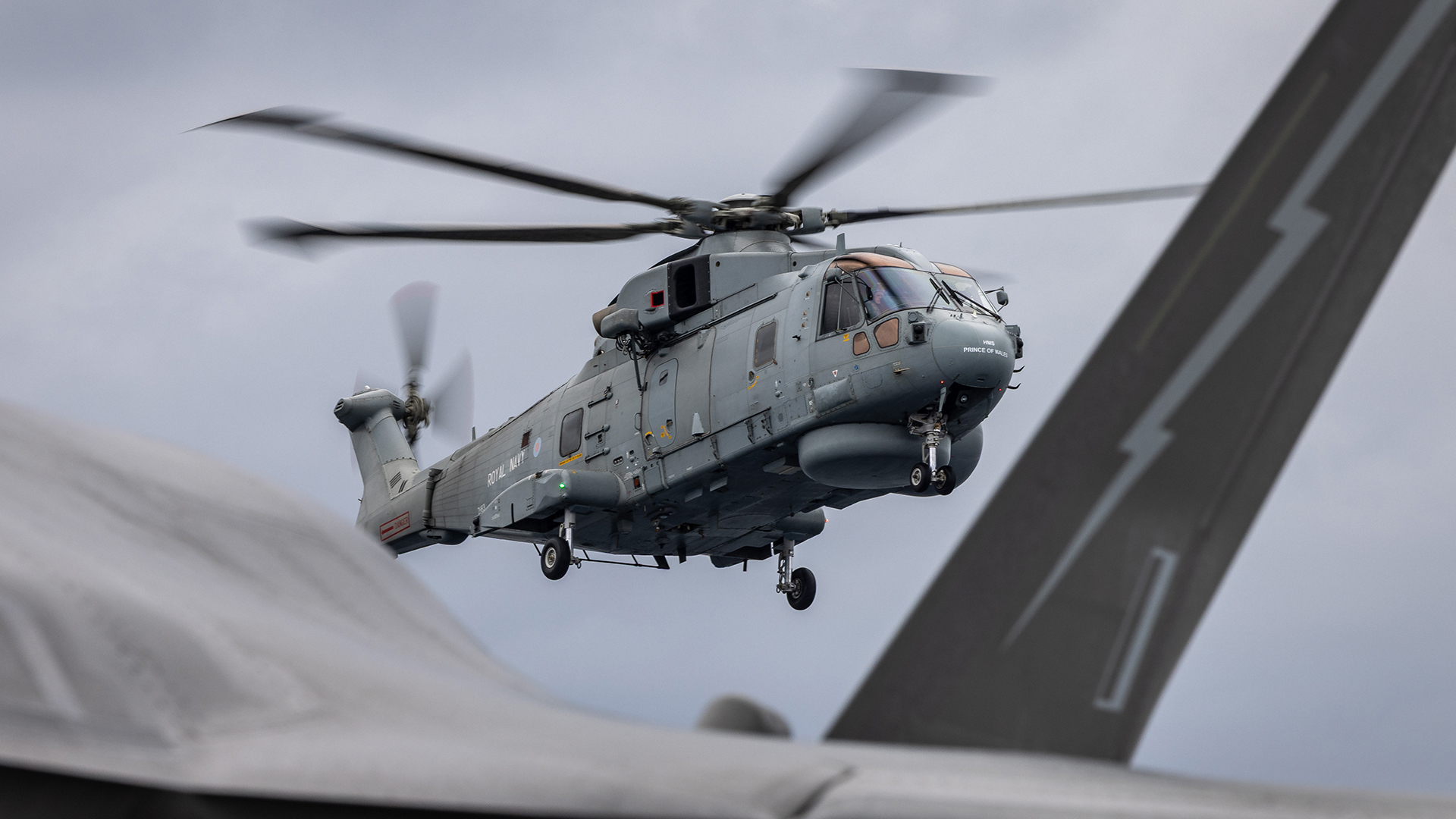
Royal Navy photographers captured breathtaking images of the formation using one of 815 Naval Air Squadron’s Wildcat helicopters.
CSG25 vessels sail in formation in the Med (Picture: MOD)
CSG25, also known as Operation Highmast, is a multinational deployment to the Indo-Pacific.
Led by the Royal Navy’s flagship, it aims to reaffirm the UK’s commitment to the security of the Mediterranean and Indo-Pacific, while providing an opportunity to promote British trade and industry.
The CSG25 deployment will traverse the globe down to Australia, conducting several exercises and operations with air, sea and land forces of a dozen allies.
HMS Astute crashes through the waves as she surfaces for photographs with Carrier Strike Group 25 (Picture: MOD)
Almost 4,500 British personnel will be working on the deployment, including around 600 RAF personnel, 900 soldiers and 2,500 Royal Navy sailors and Royal Marines.
The first UK Carrier Strike Group happened four years ago against the backdrop of the Covid lockdowns because of the pandemic.
Carrier Strike Group 25’s air contingent includes Merlin and Wildcat helicopters as well as F-35B Lightning jets (Picture: MOD)
PT PAL Indonesia has once again been trusted by the Philippine Navy in its warship fleet modernization program. Amid the construction of the 3rd and 4th Landing Dock type ships owned by the Philippine Navy, PT PAL is now preparing to carry out maintenance and repair docking of the Strategic Sealift Vessel [SSV] BRP Tarlac 601.
This ship officially docked at the West Peninsula Pier, a facility of PT PAL’s Maintenance and Repair Division. The arrival of the BRP Tarlac 601 ship was welcomed by Production Director Diana Rosa and staff April 17th. This marks the immediate start of the docking of the Maintenance, Repair, and Overhaul (MRO) program, as well as the first international warship MRO project in PT PAL’s history.
Accompanying the Director of Production of PT PAL, Diana Rosa, was Lieutenant Colonel [P] Ali Sodikin, A.Md., S.E., Head of Lantamal V Shipyard, along with officials from Lantamal V and the ranks of GM of PT PAL Indonesia. In her remarks, Diana Rosa said that “we are pleased to welcome the return of BRP Tarlac 601 to PT PAL Indonesia. We are also honored to have received continuous trust from the Philippine Navy in modernizing its fleet for a long time. And the cooperation between the two countries continues to this day and is getting stronger“, said Diana Rosa.
PT PAL successfully won the open tender process for this MRO project, outperforming local shipyards from the Philippines. This victory confirms that PT PAL’s after-sales service, from construction, maintenance, to ship repairs, is recognized regionally and globally.
As the largest warship operated by the Philippine Navy since 2016, BRP Tarlac 601 is a superior export product made by the children of the Indonesian nation. In this MRO project, the main focus of the work includes the propulsion system, below-waterline maintenance, and the valve system, with a targeted work time of four months.
This collaboration is a symbol of strengthening defense relations between Indonesia and the Philippines, as well as the potential for continued cooperation on other ships, such as its sister ship, BRP Davao Del Sur 602. “As a maritime defense industry, we are committed to upholding quality and professionalism. PT PAL is proud to be able to take an important role in ensuring the readiness and reliability of the BRP Tarlac 601. This ship is not only the face of the strength of the Philippine Navy but also the result of solid technical collaboration and defense diplomacy between our two countries. We believe this collaboration will continue to grow and strengthen Southeast Asian maritime solidarity. We sincerely hope that this project will run smoothly and be a positive step towards broader and more sustainable cooperation in the future“, concluded Diana Rosa.
On that occasion, the commander of the BRP Tarlac 601 ship, Capt. Fredie C Parpan, expressed his gratitude for arriving in Surabaya safely after an 8-day journey. “We arrived safely at the PT Pal shipyard is a testament to two things, the exceptional craftsmanship of this ship, built by Indonesian hands, and the dedication of her crew who navigated her all the way back despite the need for repairs. this vessel may be due for dry docking, but she sailed with strength and reliability- sangat kuat dan andal. because she was built well. and we trust that once again, PT PAL will return this ship to peak condition, ready to serve in defense of our sovereignty and in the service of our people,” he explained.
Before closing his speech, Capt. Fredie also conveyed that there would be learning opportunities for the Philippine Navy crew at BRP Tarlac 601, “we are here for our scheduled dry docking and other related repairs. we see more than just the technical side of things. we see an opportunity, beyond restoring the material condition of the ship. it is also presents valuable avenues for learning, our personnel will have the chance to observe and engage in repair processes, broadening their technical knowledge and familiarizing themselves with international shipyard standards and practices” Fredie concluded.
Through PT PAL, Indonesia appears as a solution partner for ASEAN maritime power by becoming an inclusive, independent, and international standard defense service provider. PT PAL as a one stop solution maritime fleet, will ensure combat readiness and operational sustainability of the Philippine Navy fleet, BRP Tarlac 601.
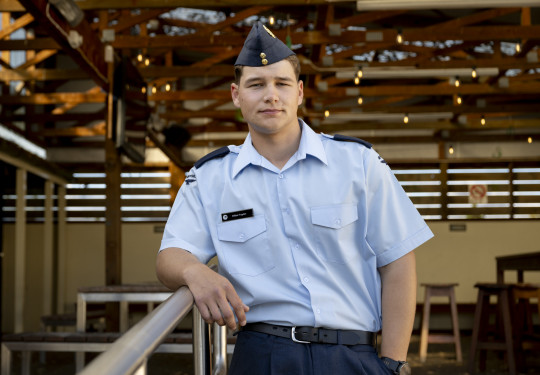
The discipline and work ethic of his ex-Navy father led Palmerston North’s William Fogden to enlist.
29 April, 2025
It was the building site work on an expanding Air Force base that convinced him to choose the wide open skies of the Royal New Zealand Air Force (RNZAF) and train to be a helicopter loadmaster.
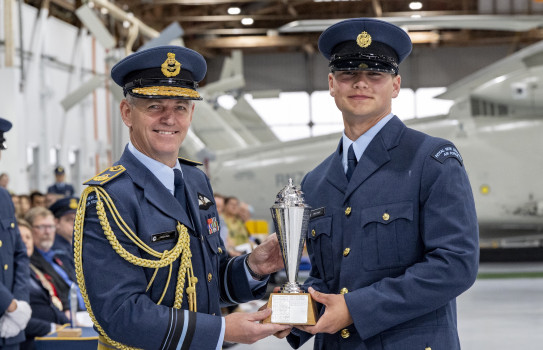
He has just completed the 12-week recruit course at RNZAF Base Woodbourne, where he was awarded the Lawson Cup and the Chris Black Memorial Trophy.
The Lawson Cup is presented to the best all-round recruit and the Chris Black Memorial Trophy to the recruit who best displays the qualities of determination, enthusiasm and morale building for others, particularly in the areas of training. The recipient is chosen by the course members.
Aircraftman Fogden, 19, is no stranger to military life – his father served with the Royal New Zealand Navy for 20 years as a communications specialist, so naturally hoped he would follow in his footsteps.
“I have always had a passion for the Defence Force as I have seen how it has helped shape my dad’s life, his discipline, work ethic and the friends he has made.
“Dad wanted me to join the Navy, I was hesitant at first, but soon came around to the idea – initially I wanted to join the communications trade or as a Navy pilot for the Seasprites.”
But he was inspired towards the Air Force while working for a concrete company in the Manawatū after he left school.
He worked at RNZAF Base Ohakea on the No. 3 Squadron Hangar and on the new P-8 Poseidon hangar.
“It was so cool and really reinforced my decision to join the Air Force.”
Aircraftman William Fodgen is presented the Lawson Cup by Chief of Air Force, Air Vice-Marshal Darryn Webb, MNZM
Aircraftman Fogden said that while he hopes to one day be a pilot flying the NH90s, he was really excited for the next part of his training as a helicopter loadmaster.
“I can’t wait to start my trade training in the A109 light helicopters. I know it’s still going to be a tough journey to get there, but I am also excited for the challenge.”
He said the highlight of the recruit course had been meeting all his fellow aviators and creating friends and memories that he will keep for life.
He also enjoyed firing the Defence Force’s MARS-L rifle and found his work with building computers and remote control cars helped.
“I noticed this when we took apart and put back together the MARS-L, I could do it really fast and I was used to working with small parts.”
“There have been some challenges though, time management has been hard especially at the start – it was quite overwhelming. But it has gotten a lot easier now as a lot of what we have done has become habit.”
Aircraftman Fogden said those wanting to join the Defence Force should start their application today.
The Gallipoli campaign was an ill-fated attempt by Britain, Russia and France to weaken the Ottoman Empire by taking control of the Turkish Straits.
Thousands of Australian and New Zealand troops took part in the failed operation and, in recognition of their efforts, the start of the battle is now known as Anzac Day.
A monitor ship from the Royal Navy and a Victoria Cross are artefacts that tell us much about the people associated with them and what happened on the battlefield.
The Gallipoli Campaign took place in what is now modern-day Turkey.
The idea was to control sea access to Constantinople, the capital of the Ottoman Empire, now called Istanbul, but it failed totally.
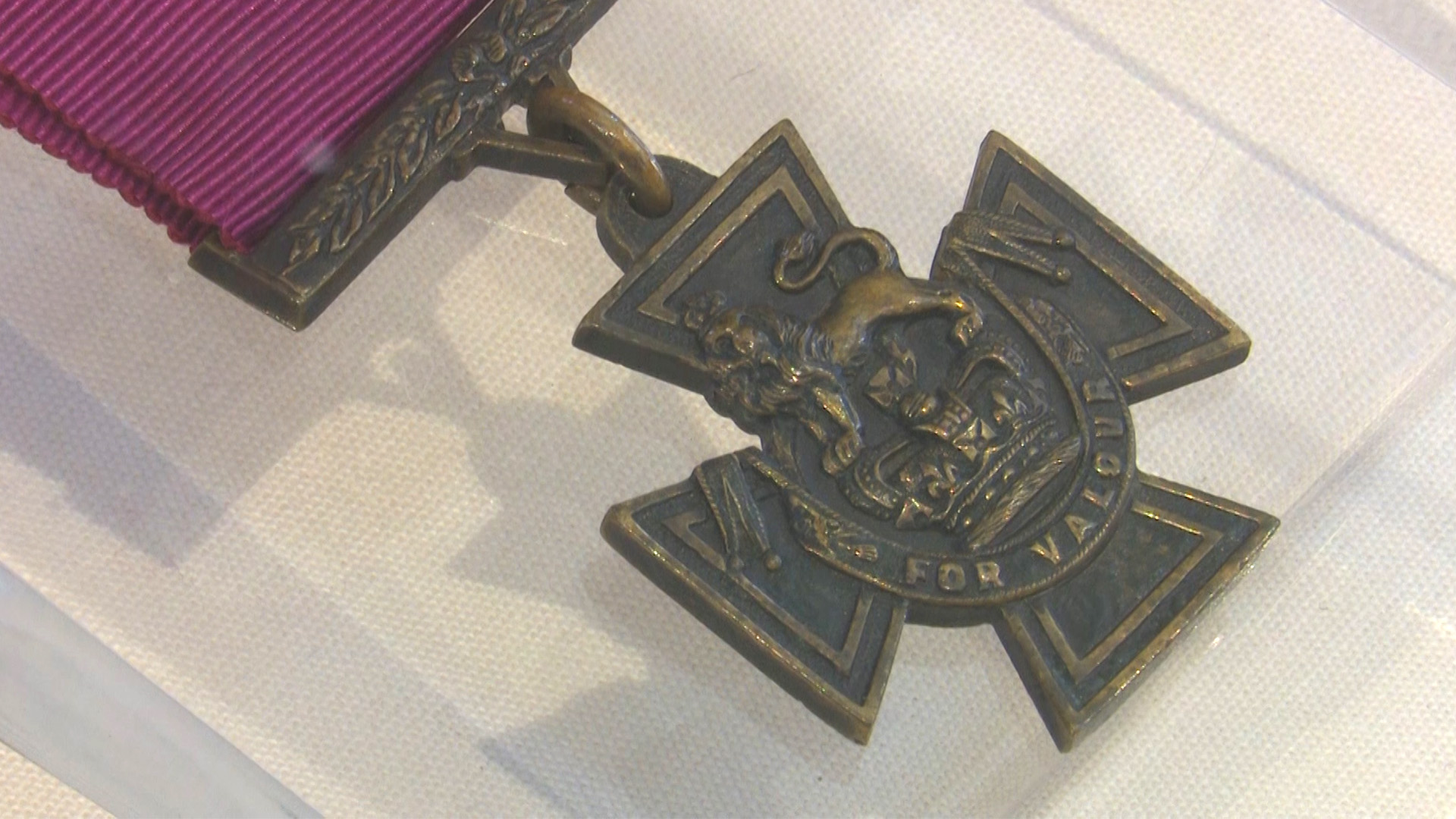
Lance Cpl Parker was awarded the Victoria Cross for his bravery as a stretcher bearer (Picture NMRN)
One man who saw firsthand the horror of more than half a million casualties at Gallipoli was Royal Marine Lance Corporal Walter Parker.
He was a stretcher bearer who had volunteered to assist troops in an exposed trench.
When he went out to the trench, he was wounded twice on the way, yet still managed to help the wounded who were trapped there.
He was wounded a further two times on his return.
In 1917, he became the only Royal Marine to receive the Victoria Cross for his actions at Gallipoli.
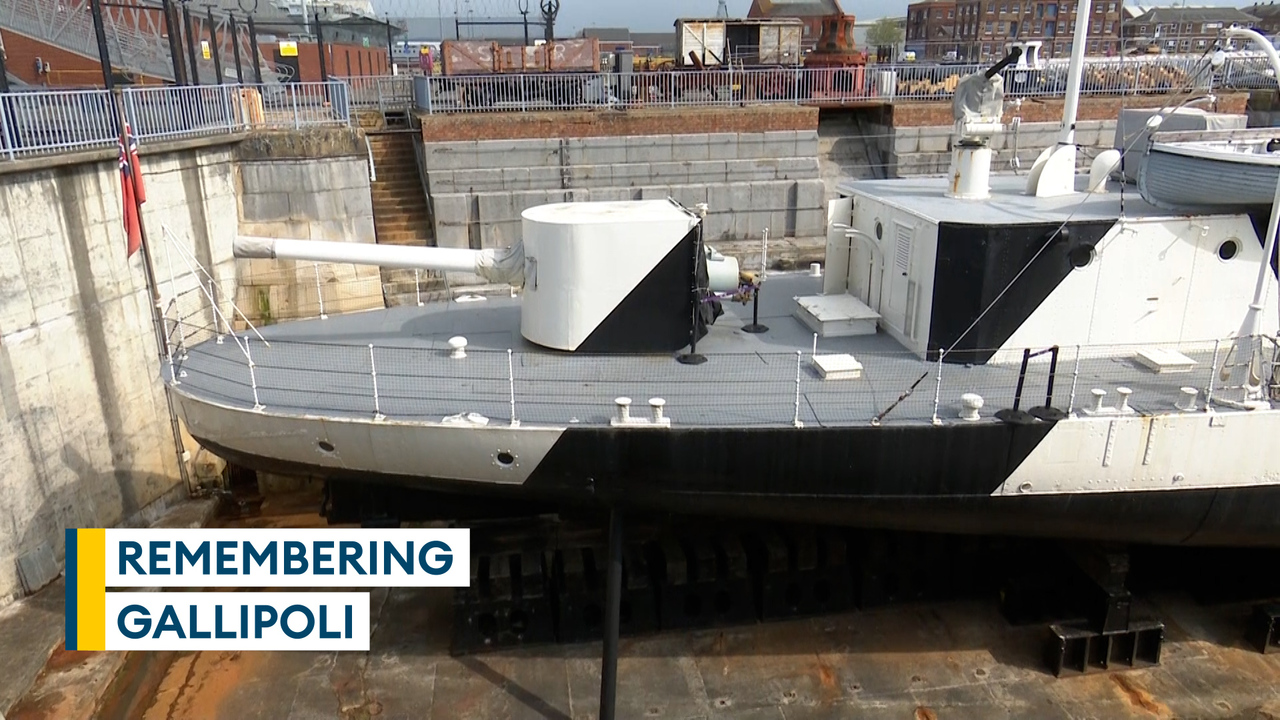
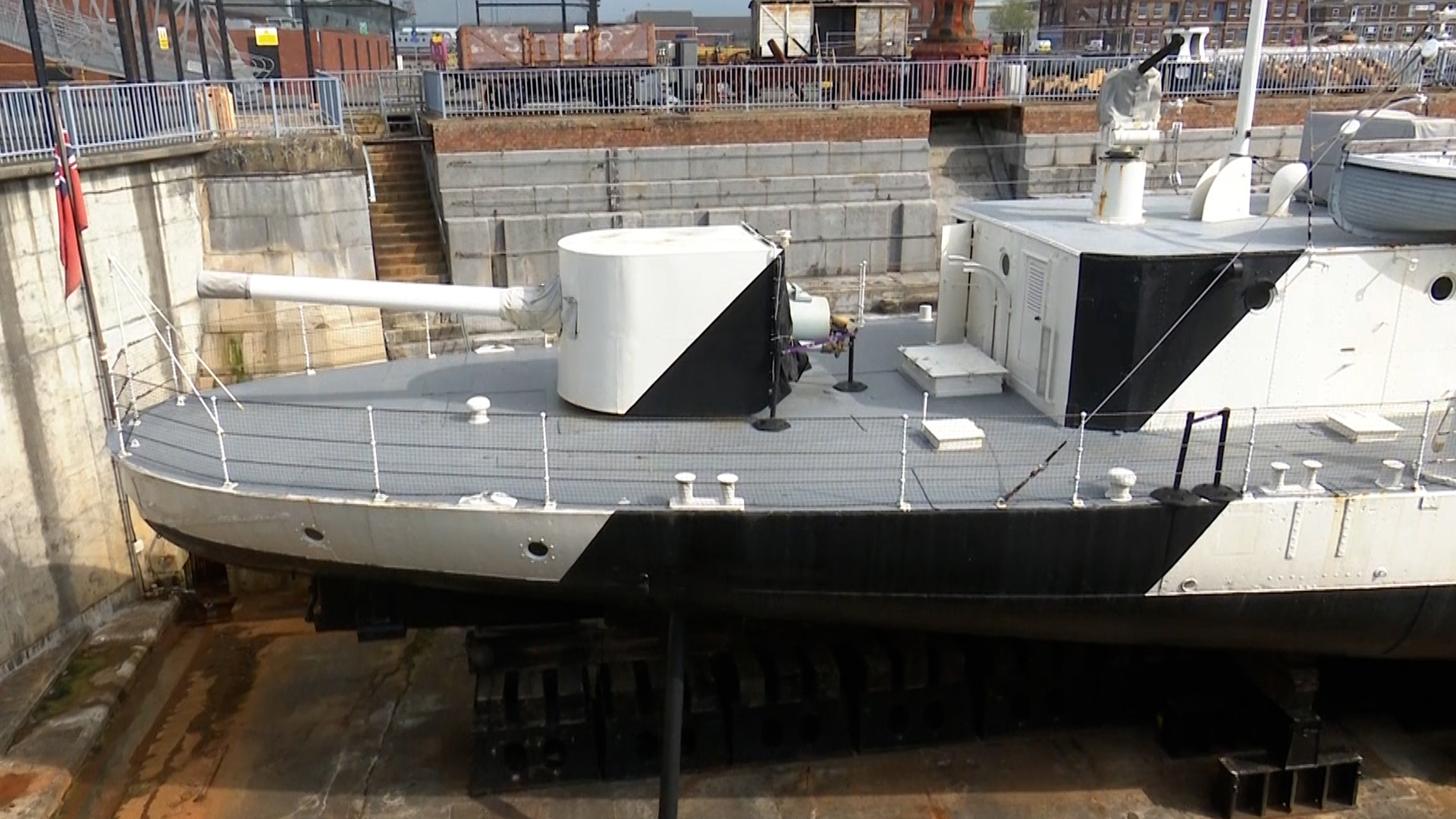
The Royal Navy monitor ship HMS M.33 was deployed for three years during the First World War
At the National Museum of the Royal Navy (NMRN) in Portsmouth is HMS M.33 – known as a monitor ship.
It was specially designed to sit and bombard the coast in support of land troops during the Gallipoli campaign and is one of only three First World War ships left from the British fleet.
“This ship was away from home for more than three years,” said Matthew Sheldon, NMRN chief executive.
“The crew didn’t get to go home in all that time and they were probably witnesses to the drama, the sacrifice of the campaign.
“They themselves were unscathed and were able to tell the whole story.”
Monitor ships came in all shapes and sizes. It was Winston Churchill’s idea to build them, to use up a surplus of 6-inch guns.
They were a big weapon for a small ship, which was made especially low in the water line and stable to provide a suitable firing platform.
The crew of the HMS M.33 were able to bear witness to the horrors of Gallipoli and survive.
These days, the ship is used to commemorate events such as Anzac Day
The treatment and transfer of severely wounded from the battle site to somewhere they can be properly treated often requires transport by sea.
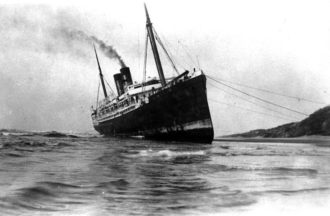
This was done in hospital ships and during the First World War New Zealand provided two of these vessels, funded by a combination of Government finance and voluntary donations.
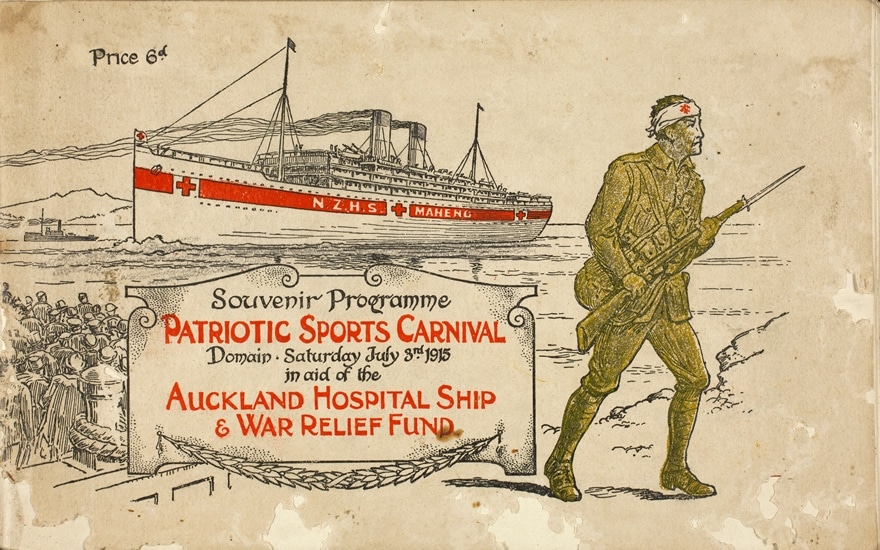
maheno-fund-raiser-poster
They were the brainchild of the Governor, Lord Liverpool, who played a major part in their inception and took a personal interest in both ships.
Following the landings at Gallipoli and receipt of the casualty lists, the Governor, Lord Liverpool, suggested that New Zealand should provide a fully equipped hospital ship, a suggestion that was immediately accepted by the British Government.
With much optimism it was anticipated that the ship would be ready to leave New Zealand within a month.
To fit-out and equip the ship a plea for public donations was launched, with the Bank of New Zealand accepting donations and the Order of St John accepting donations in kind.
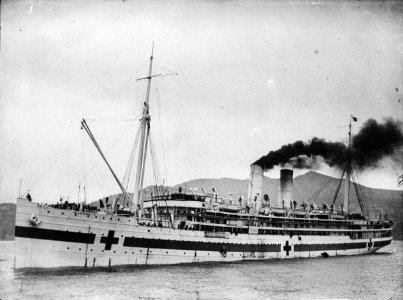
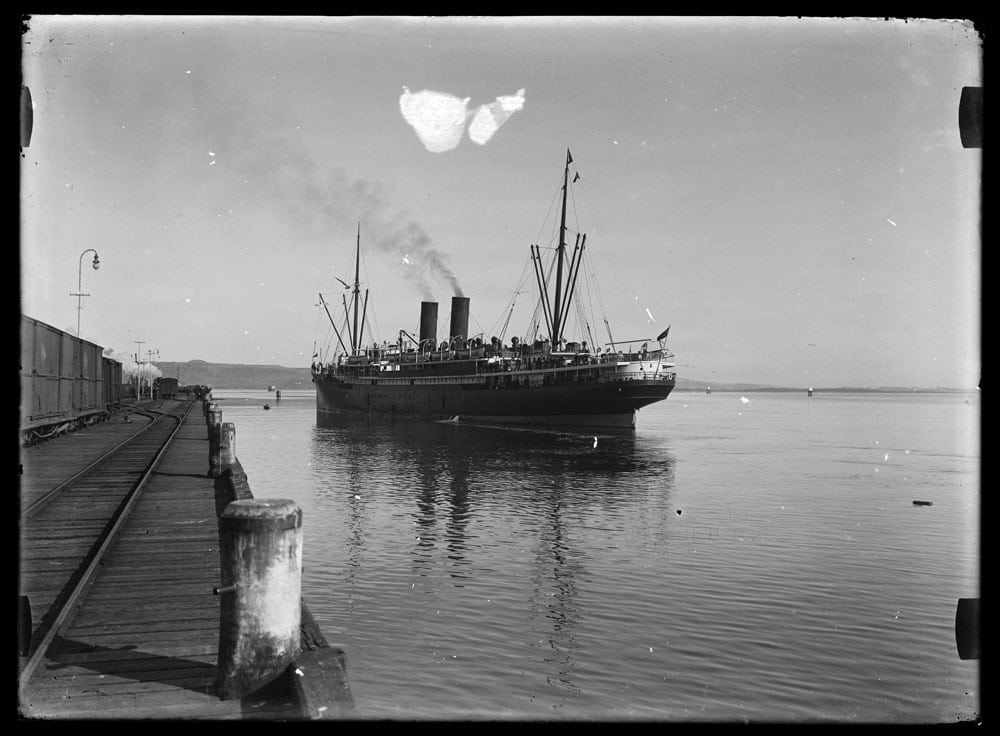
Hospital ship Maheno. Dickie, John, 1869-1942 :Collection of postcards, prints and negatives. Ref: 1/1-002212-G. Alexander Turnbull Library, Wellington, New Zealand. http://natlib.govt.nz/records/23193984
General details of the fitting-out requirements of the ship were forwarded from Britain, including the painting of the ship white with a green band and red crosses.
Subsequent correspondence advised that the ship should wear the Red Cross Flag and the New Zealand Blue Ensign and that two chaplains should be carried. In the event three chaplains were borne.
The SS Maheno was chartered, fitted-out and maintained by the New Zealand Government while the equipment was funded by the Governor’s appeal.
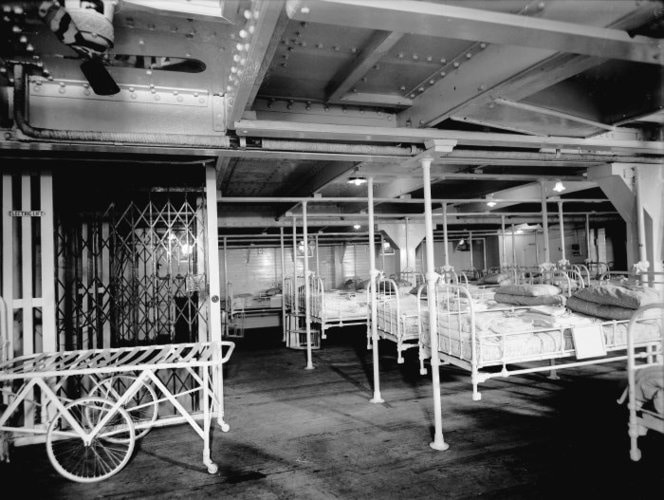
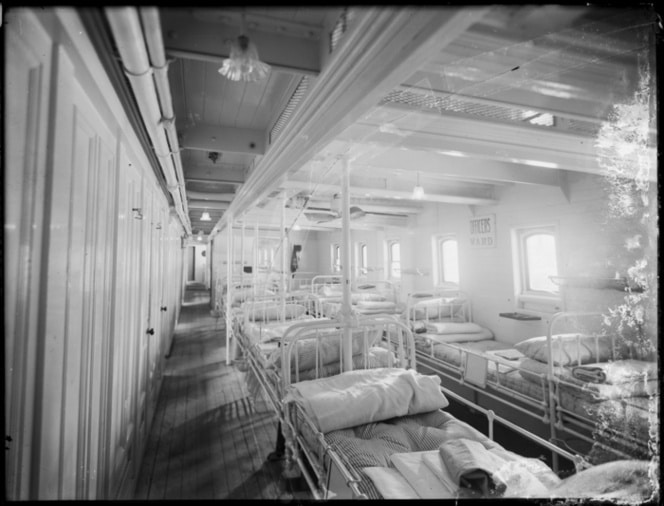
Hosptial-Beds-MahenoHospital-beds-Officers-ward
There were eight wards and two operating theatres, together with other essential equipment, such as a sterilising room, X-ray room and laboratory
The work was personally superintended by the Governor and en route to the ship the equipment was ‘warehoused’ in the ball room at Government House.
Also on board were two motor launches which had been donated, one from Auckland and the other from Wellington. From comments received the ship was better fitted out than any of the other Allied Hospital Ships.
The original date for the ship’s departure was seen to be too optimistic and was put back to 10 July.
At this stage the intention was for the ship to complete one voyage, of about six months duration, returning to New Zealand with soldiers incapable of further service.
Although the ship would generally come under the jurisdiction of the War Office the Government was explicit that the ship and its personnel belonged to New Zealand, in particular, no personnel or equipment were to be removed from the ship.
As early as 26 July, the possibility of a second voyage was being considered, and by the end of the month it was being assumed.
Hospital Ship Maheno
At 12.55 pm on 11 July, following a Church parade, Maheno sailed from Wellington. She was under the command of Captain D. McLean with 105 officers and ratings and Colonel W.E. Collins in charge of 81 officers and other ranks of the New Zealand Army Medical Corps, including 14 nurses.
Additionally, there were some naval signalmen included in the complement. Also embarked were 68 nurses enroute to Egypt.
Each member of the medical staff had received a distinctive green and scarlet lanyard from the Governor.
Maheno arrived at Suez on 16 August and on the 25th anchored in ANZAC Cove, with the odd stray bullet landing on the deck.
The next afternoon a battle was fought ashore and with the first load of 445 wounded Maheno went to Mudros on the 28th, to transfer them to a hospital carrier the next day.
Having cleaned the ship it returned to ANZAC Cove.
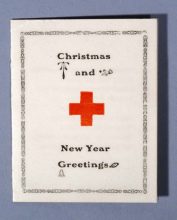
Christmas card from HMNZ HS MARAMA 1917
The next five weeks were spent treating wounded from Gallipoli, either at ANZAC Cove, Mudros or transporting them to Malta or Alexandria.
On 8 October, at Alexandria, the ship received orders to proceed to England. With a full load the ship sailed at 10 pm, arriving at Southampton at 9.55 am on 17 October, after a rough passage across the Bay of Biscay.
Maheno left Southampton on 30 October, returning to the Mediterranean and ANZAC Cove. With 418 patients Maheno then sailed for Alexandria, arriving on 15th November.
A week later orders were received to proceed to New Zealand and with 76 patients the ship sailed on the 22nd embarking further patients at Port Said and Suez.
After an uneventful voyage Maheno arrived at Auckland on 1 January 1916.
At Auckland the ship was met by the Governor and a civic reception was given to the personnel. Sailing that evening Maheno arrived to another civic reception at Wellington, before sailing for Lyttelton and Port Chalmers with the Governor on board.
Before arriving in Dunedin one of the Royal Navy signalmen, Signalman Pattie, received a presentation for rescuing a man who had fallen overboard.
The patients were given a civic welcome at Dunedin.
Two months after Maheno left New Zealand Lord Liverpool was already considering the possibility of New Zealand providing a second hospital ship and this too was immediately accepted.
Hospital Ship Marama
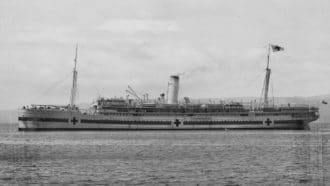
The second ship was the SS Marama, and at 6,437 tons, larger than Maheno, able to carry 508 wounded in cots and it was anticipated that it would arrive in Egypt about the end of December 1915.
Again the Governor was responsible for equipping the ship. Fitting out took until 30 November, when it proceeded to Wellington to embark the medical personnel, sailing on 5 December.
Like Maheno, Marama was intended primarily to carry wounded New Zealanders, although it was placed at the disposal of the War Office and could carry men of the Imperial forces when possible.
With this object it was proposed that the ship first proceed to Gallipoli. Again there was a strict condition imposed that none of the medical officers, nurses or attendants were to be removed from the ship.
Hospital ship, SS Marama
Marama arrived at Port Said on 18 December, where wounded were embarked for Alexandria.
With a further load of wounded embarked Marama sailed for Southampton, arriving on 31 January. There the ship was inspected by the Admiralty and further improvements taken in hand to bring it up to a first class standard.
Marama sailed for Alexandria on 15 February with Australian and New Zealand wounded for onward repatriation.
Maheno sailed from New Zealand on its second charter in early 1916 and by July both ships were working on the cross Channel run, between France and England as there were insufficient cases requiring return to New Zealand to fill either ship.
In September the situation changed, with the New Zealand Division being heavily involved in the Battle of the Somme.
For the Hospital Ships this resulted in much activity on the cross Channel run, and by the middle of the month there were sufficient cot cases to fill Marama for return to New Zealand. By the end of October there was also a full load for Maheno.
Marama’s return was not without some controversy, with Navy Office Melbourne advising New Zealand that it intended to load 15 tons of cordite in the ship for transit to New Zealand.
As could be expected this resulted in protests from both the Governor of New Zealand to the Governor General of Australia and the Acting Senior Naval Officer to the Australian Commonwealth Naval Board.
The proposal was cancelled. Just who and what could be carried in hospital ships was to be an on-going consideration.
The situation was re-iterated by the Secretary of State for the Colonies in September 1917 and in November of that year it was further advised that even the carriage of swords and revolvers of wounded officers was prohibited.
It had originally been intended to route Maheno via South Africa, however the ship could not carry sufficient coal for the passage from Durban to Fremantle and accordingly the ship was routed through the Suez Canal.
This caused some anxiety in New Zealand because of the mining of a Hospital Ship in the Mediterranean earlier in the year.
In response the Secretary of State for the Colonies advised that while the Admiralty could not guarantee that Maheno would not strike a mine, every possible means would be taken to avoid this happening.
Throughout there was a continual fear that one of the ships could be lost through enemy action.
This engendered numerous telegrams from the Governor to the Secretary of State for the Colonies, which if a response was received, was to the effect that all possible efforts were being made to ensure the safety of the ships.
One result was that they were not used in the Mediterranean from 1916. During mid-1918 the danger to hospital ships around England was such that none were permitted to go to, or sail from the United Kingdom.
This resulted in the two New Zealand ships being employed conveying wounded from either Marseilles or Suez to New Zealand.
The end of the war did not see the service of the hospital ships cease, rather the workload increased. Not only was there a need to transport invalids from England to New Zealand, but there were many to be taken from the Middle East to Britain.
In January 1919 the British Ministry of Shipping wished to take over the Charter of Marama and hoped that the ship would be transferred with all fittings intact.
The Governor General responded that while all of the voluntary equipment would willingly be handed over, it was hoped that the instruments, X-ray machine and bacteriological equipment could be retained as it could not be purchased in New Zealand and it was intended to allocate it to New Zealand hospitals.
After some discussion as to the actual terms this was agreed and subsequently similar arrangements were made in respect of Maheno.
When their service under the Imperial Government was completed the ships returned to New Zealand to be refitted and returned to their owners.