Hospital Ship Maunganui

Hospital Ship Maunganui
HMNZT Maunganui

The Maunganui was an oil burner 30 years old with a speed of 15 to 16 knots. Her gross register was 7527 tons, her displacement 11,340 tons, her length 430 feet and breadth 55.6 feet. She was larger than both the Maheno and Marama which were the New Zealand hospital ships of the First World War. Plans were made for some 390 patients to be accommodated in 100 swinging cots, 100 single fixed cots and 95 double (two-tier) fixed cots. (The number of cots ultimately provided was 365 – 22 fracture cots, 84 single cots and the rest two-tier cots.) The conversion involved a good deal of reconstruction, which was carried out by the Wellington Patent Slip Company at a cost of about £50,000. In addition much special equipment was installed. Plans were developed at a series of conferences between DGMS, other officers of Army Headquarters and of other Government departments, and the Union Steam Ship Company, while the Prime Minister, the Rt. Hon. P. Fraser, took a personal interest in the ship. The accommodation in the ship was completely stripped and redesigned in the most serviceable manner.

A complete emergency system of lighting was installed, as well as electric lifts large enough to convey two stretchers from deck to deck, also with emergency power. A huge tank holding 700 tons of fresh water was built in to ensure adequate water supply between ports.

On B Deck was the operating block. This wing contained everything necessary for the equivalent department in a modern hospital. Operating theatre and rooms for sterilising, massage, X-ray, diathermy, and incidental purposes occupied the space where once was the music room, and nearby was a fully-equipped dental surgery.

Further aft on the same deck were recreation rooms for officers, for men and for nurses, while near the stern the plant was installed for a complete laundry, with modern drying rooms attached. C Deck was devoted mainly to wards.

The theatre block consisted of two main units: a plaster room and the theatre proper. Both were exceptionally well appointed when compared with civilian general hospital standards and were equal to the many demands that the Maunganui’s varied roles made upon this important section of the surgical side. Not the least of these advantages was the proximity of the X-ray department, which greatly facilitated any procedures requiring the assistance of X-ray screening and radiography. In this connection especially, the orthopaedic work benefited greatly.

The plaster room was fully equipped for the purpose – Hawley table, metal sinks and benches for the making of plaster slabs, X-ray viewing boxes, plaster bandage machine and ample cupboard and shelf space. The room was of generous proportions, enabling it to be used as an emergency theatre.

The operating theatre proper was even larger. A modern operating table with complete accessories and a powerful theatre lamp on an overhead rail, which prevented the lamp swinging to the ship’s movement, were notable features of this important section. Adequately sized sterilisers provided hot and cold sterile water. There was even an artificial lung. Numerous extras such as ‘angle-poise’ lamps were in evidence and a large glass-fronted cupboard provided ample storage for instruments. Properly equipped washbasins were installed. The theatre and the plaster room were finished in a pleasing and restful shade of blue.

Anaesthetic equipment again was more than ample. In addition to the usual bottles and masks for general inhalation anaesthesia, the theatre unit also had a fully equipped McKesson gas machine and an Oxford vaporiser. Three large side rooms opened off the main theatre and plaster room, while adjacent to both was the theatre store-room and a surgeons’ change-room equipped with shower and toilet, together with locker facilities. All essential lighting was duplicated on emergency circuits and the whole theatre block was ideally situated forward under the bridge on the promenade deck. The theatre was readily accessible to the main surgical wards owing to its central position and its proximity to the cot-lift.

One feature in which the Maunganui differed from conventional British hospital ship layout was in the siting of the autoclave. This equipment is usually placed in the theatre block, but in the Maunganui it was sited some distance aft on the same deck. This was undoubtedly a tremendous advantage in the tropics and prevented overheating of the theatre. The various specialist departments were all grouped together: theatre, laboratory, X-ray, dispensary and physiotherapy. In addition, all the main cot wards with one exception opened off this central area. This centralisation greatly aided the working of the hospital side of the ship, thus saving time and space. The Maunganui could embark patients, both walking and cot, rapidly.

The main dining-room was the main ward. Each of the eight wards had a different colour scheme, and where the lighting arrangements were changed, diffused lighting was installed over the beds.

At the extreme stern of the ship and on the open deck was the isolation ward, complete in itself and entirely separate from the remainder.

Not only was the deck space utilised economically in the provision of wards and incidental accommodation, but the holds which once carried cargo and luggage were also converted into quarters of various kinds. Where No. 4 hold used to be, the NCOs and orderlies had their accommodation, while another hold became a messroom for the men.

While the power unit of the vessel itself was not changed, a complete emergency system of lighting was fitted and special conveyors were arranged for the transfer of food from the commissariat to various parts of the ship.

Events in Greece hastened the completion of the conversion of the Maunganui to a hospital ship. The Prime Minister urged the supervising committee to day-and-night efforts to expedite her departure, and the DGMS was given a free hand to purchase all the medical and surgical equipment necessary without having to await the approval of the Purchasing Board. The estimated date for completion had been 15 May, but the ship was got ready by 21 April 1941. This was made possible only by expeditious work in the conversion of the ship and the fortunate procurement of equipment, some of which was not available in New Zealand. In the meantime the British hospital ship Somersetshire had transported invalids to New Zealand from the Middle East in March 1941.

The Maunganui under the terms of her requisition, was manned and operated by the Union Steam Ship Company of New Zealand Ltd., the deck, engine and providore departments being staffed by the company’s officers and the ratings being drawn from the New Zealand maritime unions. The medical personnel were selected by the Director-General of Medical Services and the sisters were appointed from the New Zealand Army Nursing Service by the Matron-in-Chief.

The staff of 104 medical officers, nursing sisters, and orderlies had been assembled at Trentham Military Camp. On 18 and 21 April they embarked and on 22 April 1 NZ HS Manganui left Wellington for Suez, with Colonel Murray[1] as OC Troops, Miss Lewis[2] as Matron and Captain Whitfield, Master. The Maunganui was not a unit of 2 NZEF and the staffing and equipping of the ship remained a New Zealand Army Medical Headquarters’ responsibility throughout the war.

The arrival of the Maunganui at Suez on 22 May 1941 was welcomed in 2 NZEF. The DDMS 2 NZEF made the following comment:

The immediate impression on the inspection of the ship was a very pleasing one. My personal expectations, knowing the difficulty of securing fittings in New Zealand, were far exceeded. It has been the unanimous opinion of all officers of the 2 NZEF, from the G.O.C. down, that New Zealand has every reason to be proud of its Hospital Ship.

Evidence of this was obvious from the remarks of a Commander of a British hospital ship then lying at Suez, who stated that he had commanded three hospital ships in the present war, had visited every hospital ship that had arrived in the Middle East, and that he was definitely of the opinion that the Maunganui was the best fitted and finest hospital ship he had seen.

The Maunganui was held at Suez until 10 June 1941 in order to take casualties from Greece and Crete. Invalids embarked for the voyage to New Zealand numbered 338. An allocation of forty beds was made to the AIF, in view of the fact that on each voyage of the Australian hospital ship some beds were reserved for New Zealanders. Thus on her first voyage the Maunganui took back a full load of patients, including many of the casualties from the Division’s first major actions. On the succeeding fourteen voyages she was always a full ship on her homeward run. On her outward trips, too, it was customary to pick up British invalids at Colombo and Bombay and take them to Egypt, where they were transferred to a British hospital ship. Apart from about six weeks in 1942 when she was laid up for overhaul, and a period in 1943 when, because of an accident to one of her propellers, she was taken from North Africa to the United Kingdom for repairs, the Maunganui was always on service.

The Maunganui alone, however, was not sufficient to bring back to New Zealand all the invalids from the Middle East, especially after campaigns where casualties were heavy. Valuable assistance was rendered by the Australian hospital ship Wanganella, which carried many hundreds of New Zealanders, and by the Netherlands hospital ship Oranje.

HS Maunganui spent much of 1945 with the British Pacific Fleet. On her fifteenth voyage, beginning on 17 March 1945, the ship was diverted at Melbourne from the Middle East to the Pacific, and she went on to Sydney, to Manus Island, to Leyte Island, where the ship functioned as a general hospital under Lieutenant-Colonel F. O. Bennett, with Miss G. L. Thwaites as Matron, from 13 April to 21 May before returning to Wellington. Leaving Wellington on 28 June, the ship again headed for the Pacific and was the medical centre for the British Pacific Fleet at Manus Island from 7 July to 18 August before moving on to Hong Kong and Formosa with the American Task Force 111 to pick up patients from among the prisoners of war released from the Japanese. Most of these patients were brought back to New Zealand on her return on 8 October.

While at Leyte in the Philippine Islands on the fifteenth voyage the ship admitted 342 patients, most of them from other ships in the Fleet Train which was anchored around the Maunganui. The ship was used as a naval auxiliary hospital, half of the fleet being allotted to it and the other half to HS Oxfordshire. Patients were discharged to their own ship or, if this had sailed, to a ship which acted as a pool depot. Some serious cases were transferred to ships going to Sydney, and patients were also brought back to Sydney in the hospital ship when she returned.

At Manus on the sixteenth voyage the ship admitted and discharged 242 patients before sailing to Hong Kong, where 111 patients were embarked. Then 108 patients were embarked at Kiirun, Formosa, and later another 156 at Manila on the voyage south again. A few were discharged at Hong Kong, Formosa and Manila, but 362 were brought back to New Zealand where, except for some Australians immediately transferred to a United States hospital ship to go to Sydney, they received hospital and convalescent treatment before being finally repatriated to their own countries, most of them to the United Kingdom by the Maunganui on 23 November. The patients embarked at Hong Kong included civilians as well as service patients, and many of those embarked at Formosa were British service personnel who had been taken prisoner at the fall of Singapore; those embarked at Manila included many Australians from a United States hospital and a prisoner-of-war reception depot there. They all speedily put on weight and improved in health on the hospital ship, whose staff was kept busily occupied in their treatment. The Maunganui took the ex-prisoners of war to the United Kingdom on her final voyage beginning on 23 November 1945 and ending on 20 March 1946, when she brought back to New Zealand the last of 2 NZEF invalids from Italy and Egypt. By this time the number of patients carried numbered 5677.

Lessons from Experience

The most important matter in the administration of a hospital ship was stated to be harmony between the Army and the Merchant Navy. This centred on the careful choice of the Master and the OC Troops. On the Maunganui successive OC Troops worked in the utmost harmony with the Master, who showed the army medical staff every consideration. The person next in importance to OC Troops was deemed to be the Adjutant, who also needed to be specially chosen for the position. With a strong Matron, nursing sisters and a small number of voluntary aids were favoured. It was thought, however, that a preponderance of the nursing orderlies should be males, as they have numerous duties other than nursing to carry out – to supply guards, deal with fractious patients, make up stretcher and baggage parties, and assist in emergency precautions aboard ship, including closing the watertight doors, evacuating patients from wards and manning lifeboats. The male establishment of the Maunganui (72) was held to be too small for all these purposes, especially as work was frequently heavy and exacting, particularly in tropical waters. The Maunganui had more nursing sisters than most British hospital ships and was thought to be the better for it. Even then some officers thought that thirty rather than twenty sisters was desirable, and that there should be two dietitians, three physiotherapists and an occupational therapist. It was agreed that any future decisions on establishments for hospital ships would depend on the size of ship, length of voyage, type of patient and adaptability of staff.

As regards the ship and fittings, it was felt that the Maunganui was very suitable for the purpose – she had adequate speed (averaging some 14 knots), stability in heavy seas, interior hospital arrangements well planned, and equipment of a high standard. One standing criticism was the lack of air conditioning, especially in a ship having to go through the tropics. Owing to a variation in requirements with every voyage it was recommended that a hospital ship should have six or more small rooms whose special purpose could be determined during each voyage, e.g., for plaster room, laboratory, special patients. It was felt that a reasonable amount of deck space for recreation was always necessary, as also was ample dining space for convalescent patients, and swinging cots and a reasonable number of wide fracture beds.

Other points submitted for consideration arising from the Maunganui‘s experience were: a proper landing stage at least eight feet long at the foot of the gangway for stretcher cases; facilities for landing stretcher cases by winch; adequate laundry facilities; no wards between watertight doors or below the water line; companion-ways as wide as possible; and provision of the best type of life-jacket.

US Navy’s Toledo Attack Submarine Completes Engineering Overhaul

The US Navy’s USS Toledo (SSN 769) has returned to service after its eleven-month engineering overhaul at the Norfolk Naval Shipyard in Portsmouth, Virginia.

Refurbishment and modernization efforts, such as mast and periscope installation, as well as engine room tests, were conducted to extend its operational life.

Maintenance for the nuclear-powered attack submarine was carried out by 50 employees across the shipyard production shops.

All updates were run under the force’s Shipyard Infrastructure Optimization Program, which aims to meet nuclear fleet maintenance requirements while optimizing shipyard processes.

“An Engineered Overhaul is a marathon, and I appreciate all the significant efforts from the project team, crew, and contracting partners to keep pushing us to the finish line,” Norfolk Naval Shipyard Commander Captain Jip Mosman said.

SSN 769 is one of 20 Los Angeles-class submarines currently in service.

The USS Toledo

The submarine began its deployment in 1997, serving in drug interdiction missions in the Caribbean Sea and taking on reconnaissance roles during the Afghanistan War.

Its more recent deployments include port calls in Bahrain, Norway, and Scotland. SSN 769’s crew was given the Navy Unit Commendation award in 2020 for their eight-month intelligence collection deployment.

The submarine weighs 6,096 tons and can achieve submerged speeds greater than 34.5 miles (55.5 kilometers) per hour.

Its propulsion consists of an S6G pressurized water reactor with a 165-megawatt core, two steam turbines, and a secondary 325-horsepower propulsion motor.

Gisborne WWII hero Ken Gordon reflects on service, honoured by King Charles

By Wynsley Wrigley

Central government, local government and health reporter·Gisborne Herald·

24 Apr, 2025 05:00 PM6 mins to read


SaveShare

Gisborne's last surviving World War II veteran, sailor Ken Gordon, third from left, is pictured as a seaman boy during the war.

Gisborne’s last surviving World War II veteran, sailor Ken Gordon, third from left, is pictured as a seaman boy during the war.

Royal New Zealand Navy veteran Ken Gordon has received a letter from King Charles thanking him for his war service. To mark Anzac Day, the Gisborne Herald’s Wynsley Wrigley spoke with Gordon about kamikaze attacks, the exhilaration of combat and seeing Emperor Hirohito during the formal Japanese surrender in Tokyo Bay

Gisborne’s last surviving World War II veteran Ken Gordon was a 17-year-old “seaman boy” on HMNZS Gambia, whose crew claim to have fired the last shot of the war.

Gordon also recalls – three weeks later on September 2, 1945 – catching sight of Emperor Hirohito from Gambia during the formal Japanese surrender in Tokyo Bay.

The veteran, who turns 98 in November, said it was “a bit of a joke” to see the formal Western-style top hats and tails worn by the emperor and others in the Japanese delegation.

Still in the Navy during the Queen’s first visit to New Zealand in 1953-1954, Gordon served in the Royal Guard as the monarch met thousands of Kiwis at Eden Park.

Gordon was taken by surprise when he had his third brush with royalty only last week when he received a framed letter from King Charles.

It was titled A Message to the New Zealand Veterans of the Second World War on the 80th Anniversary of the War’s End.

The King wrote that it was with “great admiration that I write to thank you, once again, for your selfless service in those most difficult and dangerous times”.

The lengthy letter ended with, “it is my fervent hope that the years have brought you to a place of peace, and that peace shall remain with you always”.

Gisborne's last World War II survivor Ken Gordon, who served in the Royal New Zealand Navy, shows the framed letter he received from King Charles.
Gisborne’s last World War II survivor Ken Gordon, who served in the Royal New Zealand Navy, shows the framed letter he received from King Charles.

“I just didn’t believe it,” Gordon said of the moment when he opened the package.

“It came out of the blue – not many would have been sent out.”

It is estimated there are about 400 New Zealand veterans of World War II still living, but there are no official records.

Gordon is not an ardent royalist. His proudest moment was seeing the New Zealand battle ensign as Gambia’s crew went into combat.

He says he enlisted as one of the Navy’s last seaman boys at 14, and experienced combat for the first time at 16.

Gordon said he was never scared during combat – not even the first time.

“You were switched on. You were there to do a job. I felt no fear at all.”

Gordon, a No 2 gunner on an Oerlikon twin-barrel 22mm anti-aircraft gun, said combat was an adrenaline-packed experience with exhilaration and cheering, despite the inherent danger.

“When action stations sounded – what a sight, what a sound. It absolutely switched you on. You were flying, absolutely flying.

“We were cheering. I don’t think the Americans (who were on board the New Zealand cruiser as monitors) could understand it.”

Gambia first saw combat in the Pacific in 1944, participating in US carrier raids.

HMS Gambia (pennant number 48, later C48)

In 1945, Gambia was part of the British Pacific fleet which attacked Japanese installations and facilities and came under attack from kamikazes for the first time.

Gambia had to slowly tow disabled destroyer HMS Ulster 760 miles (1223 kilometres) to Leyte Gulf and faced the strong possibility of being attacked by Japanese submarines.

Another task in 1945 was screening US aircraft carriers.

The American and British fleets, including the Gambia, could put up an incredible barrage, said Gordon.

“The sky was absolutely pockmarked with black clouds of exploding shells.”

The kamikaze pilots had to run that gauntlet.

“They were going straight for the [aircraft] carriers.”

On August 9, the day the second atomic bomb was dropped on Nagasaki, Gambia was firing on the steelworks at Kamaishi on Honshu Island.

It was the last bombardment of Japan.

“That was the big one. We went in with the British fleet. We went in with no air protection whatsoever.

“We rolled out our white ensign, our battle flag. We had it on our stern and on our masthead.

“It was a big thrill to see New Zealand in action with our flags flying. We were representing New Zealand in the fleet.

“It was a great day. It was the most thrilling part of the war … it was absolutely incredible.”

After the end of hostilities, the Gambia was attacked as it sailed to Tokyo Bay to represent New Zealand at the formal Japanese surrender.

Japan had accepted the Allies’ demand of unconditional surrender on August 14, 1945.

The attack took place on the morning of August 15, VJ Day, when the Gambia’s crew thought the war was over.

“We were already closing down our armaments and storing away ammunition.”

Many sailors and Royal Marines were on the deck of Gambia when they heard the spine-chilling sound of the kamikaze attack.

“We were taken by surprise.”

Gambia and two American Corsairs opened fire.

“The Americans chopped this guy out of the sky. I wouldn’t be here otherwise.”

Gordon still has a photograph of the deceased Japanese pilot floating past Gambia.

It was this battle that led the New Zealanders to claim they fired the last shots of the war.

Gambia also transferred released Allied Prisoners of War after the Japanese surrender.

Gordon was incensed by their condition after years of Japanese captivity, but he spoke highly of the New Zealand nurses he met.

Originally from Kōpuawhara, near Mahia, Gordon still speaks fondly of meeting fellow resident Nurse Kerr in March 1945.

Gordon was barged to the hospital ship Maunganui to meet Kerr after a signal was sent asking if any sailor on Gambia knew anyone on the hospital ship.

The nurse had looked after him “as a kid” at Kōpuawhara, and had brought some of his brothers and sister into the world.

“Up the gangway [of HS Maunganui] I went,” said Gordon.

Hospital Ship Maunganui

“Talk about a mother figure – there she was up the top waiting.

“I was still only 16 or 17. She couldn’t believe it. Here was me, from her knowing me as a kid, and here I was in action and her at the top of the gangway.

“That was fantastic.”

Gordon, if feeling well enough, planned to go to the Gisborne dawn service on Anzac Day morning.

ANZAC Day feature: Brutal nuclear blast from the past

By Phil Taylor April 25, 2025

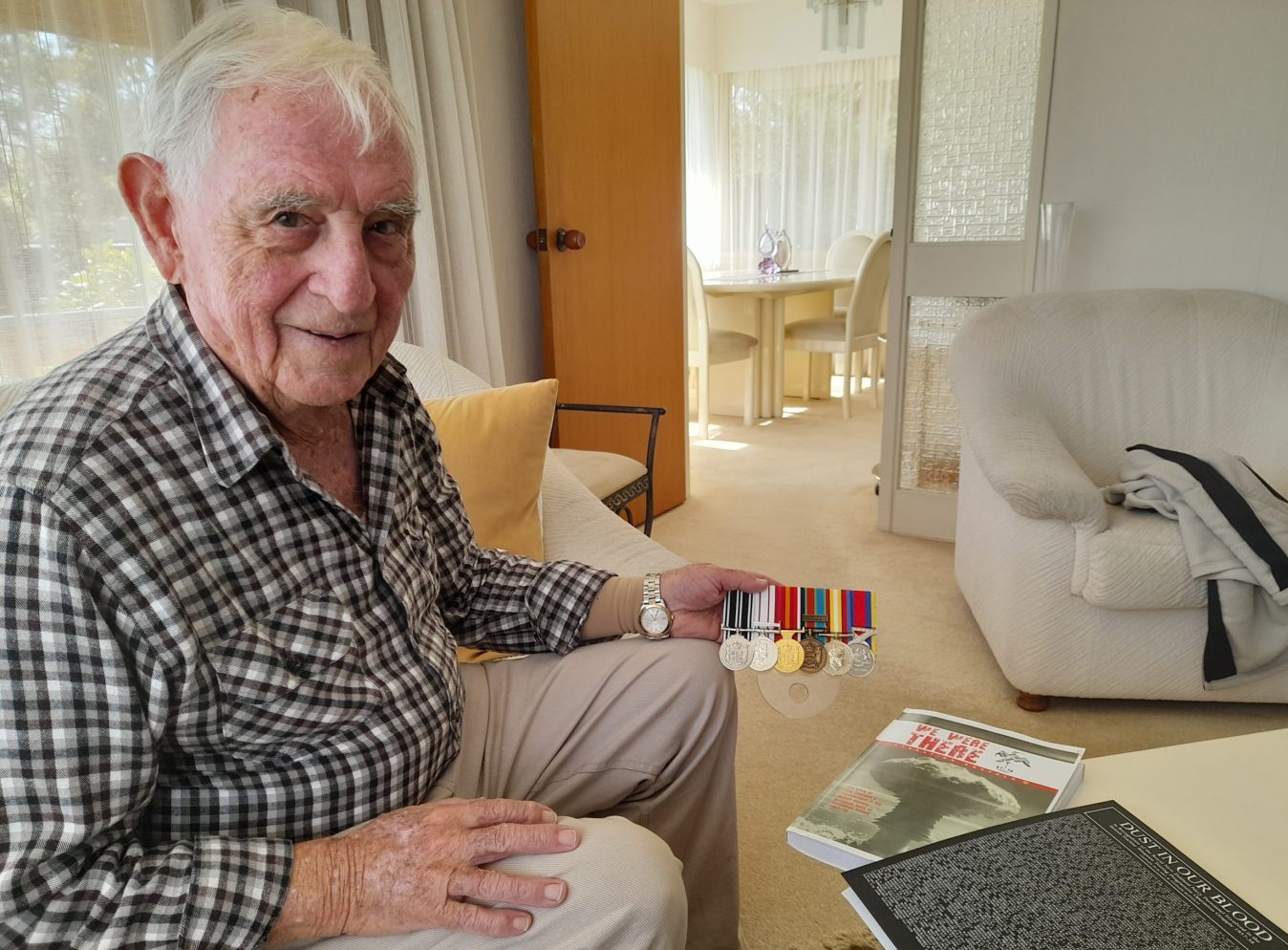
Former Royal New Zealand Navy serviceman Ivan McCabe with his military medals, including the Nuclear Testing Medal received in February 2024. Times photo PJ Taylor

Ivan McCabe never forgets the scorching heat and force of the blast of a nuclear bomb’s explosion.

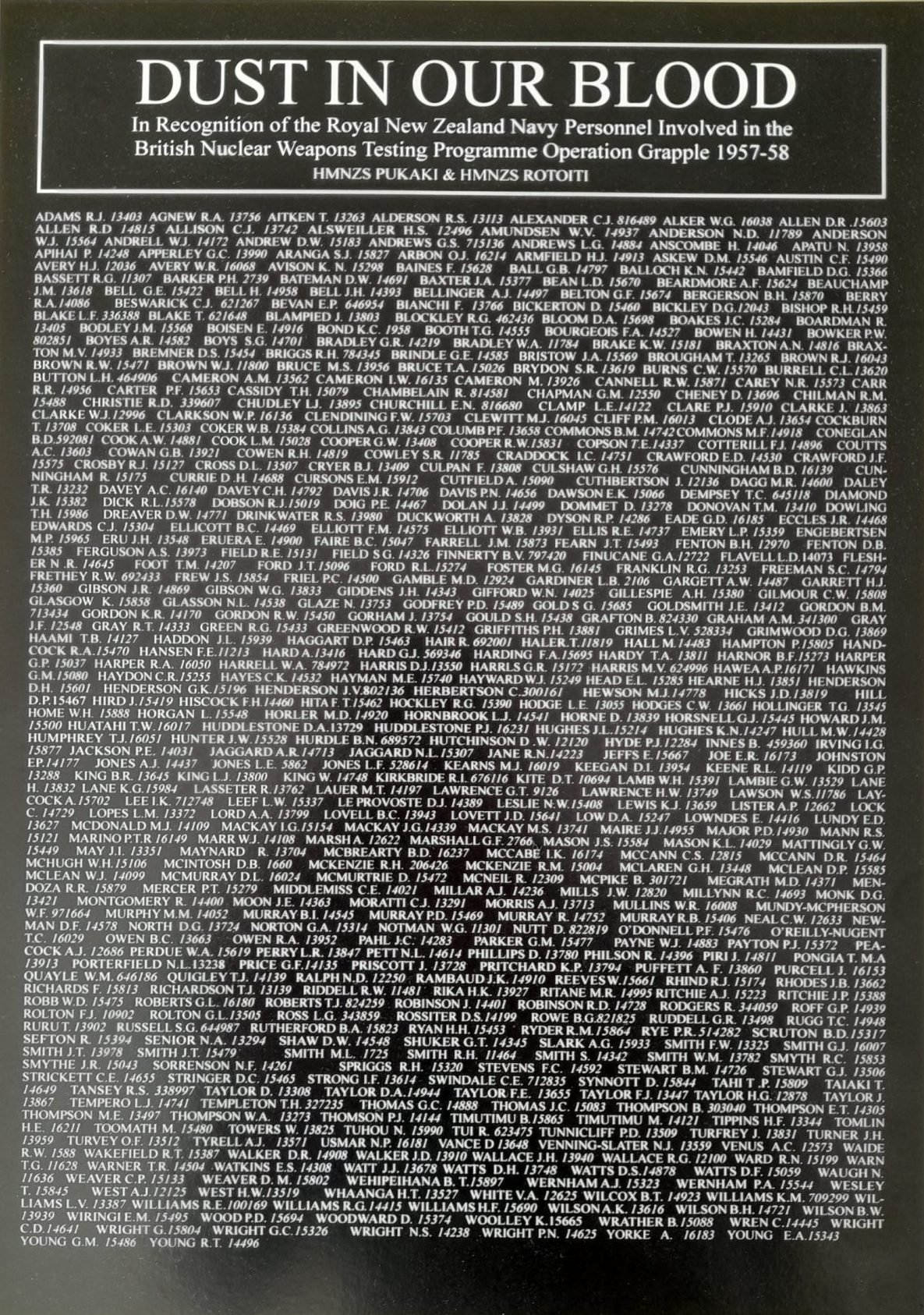
The 86-year-old retired accountant served in the Royal New Zealand Navy from 1957 to 1964 and stood on the deck of frigate HMNZS Pukaki along with crewmates with their backs to the powerful detonations.

HMNZS Pukaki (F424)

The Navy ship and personnel were there under orders from the New Zealand government which had been asked by the allied United Kingdom government to participate in its nuclear bomb testing programme exercises in the Pacific Ocean.

It was code named Operation Grapple, a set of four series of British nuclear weapons tests of early atomic bombs and hydrogen bombs in 1957-1958 at Malden Island and Kiritimati (Christmas Island) in the Gilbert and Ellice Islands, now known as Kiribati.

McCabe, vice-president of the New Zealand Nuclear Test Veterans Association, was age 19 when he stood 12-20 miles from the detonation of nuclear bombs.

He’d signed up for the Navy a year earlier as an eager 18-year-old originally from Central Otago, serving as a cook.

“They were powerful in force, and we weren’t quite sure what we were looking at standing under those mushroom clouds,” McCabe says, of the British nuclear bomb testing.

The Sunnyhills, east Auckland, resident told the Times he was there on duty for the last four tests of Operation Grapple.

Those were the early days of British nuclear weapons development, but they had progressed to the size that each was greater than all the detonations that massacred Hiroshima in Japan at the end of the Second World War.

“That bloody bomb,” says McCabe. “You felt the heat of that and appreciated what those people in Hiroshima had experienced.

“The crew lined up on the ship’s upper deck, just in our anti-flash material garments and anti-glare goggles. They were like old-fashioned sunglasses.

“All the ship’s company were required to have their backs to the blast’s centre. Then there was a countdown from 10. At zero the bomb had gone off, and seconds after that you felt the heat of the bomb on your back.

“We all had our hands on our faces. Many remember seeing the bones in their hands.

“There was a huge rush of air and when we turned around the mushroom cloud was rising, and I remember seeing an RAF bomber flying through it.”

After the explosions, McCabe recalls seeing dead fish and birds.

“In recent times, it has been a question of, why did the New Zealand government of the day deploy us [on Operation Grapple], when it knew the nuclear explosions were detrimental to our health.

“They only had to look at what had happened in Hiroshima.”

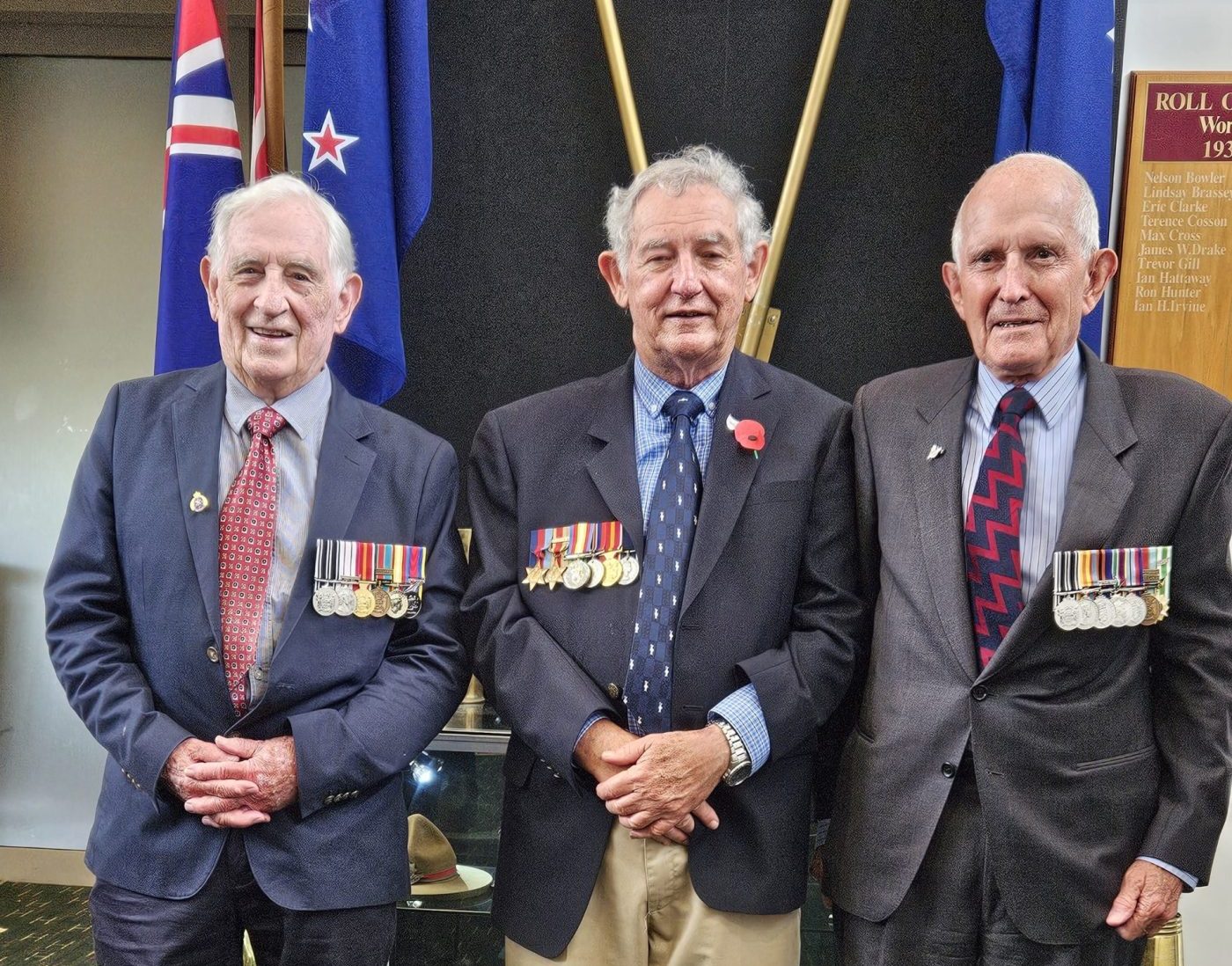
Ivan McCabe, Derek Priscott, who received the Nuclear Testing Medal on behalf of his father, the late John Priscott, from Howick RSA president Barry Dreyer. Photo supplied Adele White

There were also British nuclear weapons tests in Australia during that era from 1952 to 1967.

McCabe says after the initial tests were carried out on the land there, at places such as Emu Field (1953) and Maralinga (1956-57) in South Australia, the government across the Tasman told Britain it must move them offshore.

He says it was done because the Australian government eventually recognised that severe damage was being caused to the health of the indigenous outback Aborigine people and the soil.

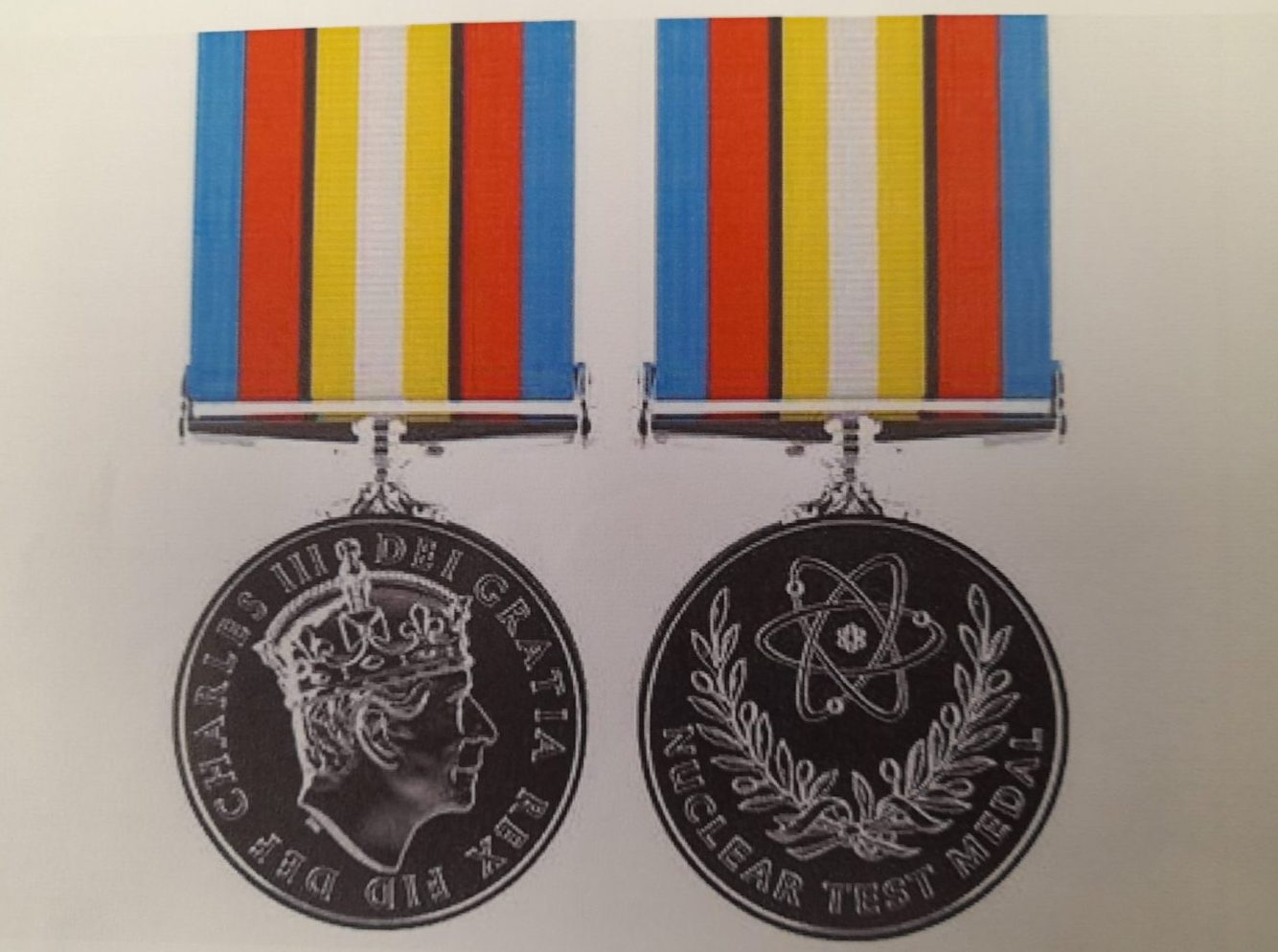
A Nuclear Testing Medal recognising military service during Operation Grapple and other testing programmes has finally been established in Britain and is available to former New Zealand Defence Force servicemen who were there on duty.

McCabe received his from the British High Commissioner to New Zealand at a ceremony in February last year.

“The medal was initially struck with a portrait of Queen Elizabeth II and has now been struck bearing King Charles III.

“The medal can be awarded posthumously to a veteran’s legal next of kin.”

The Nuclear Testing Medal, first announced by the British government in 2023, 70 years after its nuclear bombs programme. The ribbon colours represent the blue Pacific Ocean, the red of the Australian outback, the white to illustrate the heat of the bomb, and black and yellow that are used in the radiation danger symbol. Photo supplied

One such deceased serviceman, former Royal Navy and NZ Royal Navy man John Priscott, had his medal presented to his son Derek on behalf of his family at a ceremony on Armistice Day, November 2024, by Howick RSA president Barry Dreyer.

McCabe, in his role as NZ Nuclear Test Veterans Association vice-president, is also letting other ex-Defence Force serviceman who were on duty in Operation Grapple, or their families know that they’re eligible for the Nuclear Testing Medal.

Despite their advancing years because the British nuclear testing was almost 70 years ago in the Pacific, and their decreasing numbers, McCabe says the association membership is still fighting for official acknowledgement.

It would like an apology from the New Zealand Government “for deploying personnel to a location that they knew or ought to have known was detrimental to their health and well-being”.

McCabe says the association is also calling for “funding for research of the ongoing health effects of the ex-servicemen’s next of kin. As the veterans now put it: ‘This is the last chance, as at an average age of 85-plus we’re rapidly running out of time’.”

He says there are less than 100 Kiwi ex-Defence Force personnel who served on Operation Grapple still alive.

“This is about the atomic radiation we’ve been carrying in our bodies.”

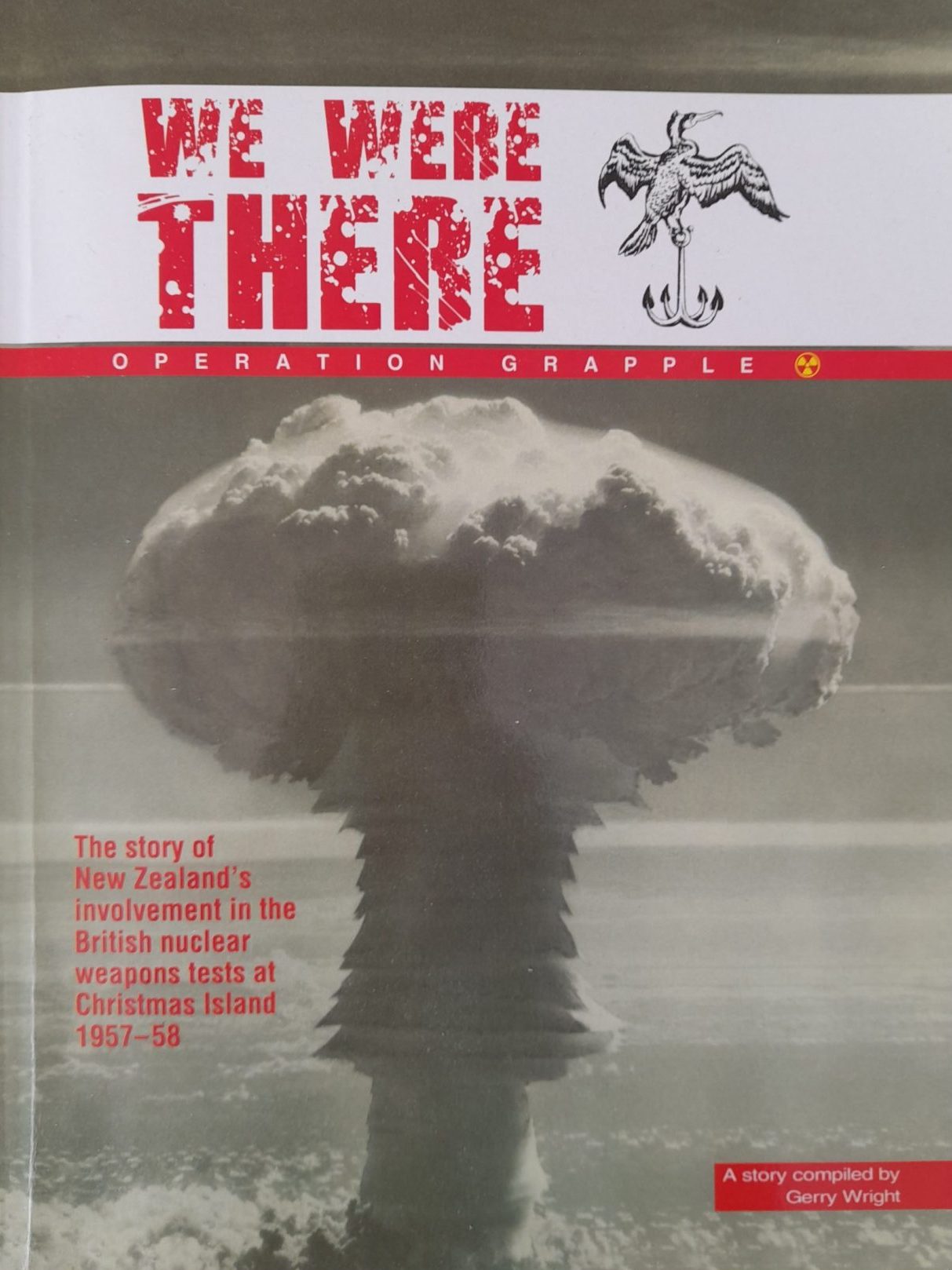
A history book about Operation Grapple, We Were There, compiled by ex-Royal New Zealand Navy serviceman Gerry Wright. The cover photo is of a British test nuclear bomb’s mushroom cloud rising over the Pacific Ocean and British and Kiwi servicemen in 1957-58. Photo supplied

He says Roy Sefton, a former leader of the association, started its campaign seeking official recognition “because he became aware of health issues affecting veterans in similar ways”.

McCabe says respected health researcher Al Rowland has done medical assessments on many veterans exposed to the nuclear weapons blasts “that studied gene dislocation – when the human genetic systems are disturbed”.

“The research showed that the genes did not reattach. That research has been acknowledged worldwide as gold standard.”

The association, McCabe says, continues to be disappointed at the Government’s response, because of its “dissenting view” from its own medical assessments and Rowland’s research that’s “not been accepted”.

“We are not done with it yet.

“The possibility that children of personnel could be affected was first raised in the study at Massey University in 2007.

“Al Rowland, who led the investigation, said results were ‘unequivocal’ that veterans had suffered genetic damage as a result of radiation.”

There’s also an irritation for the association regarding the participation of the personnel at Operation Grapple, compared to the Navy crews that were sent to Mururoa Atoll in the 1970s to observe French nuclear testing, which was in effect, a protest by the Norman Kirk-led Labour Government.

“That deployment in the 1970s was similar in some ways to Grapple, but completely different as it was in the ban-the-bomb era in the lead up to our nuclear free legislation.

“The association hope that one day the two parts of our nuclear history can be told in an informed and balanced way.”

Photo supplied
  • The late John Priscott was a long-time Royal Navy and Royal New Zealand Navy man.

He joined the Royal Navy in 1939 serving throughout the Mediterranean where his ship was bombed then torpedoed during World War II.

As a member of the 20-strong skeleton crew, they managed to save the ship which lived to fight again at the D-Day landings.

After the war, he transferred to the Royal New Zealand Navy and emigrated to Auckland in 1951.

Aboard HMNZS Black Prince, which escorted Queen Elizabeth II on her 1953 Royal tour, he attended the Spithead review and the Coronation.

He was aboard HMNZS Pukaki during all the British nuclear testing in the Pacific, as well as with Sir Edmund Hillary on his expedition to the Antarctic.

Priscott’s family has now finally received the Nuclear Testing Medal awarded to those that were involved.

Southland Regional Naval Officer Lieutenant Commander Nigel Finnerty reflects on Anzac Day as he samples shipboard life as a guest aboard HMNZS Canterbury.

From one Canterbury to another

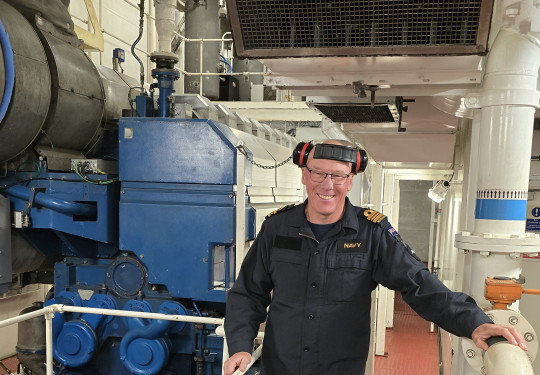
LTCDR Finnerty’s happy place – the engine room on HMNZS Canterbury

24 April, 2025

I left the navy 24 years ago, and since moving home, I’ve served as the Regional Naval Officer for Southland.

Every year, I look forward to getting up early on April 25 to stand at the Invercargill Cenotaph — no matter the weather — alongside 5,000 others from our community.

I stand there thinking not just of the sailors, soldiers and aviators who served before me, but also reflecting on my own time in the Navy — the things I did, the people I served with, and what it all meant to me.

I also find myself wondering what it would be like to serve now, in today’s Navy. And I wonder, 25 years from now, who’ll be getting up early on Anzac Day to remember those who came before them?

For 20 years, my naval career took me all over the world. When I retired, I thought that was it — my sea time was over.

After so many years working on the sea, I figured I wouldn’t want to get back on a ship again.

But I had this idea that maybe I could go to sea without having to work. (Some people might say officers didn’t work anyway, but I know the truth!)

So I went on a couple of ‘‘civvy’’ cruises to try to get it out of my system. But it wasn’t the same. The Navy was still there. They don’t do it like we did.

Then, when I was asked to put the uniform back on and join a 12-day trip to the Auckland and Campbell Islands on HMNZS Canterbury, no-one could hold me back.

It was a chance to see how the modern Navy works, how things have changed — and to see if I still fitted in (many years later, with significantly less hair).

So it was with a mix of nerves and excitement in February, that I slung my kit bag over my shoulder, said goodbye to the family, and headed up the brow (gangway) to join the ship in Bluff.

And, almost immediately, walking down the passageway towards the 12-berth cabins, I felt it — a sense of coming home.

The pipes over the speakers, the uniforms, the smells, the food, and the people — it was all so familiar.

Even though I’d never served on this version of Canterbury (my HMNZS Canterbury was a frigate), I felt comfortable. I was back in the Navy.

HMNZS Canterbuty (L421)
HMNZS Canterbuty (F421)

I spent 12 days immersed in Navy life. The routines came back quickly. The navy lingo flowed freely. The crew’s quiet confidence the job would get done was infectious. The ship’s versatility was impressive, and the ‘can-do’ attitude of everyone really stood out. But the thing that struck me the most? Today’s sailors aren’t that different from yesterday’s.

Sure, some things have changed — the technology, the accommodation, the uniforms

— but sailors are still the heart of the ship — they work together to get the job done. It’s not that different from what my mates and I were doing 30 years ago.

This amazing opportunity to live the military life again, even just for a short time, gives me great heart. I’m confident that those serving today will be standing at cenotaphs around New Zealand in 25 years, remembering those who came before, and those they served alongside. They are Anzac now, and they will carry that legacy into the future.

So what will I be thinking about this Anzac Day? I’ll be thinking about those who came before me — those who gave the ultimate sacrifice, and those who came home and helped build New Zealand. But I’ll also be thinking about those who are out there now, doing the business of the New Zealand Defence Force, whether at home or over the horizon. They’re living the life that we who served before them once lived. They are our future.

You can take the sailor out of the Navy, but you can never take the Navy out of the sailor.

JCs Royal New Zealand Navy Ships and New Zealand Defence, Also other World Defence Updates

Ships and Defence News Past and Present

Skip to content ↓