Watch: British and Canadian warships join forces for CSG 25
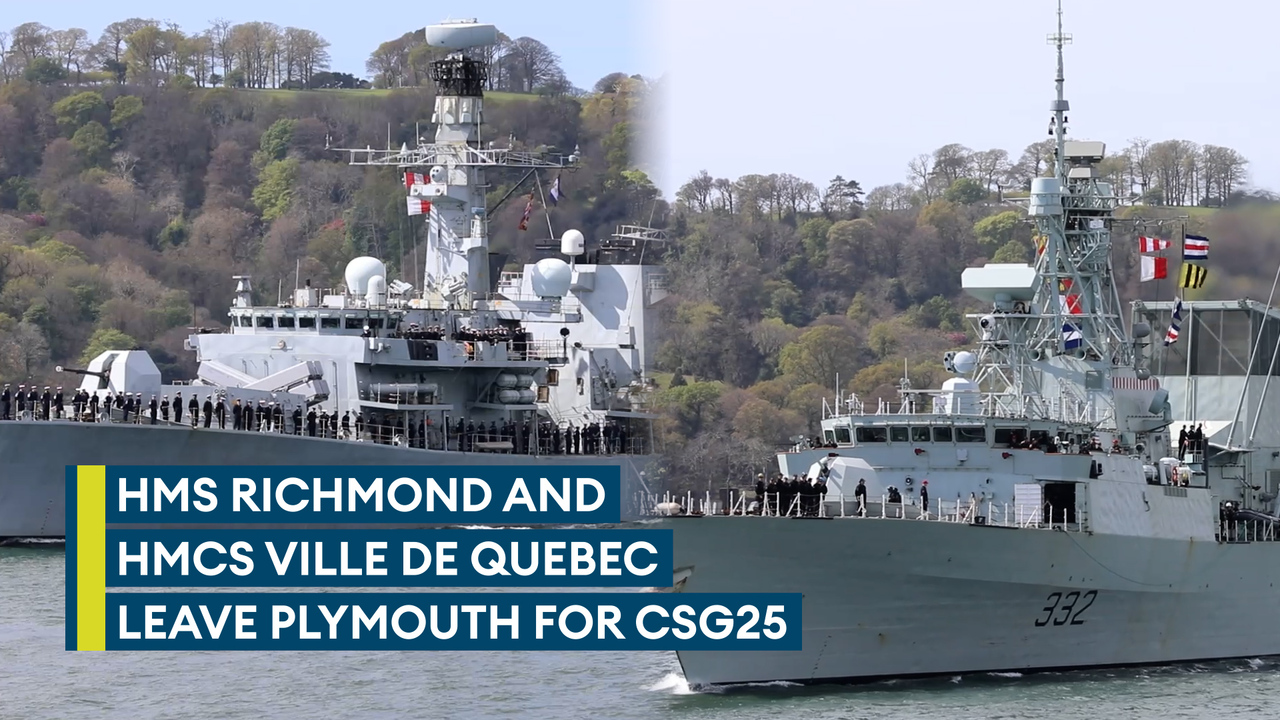
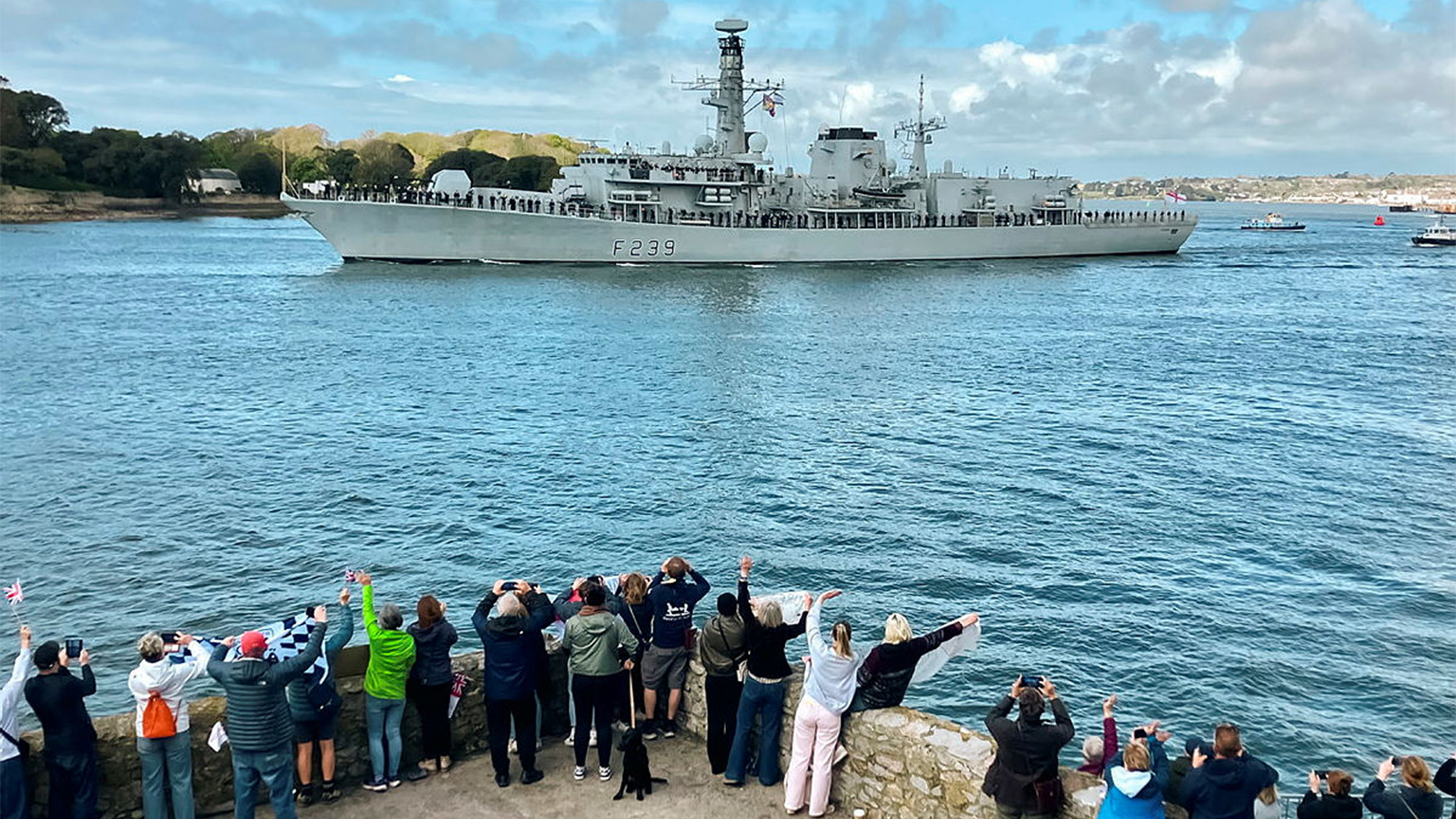
HMS Richmond has left her home port of Plymouth to join the flagship on the Royal Navy’s biggest deployment of the year.
The submarine-hunter will spend most of the next eight months protecting aircraft carrier HMS Prince of Wales and other ships which make up the UK Carrier Strike Group.
She was waved off by families who gathered as sailors have done for decades at Devil’s Point.
An hour later, she was followed into Plymouth Sound by Canadian frigate HMCS Ville de Québec, who is also assigned to the carrier force for much of the remainder of 2025.
CSG 25 will work with Nato allies in the Mediterranean before moving on to the Indo-Pacific region with major exercises off Japan and Australia, before making the return journey and home in time for Christmas.
HMS Richmond is part of the defensive “ring of steel” drawn around the task group to protect it from hostile eyes and ears as well as potential threats.
Her first duty, in sync with her Merlin Mk2 helicopter from 814 Naval Air Squadron from RNAS Culdrose in Cornwall, is to keep hostile submarines well away from the CSG.
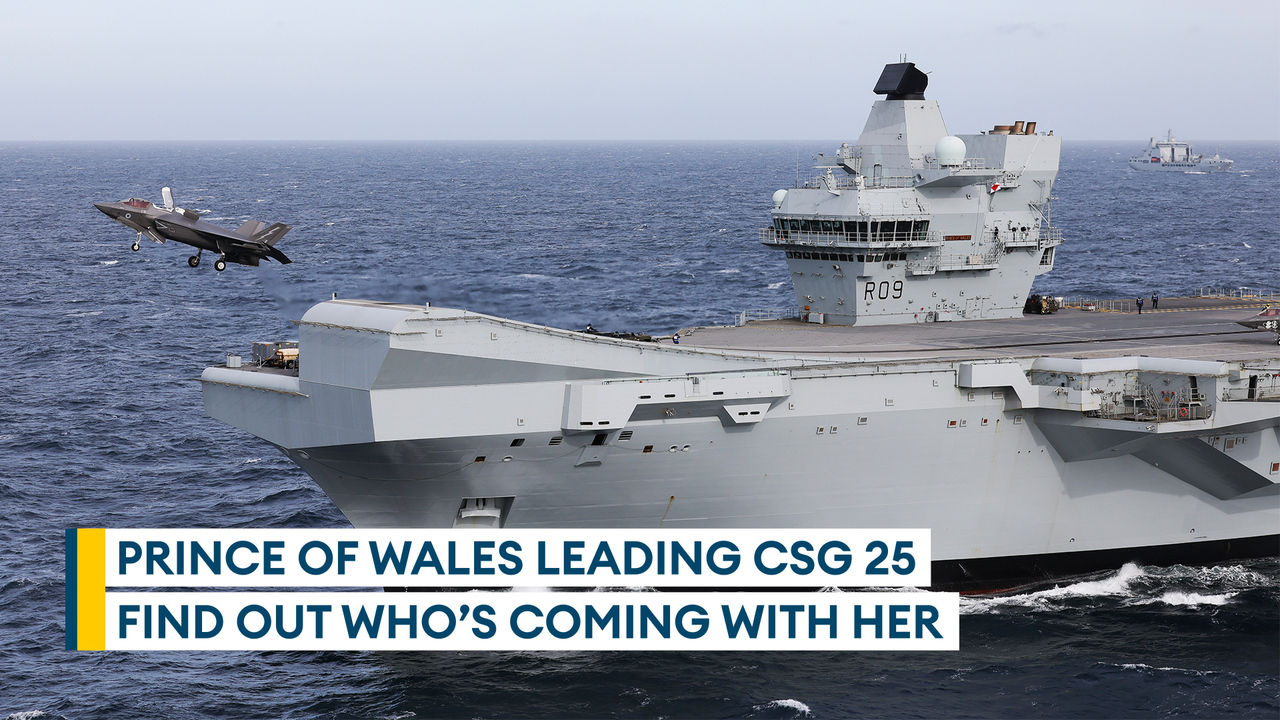
The Navy says HMS Prince of Wales is the sword, offering offensive capability, while HMS Richmond is the shield (Picture: MOD)
Beyond that she can be called upon for a host of duties and missions such as board and search operations to counter smuggling, drug-running or terrorist activity.
She can also provide air defence with her Sea Ceptor missiles and naval gunfire support should targets ashore need pounding.
Leading Hand Martin Tutchings, one of the frigate’s weapons engineers, said: “I’m really excited to deploy and do what I joined the Navy to do, travel the world and contribute to operations around the globe.”
Also excited are the crew of HMCS Ville de Québec, which sailed from Halifax earlier this month. Her crew have enjoyed a couple of days in Plymouth before departing Devonport.
The Canadians have been training more than a year for their part in the deployment – the first to the Indo-Pacific in the 30-plus-year career of the Ville de Québec.
Watch: Royal Navy flagship sets sail for historic deployment
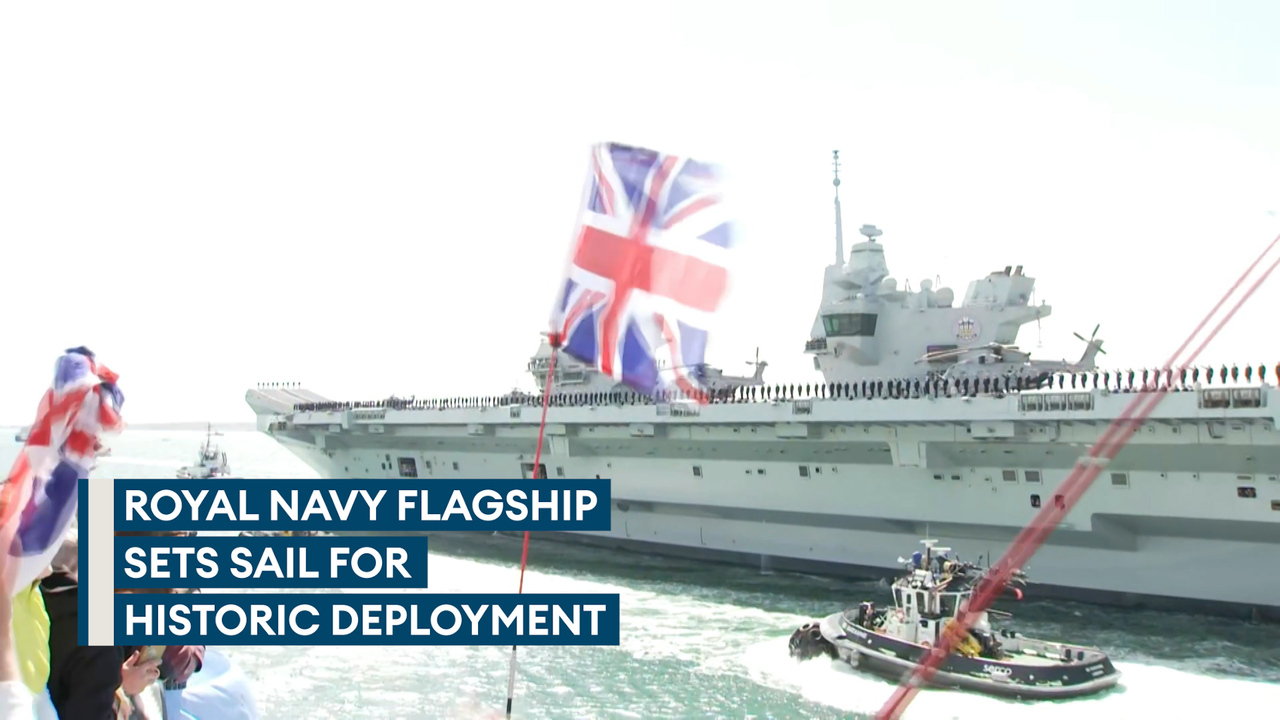
HMS Prince of Wales has set sail from Portsmouth Harbour to the sound of cheering crowds as she heads out to sea to lead Carrier Strike Group 2025.
She’s on an eight-month mission to demonstrate UK and allied collective resolve and determination to maintain security and freedom from the Atlantic to the Pacific.
Between now and December, the Carrier Strike Group (CSG 25) will conduct a series of exercises and operations with air, sea and land forces of a dozen allies in the Mediterranean, Middle East, Southeast Asia, Japan and Australia.
Some family members had been waiting since the early hours to see off their loved ones.
One lady explained that she had been staying at a campsite but had shifted to a location nearer the seafront.
“We thought we’d come over here and sleep on the street so we can get an early spot, but in a camper van,” she said.
She said being an early bird had been worth the effort, adding: “We’ve got one of the prime spots here, and we’ve just found out that our lad’s going to be on the top, in his number ones, which we weren’t expecting.”
Defence Secretary John Healey said the CSG was an “immensely complex operation” and thanked the personnel involved in Operation Highmast.
“This is a unique opportunity for the UK to operate in close co-ordination with our partners and allies in a deployment that not only shows our commitment to security and stability,” Mr Healey said. “But, [the CSG] also provides an opportunity to bolster our own economy and boost British trade and exports.
“As one of only a handful of countries in the world able to lead a deployment of this scale, the Royal Navy is once again demonstrating its formidable capability while protecting British values and sending a powerful message of deterrence to any adversary.”
Watch: HMS Dauntless joins Indo-Pacific deployment
A contingent of 18 UK F-35B jets will join the carrier in the days after departure, with that number increasing to 24 during the deployment.
The F-35Bs that operate from HMS Prince of Wales are a mix of Royal Navy and RAF units, and one father said: “My son’s sailing out today.
“He’s based in [RAF] Marham with 617 Squadron working with the F-35s. Got down there at 07:00 this morning. Just wanted to make sure we got a good spot. You snooze, you lose.”
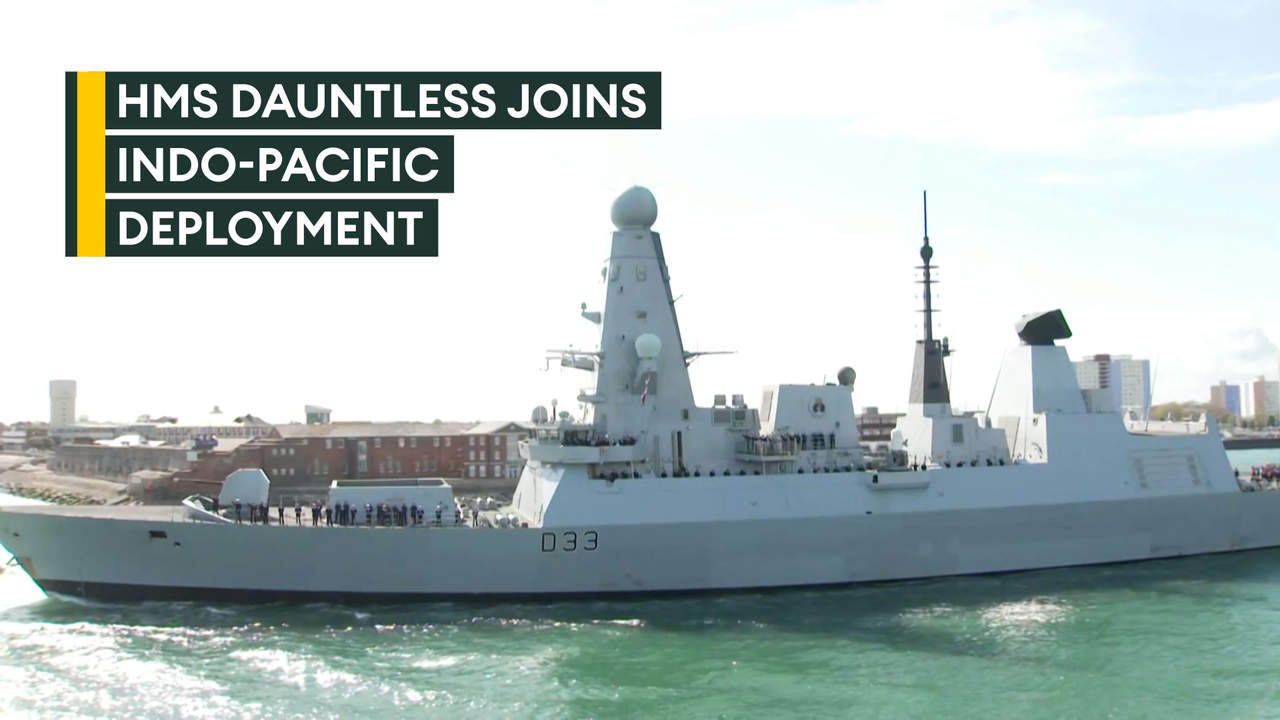
HMS Prince of Wales, the Royal Navy’s flagship, will sail alongside HMS Dauntless, HMS Richmond and an Astute-class submarine, which will shield her from any danger.
The 65,000-tonne vessel will be heading to the Indo-Pacific and onwards to Australia during the deployment.
Some 2,500 personnel – around 2,100 British personnel, and 400 from Norway, Canada, and Spain – will initially deploy as part of the CSG, and the personnel will increase to 4,500 in the Indo-Pacific region.
These families, who have been separated from their loved ones, will have to wait for a while as the personnel will be away for seven-and-a-half months.
Another man said: “Our daughter Meghan is on the ship, so it’s our last opportunity to see her for a few months, so [we’re] very proud to be down here.
“This is our second time here, so we know it gets very crowded. We’ve got our coffee. We’ve got our croissants, and we’ve got our banner – an eight-foot banner. We’re good to go!”
What: What we know about the vessels making up CSG 25
Spectators at the departure waved flags and banners from Portsmouth Harbour’s beach and walls as the vessel sailed past.
Gemma McConnell was with her children, Lachlan, seven, and Chloe, four, to see off Surgeon Commander David McConnell.
The 42-year-old from Plymouth said: “You’ve got to believe in the Navy to be a Navy wife, a proper part of it.
“It doesn’t ever make me sad when he goes away, because I think it’s an adventure, he gets to see the world, he’s getting to be with amazing people, and it just gives me an enormous sense of pride.”
Viv Pyatt, 61, came from Probus, near Truro, Cornwall, to watch her son, Able Seaman Harry Pyatt, 24, go on deployment.
She revealed that it had been an emotional send-off and added: “We all had a few tears, even my son, he had a few tears, but he’s got a girlfriend on board, so I think they’ll look after each other, so they’ll be fine.”
Submarine-hunter HMS Richmond and Canadian frigate HMCS Ville de Québec set sail from Plymouth to join CSG 25 earlier in the day.
Making up the rest of the Carrier Strike Group initially are air defence destroyer HMS Dauntless from Portsmouth, two Norwegian vessels, the tanker HNoMS Maud and frigate HNoMS Roald Amundsen, which are coming directly from Norway, and tanker/support ship RFA Tidespring.
The ensign on the flight deck of HMS Prince of Wales was at half-mast as a mark of respect for the late Pope, a Royal Navy spokesman said.
As usual, this morning I read Bungy’s RNZN In Memoriam 17 APRIL: and read about that yacht Evaine. I do remember reading of this tragedy on other occasions but did not know how it had happened so a bit of research and turned this up.
Bungy’s post – RNZN In Memoriam 17 APRIL:
DALLOW Jack William SIG NZ3594 RNZN yacht ‘Evaine’ 20………1940 RYAN William Albert OSIG A/1815 RNZNVR yacht ‘Evaine’ 23….1940 WAITE Desmond Clyde OSIG A/1867 RNZNVR yacht ‘Evaine’ 20 1940
The loss of three young members of the Royal Naval Volunteer Reserve in the yacht Evaine, near Tiritiri, on April 17, was recalled at an inquest yesterday into the death of Jack William Dallow, signalman, aged 20, of Oriental Bay, Wellington, whose body was found on the beach at Wliangaparaoa Peninsula on May 4. The, bodies of his companions, William Albert Ryan and Desmond Clyde Waite, have not been recovered. Evidence was given that permission was given to the men to go sailing in Ryan’s boat, which was found capsized five hours later about three miles from Tiritiri. All sails were set, and the leader sail appeared to have fouled the masthead. Robert Wilson Leitch, yeoman of signals, who had previously sailed with Ryan, said: “It appears to me that while hoisting the spinnaker Ryan handed over the tiller to either Dallow or Waite, who through inexperience might easily have allowed the yacht to gybe.” The coroner, Mr. F. K. Hunt, returned a verdict of accidental drowning in the case of Dallow, and intimated that later proceedings would probably be taken in respect of the other victims.
The switch will be made once the multinational Carrier Strike Group reaches the Philippines in August 2025. John Hill – April 22, 2025
View from HMNZS Te Kaha as the frigate exercises alongside partner navies in the Philippine Sea as part of Operation Crucible, the UK Carrier Strike Group in 2021. Credit: New Zealand Defence Forces.
New Zealand will send a warship, HMNZS Te Kaha, an ANZAC-class frigate, to join the UK Carrier Strike Group 2025 (CSG25) deployment when the multinational force reaches the Indian Ocean.
Shortly after, when CSG25 reach the Philippines, the Spanish Navy ship, Méndez Núñez (F-104), an Alvaro de Bazan-class frigate, will depart from the group, beginning its transit back to Ferrol Naval Base in Northern Spain.
The UK CSG, led by HMS Prince of Wales, the second of two British carriers, will depart from Portsmouth on 22 April on an eight-month voyage to the Indo-Pacific in a joint effort that the UK Royal Navy has designated Operation Highmast.
A consistent Royal Navy presence will lead the group throughout the journey, albeit some vessels from partner nations will join and depart when and where necessary under their own command. Other contributors include Canada, New Zealand, Norway and Spain, while Sweden provides some of its personnel.
Maintaining strength
It is notable that the Royal Navy will only provide half of what it had deployed in the previous CSG in 2021. At that time, the service sent two Type 45 destroyers and two Type 23 frigates to sail as escorts to the flagship carrier, HMS Queen Elizabeth.
The Royal Navy will lean slightly more on frigates from partner navies to help project a more credible deterrence throughout the deployment, which will enter contested waters in the Indian and Pacific Oceans.
Nonetheless, joint deterrence appears to be working as the UK Chief of Defence Staff, Admiral Tony Radakin, was sent to China to speak with military counterparts in the weeks leading up to the CSG deployment. It is likely that Radakin would have put to rest any fears in Beijing about their presence in the South and East China Seas later this year.
This switch between Te Kaha and Méndez Núñez demonstrates the effort in maintaining a consistent power projection in a dangerous part of the world.
Te Kaha is nine-years older than Méndez Núñez. However, the two ships are both general-purpose vessels capable of meeting simultaneous threats from the air, surface, and sub-surface.
CSG: air wing component
Part of the strength of the CSG this year is with its airwing component, particularly the number of F-35B Lightning II combat aircraft that will operate from HMS Prince of Wales.
The Council of Geostrategy, in an update in TheBroadside, revealed that the Lightning force will be at full operational capability, which includes 24 aircraft.
“This is a significant moment,” Sea Power Research Fellow Dr Emma Salisbury observed, “which means that the aircraft and its associated support and engineering is working at its full potential to be able to deploy two squadrons wherever they are required in the world.”
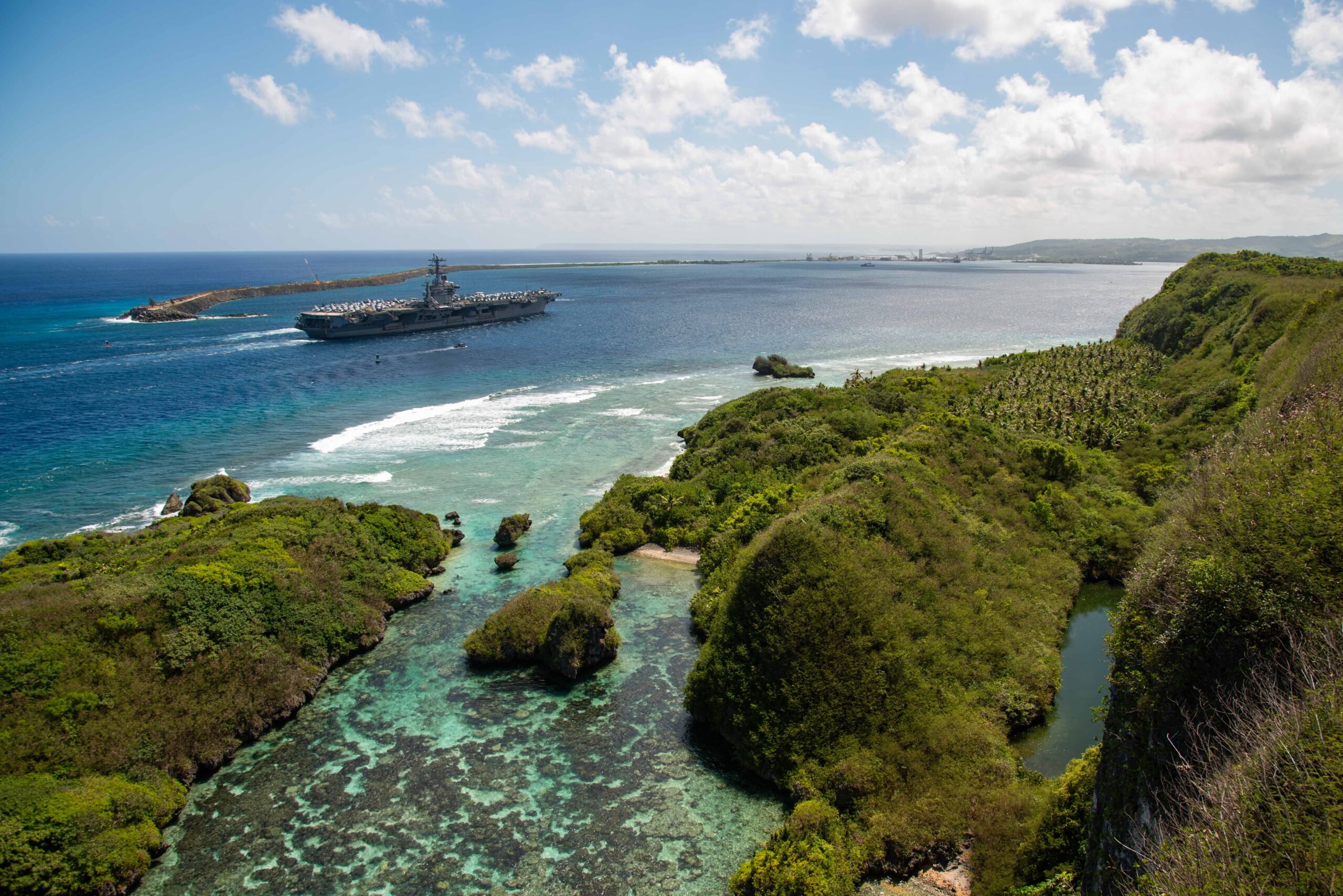
USS Nimitz (CVN-68) arrived in Guam for a scheduled port visit, April 18, 2025. US Navy Photo
Aircraft Carrier USS Nimitz (CVN-68) made its first port call since departing its Indo-Pacific deployment, arriving in Guam on Friday with two of its escorts. Meanwhile the U.S. Navy and Republic of Korea Navy (ROKN) wrapped up a mine warfare exercise in South Korean waters on last week. Nimitz, flagship of Carrier Strike Group (CSG) 11, destroyers USS Gridley (DDG-101), USS Lenah Sutcliffe Higbee (DDG-123) arrived in Guam for a regularly scheduled port on Friday, according to the service
“The Nimitz Carrier Strike Group’s arrival in Guam highlights the island’s vital role as a strategic outpost in the Western Pacific—essential for projecting power, deterring adversaries, and responding to crises across the Indo-Pacific,” said Rear Adm. Maximilian Clark, commander, Carrier Strike Group 11, in the release. “It’s always an honor to return to Guam—where our service members are welcomed like family, and where our presence truly matters. The Nimitz Strike Group is proud to be in Guam—America’s critical terrain and gateway to maintaining stability in the region.”
Destroyers USS Curtis Wilbur (DDG-54) and USS Wayne E. Meyer (DDG-108) also deployed out as part of the Nimitz CSG but during the transit of the Pacific Ocean, Wayne E. Meyer detached from the CSG, making a port visit to Singapore from Mar. 26 to Mar. 31 and headed to the U.S Central Command area of operations where it is now operating as part of the Carl Vinson CSG.
Curtis Wilbur meanwhile, has detached from the CSG to conduct a port visit to Saipan. News channel NMI News Service on Thursday posted a video showing Curtis Wilbur docking at Saipan that day. Curtis Wilbur is expected to rejoin the CSG as previous CSG visits to Guam had a destroyer from the CSG detaching and conducting a port visit to Saipan and subsequently rejoining the CSG.
During its transit of the Pacific Ocean, the Nimitz CSG consisting of Nimitz, Curtis Wilbur, Gridley and Lenah Sutcliffe Higbee carried out a formation sail with cruiser USS Michael Monsoor (DDG-1001) and fleet oiler USNS John Lewis (T-AO-205) on Apr. 10. Michael Monsoor is on an independent deployment to the Indo-Pacific though the U.S. Navy has release little information on its deployment.
Earlier in Guam on Monday, fast-attack submarine USS Minnesota (SSN-783) returned to its homeport of Naval Base Guam following its first operational tasking while forward-deployed in the Indo-Pacific region, according to a navy release, “This first operational tasking following Minnesota’s recent homeport shift demonstrated the submarine’s operational readiness and the capabilities the Virginia-class brings to the Indo-Pacific region,” said Capt. Neil Steinhagen, commander, Submarine Squadron 15, in the release.
The release stated that Minnesota’s operations included a port visit to Western Australia, marking the first of two planned U.S. Virginia-class fast-attack submarine visits to HMAS Stirling in 2025. Minnesota also visited Darwin in Australia’s Northern Territory, supporting bilateral engagements and hosting tours for local officials, according to the release.
The release also stated that while in the region, the crew took part in at-sea operations as part of the Submarine Command Course and participated in Exercise Lungfish, a tactical development exercise between the U.S. Navy and Royal Australian Navy, “Working side-by-side with our Australian counterparts helped sharpen our undersea warfighting skills. That kind of tactical development is vital—not just for increasing our own readiness, but for enhancing interoperability with allied warfighters deployed shoulder-to-shoulder in support of a secure and prosperous Indo-Pacific.”, said Cmdr. Jeffrey Cornielle, commanding officer, Minnesota, in the release.
On Wednesday, U.S. Seventh Fleet flagship USS Blue Ridge (LCC-19) arrived in Cairns, Australia for a routine port visit, according to a Navy release, Deepest thanks to the people of Cairns for their warm welcome to our Blue Ridge and 7th Fleet teams,” said Vice Adm. Fred Kacher, commander, U.S. 7th Fleet, in the release, “The U.S. 7th Fleet operates closely every day with the Royal Australian Navy to advance our combined warfighting capabilities and keep the Indo-Pacific secure and prosperous, and we are grateful that the first port visit with our flagship is here in Australia.”
Cairns will serve as a short stop for Blue Ridge as the ship brings fuel and supplies on board, reads the release.
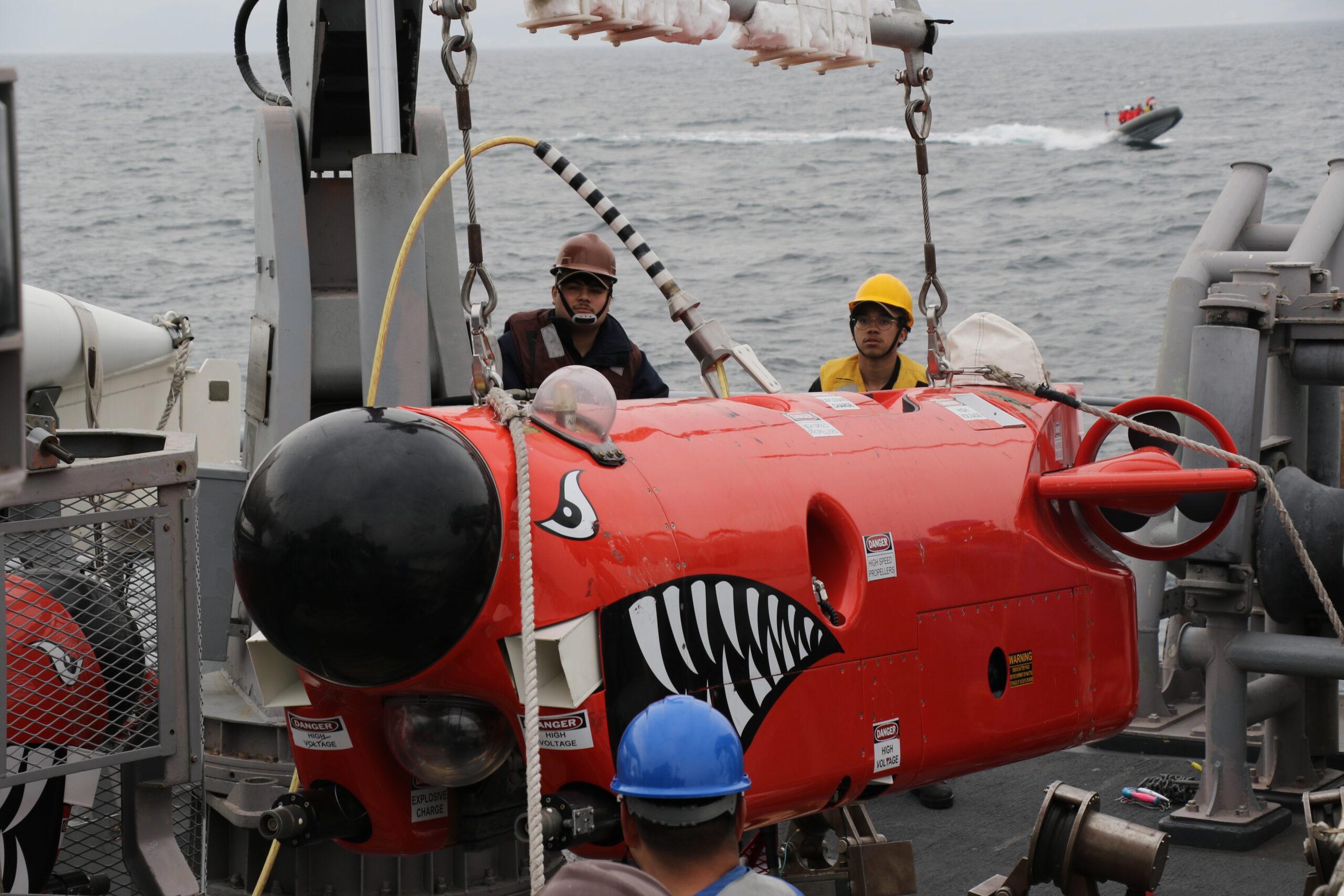
Mineman 3rd Class Angel Vazquez and Mineman 2nd Class Daniel Horne conduct mine neutralization vehicle crane operations aboard the Avenger-class mine countermeasures ship USS Warrior (MCM-10) during Korean Spring Exercise (KSE) at sea, April 10, 2025. US Navy Photo
On Wednesday as well, the U.S. Navy and ROKN wrapped up Korean Spring Exercise, which ran from Apr. 7-16 off the southeastern coast of South Korea and is part of an annual series of exercises between the U.S. Navy and ROKN designed to increase proficiency in mine countermeasures operations between the two forces, according to a navy release.
The release stated during exercise, U.S. Navy and ROKN units worked together to clear a route for ships through a simulated minefield using mine hunting, detection and neutralization capabilities, which included an underwater detonation of a simulated mine and that ROKN Mine Squadron 52 and U.S Navy Mine Countermeasures Squadron (MCMRON) 7 commanders partnered throughout the exercise to direct mine hunting tasks for U.S. Navy and ROKN units, “Operating together in a combined environment is an outstanding opportunity for us to learn about how we each take on this complex mission set,” said Capt. Antonio L. Hyde, commodore, MCMRON 7, in the release, “This exercise continues to show the region that the U.S. and Korean navies are committed to preserving a free and open Indo-Pacific region.”.
The U.S. Navy participated with mine countermeasures ship USS Warrior (MCM-10), personnel from Explosive Ordnance Disposal Mobile Unit (EODMU) 5, two MH-53E Helicopters from HM-15 Det 3A and staff assigned to MCMRON 7 while the ROKN participated with a submarine, minehunters ROKS Ganggyeong (MHC-561) and ROKS Gimhwa (MHC-567), minesweepers ROKS Yangyang (MSH-571) and ROKS Hongseong (MSH-576), minelayers ROKS Wonsan (MLS-560) and ROKS Nampo (MLS-570), submarine rescue ship ROKS Cheonghaejin (ASR-21), a patrol boat, one MH-60 helicopter and two explosive ordnance disposal companies, according to the release.