HMNZS Toroa – ‘Their today for our tomorrow’ – Anzac Day services in Dunedin

By Brenda Harwood

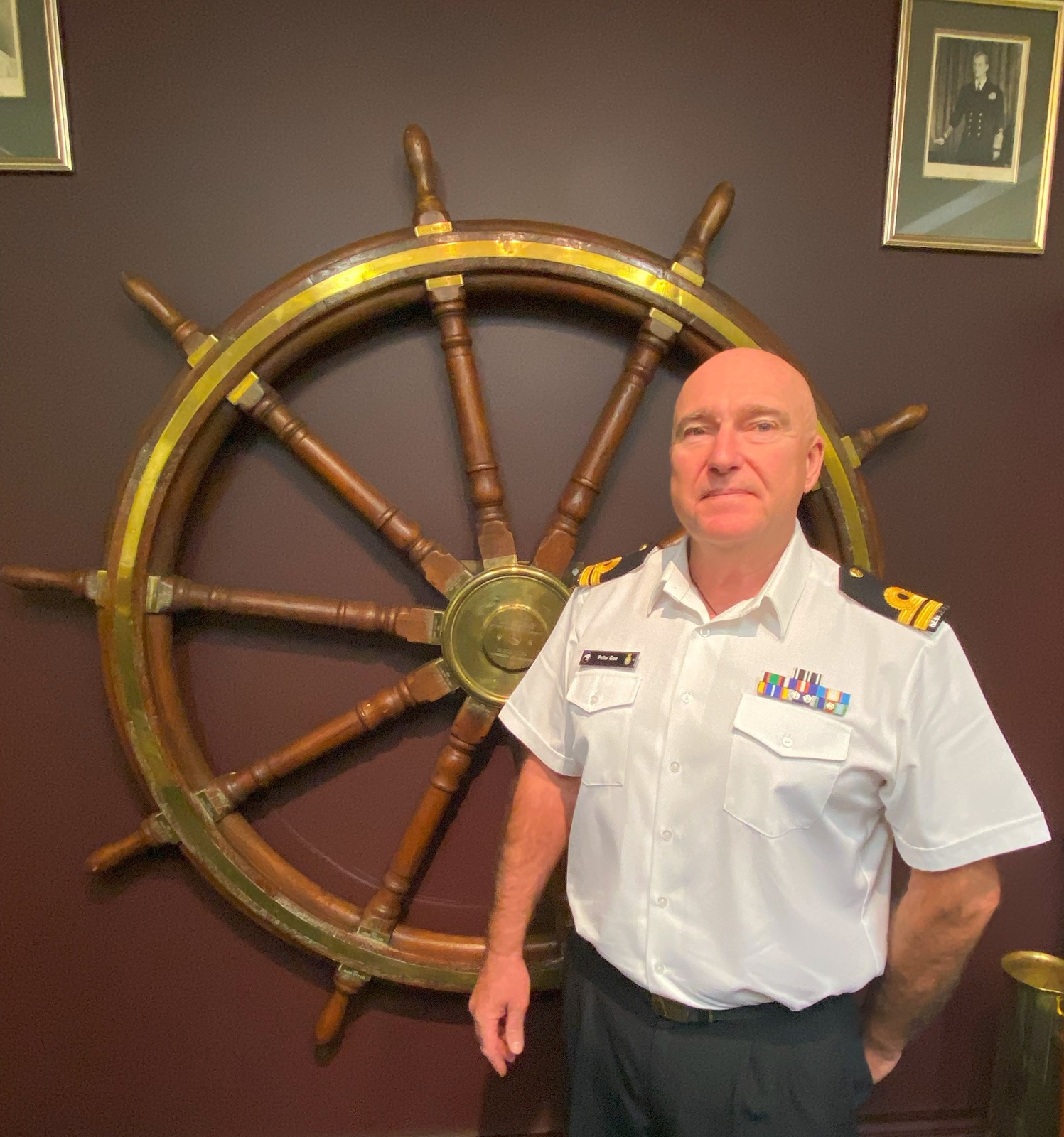
HMNZS Toroa executive officer Lieutenant Peter Gee is co-ordinating the main Anzac Day services...

HMNZS Toroa executive officer Lieutenant Peter Gee is co-ordinating the main Anzac Day services in Dunedin for the third year. Photo: Brenda Harwood

Thousands of Dunedin people will gather at the cenotaph at dawn on Anzac Day to commemorate 110 years since the Anzac landings at Gallipoli in 1915.

For HMNZS Toroa executive officer Lieutenant Peter Gee, now in his third year as co-ordinator of Dunedin’s main Anzac Day services, it is a special honour to help ensure those who served in conflicts are remembered.

Lt Gee has had a 40-year career in the Royal New Zealand Navy, both in the regular force operations branch and in the Naval Reserve, serving all over the world, including Antarctica, the Persian Gulf and Southeast Asia. His most recent deployment was two years ago in the Middle East.

Organising the Anzac Day dawn service, posy-laying service at Andersons Bay Cemetery, and the service at Montecillo Veterans Home & Hospital, was a chance to pay tribute to all those who have served, Lt Gee said.

“I like the phrase ‘they gave their today for our tomorrow’ — those who stepped up and made the sacrifice made it possible for us to have the freedoms we enjoy today,” he said.

“So, I’m hoping we will get a good turnout for the dawn service this year. It’s going to be special to be able to stand together and remember those who have served,” he said.

“The services at Andersons Bay Cemetery and Montecillo are also very important and well attended, as are the various community services.

“It’s great to see people of all ages getting out there on Anzac Day, as we mark 110 years since the Gallipoli campaign.”

The dawn service at the Cenotaph in Queen’s Gardens will start with a march-on parade at about 6.05am, and the service itself will begin with a Howitzer gun salute at 6.30am.

The service will be attended by representatives of the New Zealand, Australian and British governments, along with the New Zealand Armed Forces Land Component commander Brigadier Jason Dyhrberg, representatives of Dunedin City Council, Otago Regional Council, the Dunedin RSA, veterans and their descendants.

National anthems and hymns during the service will be led by the Dunedin RSA Choir, Kaikorai Metropolitan Brass Band and the City of Dunedin Pipe Band.

Following the dawn service, all will be welcome for breakfast at Araiteuru Marae in Shetland St, from 8am.

The Andersons Bay Cemetery posy-laying service, where scouts and guides will lay posies of rosemary on the service section graves, will start at 9.30am.

The service at Montecillo Veterans Home & Hospital will start at 11am, with a colour party from HMNZS Toroa in attendance, along with the Dunedin RSA Choir and Kaikorai Metropolitan Brass.

The University of Otago service will start at 1pm, at the University Plaza, next to the staff club.

In the evening, the Dunedin RSA Choir will present its Anzac Revue concert, from 7pm at St Paul’s Cathedral, conducted by choir director Karen Knudson, with piano accompanist Sandra Crawshaw.

Special guests will include University of Otago senior lecturer in voice Dr Tessa Romano (mezzo soprano), Dunedin Harmony Chorus, and RSA Choir scholar Teddy Finney-Waters (tenor), David Burchell (organ), and Ralph Miller (trumpet).

Lt Gee said the busy programme of Anzac Day services and events came at a good time for the services in Dunedin, with work well under way on converting the former Farmlands building, at 84 Cumberland St (SH1), into a multi-purpose, multi-use site for the defence forces in the city.

“It’s exciting to see this facility taking shape — it is going to be a good hub for our work.”

Dunedin’s Sea Cadet units — TS Waireka and TS Nimrod — have recently merged to form TS Neptune, and were growing in strength, he said.

ANZAC DAY SERVICES

• Dunedin Dawn Service: March on at 6.15am, service begins at 6.30pm, Cenotaph, Queen’s Gardens.

• Posy-laying service: Anderson’s Bay Soldier’s Cemetery, 9.30am.

• Montecillo: Raising of HMNZS Toroa ensign and Anzac Day service at Montecillo Veterans’ Home and Hospital, Bay View Rd, 11am.

• University of Otago: Anzac Service at University Plaza (next to the Staff Club), 1pm. Or if wet, inside the main common room, University Union.

COMMUNITY SERVICES:

• East Taieri: Service at East Taieri Cemetery, 8.30am.

• Taieri Mouth: Service at Taieri Beach Cemetery, Taieri Beach Rd, 9am.

• Portobello: Service at Portobello Museum & Historical Society, 9.30am.

• Macandrew Bay: Service at Macandrew Bay Hall, 10am.

• Mosgiel: Parade departs Mosgiel RSA at 9.40am, heads to Memorial Gardens Cenotaph for service at 10am.

• Brighton: Parade departs Brighton Rugby Club at 10am, heads to Brighton Hall for service at 10.15am.

• Waikouaiti: Parade meet at RSA, 10 Pratt St, at 10.45am, service at RSA Clubrooms following parade, 11am.

• Green Island: Service at Memorial Gardens, 11am.

 Outram: Parade from Mitchell Four Square to soldiers’ memorial, 11am.

• Green Park Cemetery: Service at Green Park services section, Waldronville, 12.15pm (new time).

• Note, there are expected to be more confirmed in the coming days.

brenda.harwood@thestar.co.nz

Frigates – Leander Class – HMNZS Canterbury (F421) – Many images

HMNZS Canterbury (F421)

HMNZS Canterbury (F421) was one of two broad beam Leander-class frigates operated by the Royal New Zealand Navy (RNZN) from 1971 to 2005. She was built in Scotland and launched in 1970. Commissioned in 1971, Canterbury saw operational service in much of Australasia and other regions like the Persian Gulf. She undertook operations such as supporting UN sanctions against Iraq and peace-keeping in East Timor. With her sister ship HMNZS Waikato she relieved the Royal Navy frigate HMS Amazon in the Indian Ocean during the Falklands War. Early in HMNZS Canterbury’s career, in 1973, she relieved the frigate HMNZS Otago, as part of a unique, Anzac, naval operation or exercise at Moruroa during anti-nuclear protests, supported by a large RAN tanker, providing fuel and a large platform for Australian media. This was due to F 421 being a more modern RNZN frigate, with then current Rn surveillance radar and ESM and a more effectively insulated frigate from nuclear fallout, with the Improved Broad Beam Leander steam plant, for example, being remote controlled and capable of unmanned operation and therefore the ship provided a more effective sealed citadel for operations in areas of nuclear explosions.

HMNZS Canterbury acting as planeguard for USS America. This Photo was taken by a PO Seaman (whose name escapes me for the moment) who took my camera on a personnel transfer. ’82 or ’83.
HMNZS Canterbury
Broad beam Leander class frigate HMNZS Canterbury leaving Piraeus in 1991
HMAS Melbourne HMAS Brisbane HMNZS Canterbury Silver Jubliee trip 1977
HMNZS Southland and HMNZS Canterbury, Hong Kong 1987
HMNZS Canterbury in the Mediteranean with HMAS Brisbane and HMS Arrow
HMNZS Taranaki and HMNZS Canterbury
Jackstay transfer between Taranaki and Canterbury
HMNZS Canterbury flying her paying off pennant
HMNZS Canterbury at Opua
HMNZS Canterbury prepared for her fate
HMNZS Canterbury – being made into a reef
HMNZS Canterbury – prepares to dive
HMNZS Canterbury’s demise
HMNZS Canterbury disappears

Canterbury was decommissioned in 2005. In 2007 she was scuttled in the Bay of Islands to provide a dive wreck. She lies in 38 metres (125 ft) of water.https://en.wikipedia.org/wiki/HMNZS_Canterbury_(F421)

Frigates – Type 12 Whitby Class –HMNZS Blackpool (F77) Includes some history and images of time in RNZN


This Whitby-class Type 12 frigate was designed for the RN in the early 1950s for ASW against the Warsaw Pact submarines. Blackpool was the last Whitby to be constructed and was loaned to the RNZN while HMNZS Canterbury was being built. In 1963-64 Blackpool went a major refit at Chatham and was commissioned for service with the Far East Fleet on 9 December 1964. Upon the decision being made to loan this ship to the RNZN, Blackpool returned to Plymouth on 16 February 1966. She was commissioned into RNZN service on 16 June 1966 at Chatham under the command of Commander J.I. Quinn. During her initial trials she suffered a boiler failure and had to return for repairs. In July she had a shakedown cruise around Cowes. This was followed by a Harbour training week at Portland and then she had her first sea week from 28 July to 1 August 1966. After a maintenance period she shifted to Portsmouth arriving 12 August 1966. She did a trip from there to Amsterdam, Guernsey and returned on 31 August. In early September she spent in dock and returned to Portland. She had a Flag Officer Sea Training (FOST) sea inspection in late September and also carried out Replenishment at Sea (RAS) with RFA Retainer and then went to Portsmouth.

HMNZS Blackpool

She left Portsmouth on 9 October 1966 and voyaged through the Mediterranean stopping at Gibraltar and Malta. While at Malta she met HMNZS Santon returning to the UK and did a RAS[L] at sea with RFA Wave Ruler on 22 October. She transited the Suez Canal and at Aden met HMNZS Hickleton in company with HMS Picton both returning to the UK. She arrived at Gan on 2 November and did another RAS[L] with RFA Tidereach. On 8 November 1966 she arrived at Singapore and took up station and began participation in exercises. During this time she visited Hong Kong, Pulau Tioman and Bangkok. From 24 February 1967 to 6 March 1967 she took part in FOTEX 67. Later that month she undertook exercises off Subic Bay. She was released from the Far East station and departed Singapore on 21 April 1967. Going via Darwin and Brisbane she arrived in Sydney on 10 May 1967. While there a crack was found in the keel and there were problems with the main and auxiliary feed pumps. She was in dock for repairs from 15-20 May. She first arrived in Auckland on 25 May 1967. Unlike HMNZS Otago & Taranaki she did not have her armament upgraded when in RNZN service and retained the weapons she was commissioned with.

Upon arrival, she took part in AUCKEX and then on 28 July she took part in Longex through to 9 August. She then went to Gisborne and was on the way to Picton when she was sent to Raoul Island to undertake a medivac. She returned to Auckland and then went to Dunedin and Piction as planned. On 19 October 1967 she went into refit through to 29 April 1968. Towards the end of the refit Commander D.J. Cheney took over as CO from 18 March. In May 1968 she went to Sydney for Command Team training at Jervis Bay. While at Sydney in June, a helo crashed on 5 June. She then took part on LONGEX 68 to 14 June and returned to Wellington. In July 1968 she took part in AUCKEX. She went to LONGEX on 28 July but this was curtailed on 1 August. She escorted HMNZS Inverell back to harbour after her collision with USS Caliente. ON 5 August she sailed to assist SS Gothic which has suffered a fire in her accommodation spaces that cost seven lives.

In late August to early October she took part in Exercise CORAL SANDS in Australia. After returning to Auckland, she departed again for passage to Pearl Harbour in company with an RN group. While in Hawaii, she took part in Exercise CONVEX 3/68 in November. After completing her final battle problem on 13 December, she departed Pearl Harbour for Singapore via Midway, Guam and Hong Kong arriving 24 January 1969. Once again she was posted to the Far East Station. She left Singapore on 31 March and took passage to Bangkok and then on to Hong Kong. On 2 May she assisted in a RAF helicopter medivac from the Russian vessel Never. She then went on to Japan and then to Manila for Exercise SEA SPIRIT. This was curtailed when HMAS Melbourne collided with USS Frank E. Evans. She then took passage back to Auckland arriving 30 June 1969. In August she took part in LONGEX 69. In October she was present in Gisborne for the Cook Bicentenary and returned to Auckland. On 15 October Commander I.H.D. Tyler took over as CO. In November she returned to Jervis Bay for JUC/LONGEX. She then returned via Ship Cove, Wellington, Lyttleton, and Wellington arriving in Auckland on 18 December 1969.

On 3 February 1970 she left Auckland for Waitangi for the celebrations in company with HMNZS Inverell & Kiama. Upon return to Auckland she went into another refit through to August. Commander R.E. Lawry took over as CO from 6 July. After post-refit trials, she departed Auckland on 5 October with FOF2 embarked as escort for HMS Charybdis with HRH Prince Charles embarked. She was at Suva from 8-12 October for the Fiji independence celebrations. After leaving Suva she took passage to Raoul Island and returned to Auckland on15 October. For the rest of the month she was part of RNZNVR training for Ngapona & Olphert divisions. In November she trained personnel from RNZNVR Pegasus & Toroa divisions returning to Auckland on 29 November 1970. This was her last active deployment for the RNZN. In January 1971 she acted as guardship for the One Ton Cup trials. She was then put into reserve as preparations were made to return her to the RN now that HMNZS Canterbury was ready to e be commissioned into service in the UK. Blackpool left Auckland on 22 April 1971 and was returned to the RN at Portsmouth in June 1971. The ship’s company was transferred to HMNZS Canterbury. Blackpool went into reserve and was sold for breaking up in 1978.

NZ lighthouses – Cape Reinga Lighthouse

Cape Reinga Lighthouse is a lighthouse at Cape Reinga in the Northland Region of the North Island of New Zealand.[1][2] It is owned and operated by Maritime New Zealand. The lighthouse is a common New Zealand icon and a popular tourist destination although the lighthouse itself is not open to the public.

History

Journal kept by Cape Reinga Lighthouse Keeper (1945)

The lighthouse was built in 1941 and first lit during May of that year. It was the last manned light to be built in New Zealand and replaced the Cape Maria Van Diemen Lighthouse, located on nearby Motuopao Island, which had been built in 1879. Accessing that lighthouse was difficult due to the rough seas in the area, so in 1938, it was decided to move the lighthouse to Cape Reinga for safety reasons. The complete lantern fittings from Motuopao Island were reused at Cape Reinga, though the new lighthouse was fitted with a 1000 watt electrical lamp instead that could be seen for 26 nautical miles (48 km). The lamp was powered by a diesel generator.

In 1987, the lighthouse was fully automated and the lighthouse keepers were withdrawn. The lighthouse is now monitored remotely from Wellington. In May 2000 the original lens and lamp were replaced by a 50 watt beacon. The beacon is powered by batteries that are recharged by solar cells. The beacon flashes every 12 seconds and can be seen for 19 nautical miles (35 km).

JCs Royal New Zealand Navy Ships and New Zealand Defence, Also other World Defence Updates

Ships and Defence News Past and Present

Skip to content ↓