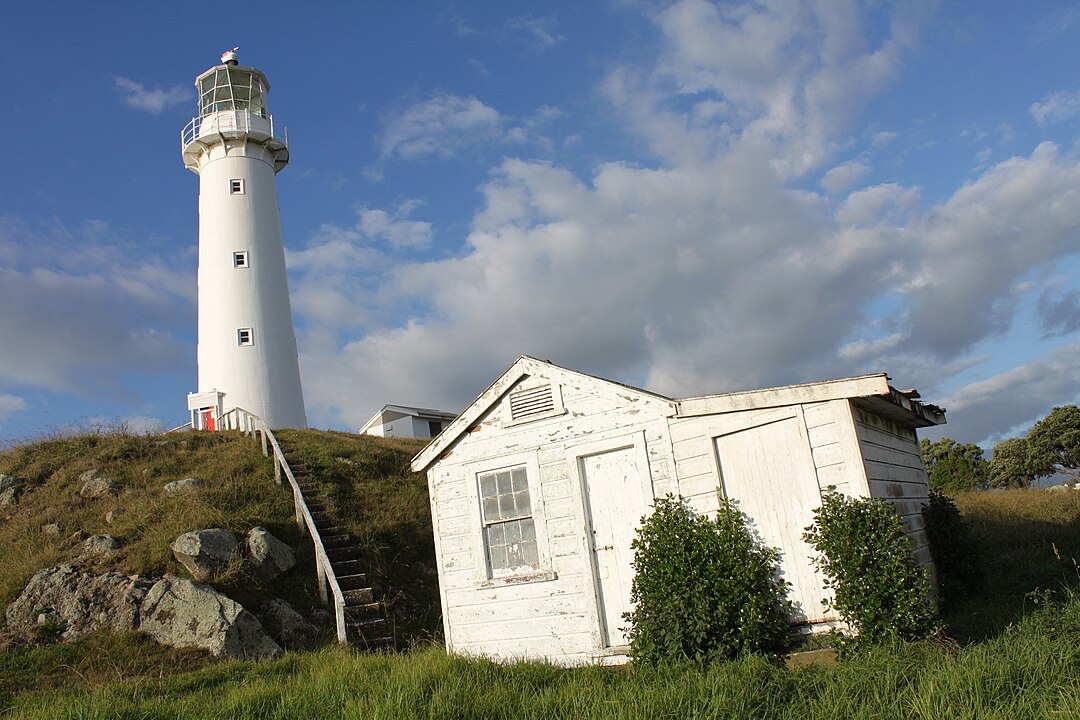
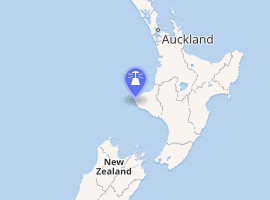
Bean Rock Lighthouse is a lighthouse situated at the end of a reef in the Waitematā Harbour in Auckland, New Zealand. It is the only remaining example in New Zealand of a wooden cottage-style lighthouse, and it is one of only a few remaining worldwide.[1] It is also the oldest wooden lighthouse and only wave-washed tower in New Zealand.[2] It is owned, operated and maintained by Ports of Auckland.[2]
The former Ponui Passage Lighthouse, near Ponui Island, had the same design as Bean Rock lighthouse and was also completed in 1871[8]Lighthouse keeper James Anderson in 1910Bean Rock lighthouse with Mission Bay in the backgroundAerial view of the lighthouse
History
The rocks were named Te Toka-o-Kapetaua by Māori, after Te Patukirikiri ancestor Kapetaua was abandoned on the rocks by his brother-in-law Tarakumukumu.[3] The European name, Bean Rock, was chosen in 1840, and named after Royal Navy Lieutenant P.C.D. Bean of HMS Herald, the master of the ship that carried out the first harbour survey of the Waitematā after the founding of the township of Auckland.[4]
Bean Rock lighthouse was built c. 1870 at a cost of 3,000 pounds and was first lit on 24 July 1871, using a kerosene lamp of 350 candlepower.[2] The location had been recommended by James Balfour and he did the early conceptual design work but was drowned in an accident before the design was completed. His design work was finished by James Stewart.[2]
Bean Rock was inhabited by lighthouse keepers and their families until 1912, when it was automated and the keepers were withdrawn.[2][5] The lighthouse keeper from 1909 to 1911, James Anderson, kept in contact with his family by sending Morse code messages by torch-light to his son who lived in Devonport.[4] In 1936, cable was laid from the Ōrākei wharf to the lighthouse and the light was run by electricity.[5] At the time, the beacon had a distinctive signalling sequence and a coloured light display to indicate the correct course to shipping in the channel.[6]
By the 1980s, the lighthouse was in poor condition due to corroded iron fittings and rotting kauri beams. Because of this, the Auckland Harbour Board decided that the lighthouse should be replaced with a religious sculpture or other significant piece of artwork.[5] The board later decided to keep the lighthouse due to the historical significance, and began to restore the structure.[5] In 1985, the lighthouse was restored, with new timber legs being sunk into new concrete foundations.[2] In the mid-1990s, the lighthouse was converted to solar power and synchronised with an automatic foghorn.[2]
Bean Rock lighthouse is listed under the Historic Places Act by Heritage New Zealand as a Category I Historic Place (number 3295).[7] As it is a working lighthouse, it is not open to the public
Model of the Bean Rock Lighthouse in Wynyard Quarter
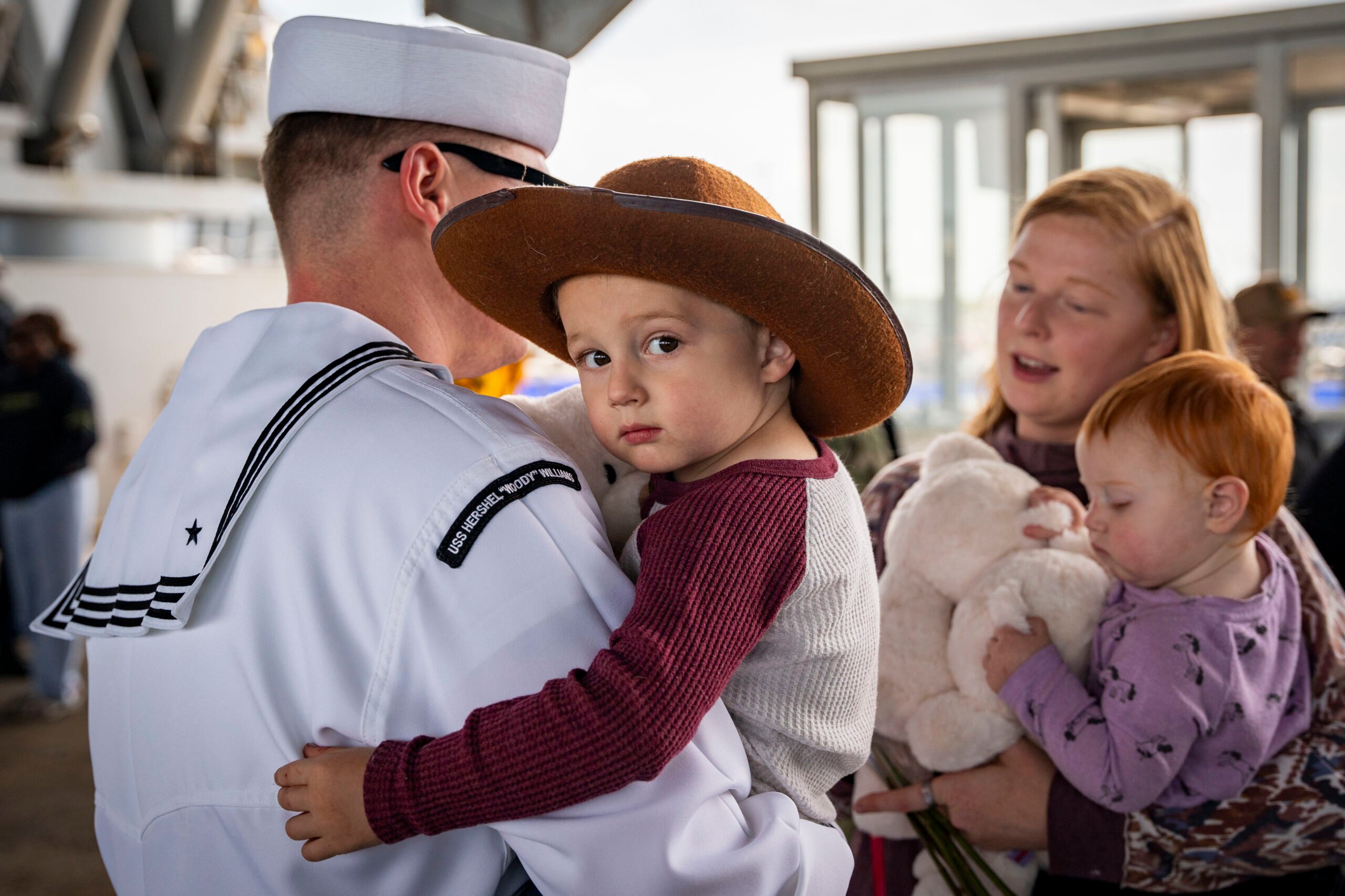
Operations Specialist 2nd Class Dakota Easley, assigned to the Lewis B. Puller-class expeditionary mobile base USS Hershel ‘Woody’ Williams (ESB-4), greets his family following the ships return to Naval Station Norfolk, April 10, 2025. U.S. Navy Photo
The Navy’s forward-deployed European and African sea base is back in the U.S. after almost five years and set for a maintenance period in Newport News, USNI News has learned.
USS Hershel “Woody” Williams (ESB-4) returned to the East Coast on Thursday after being stationed in Souda Bay, Greece, since 2020 and is set to begin a maintenance period, a Military Sealift Command spokesperson told USNI News on Monday.
“Williams returns to Norfolk’s waters with a hybrid-manned crew of 44 Military Sealift Command civil service mariners who operated, navigated, and maintained the vessel and 85 U.S Navy sailors,” reads a statement from the service.
USNI News previously reported that Williams and the U.S. Central Command-based USS Lewis Puller (ESB-3) were two ships MSC identified for potential layup to ease the stress on the civilian mariner force. Based on the design of an Alaska-class oiler, the ESBs are designed to serve as floating bases for both mine countermeasures and special operations forces. Capable of supporting helicopters as large as the CH-53E and the MV-22B tiltrotor, the ships have been in high demand both in CENTCOM and AFRICOM for a variety of missions.
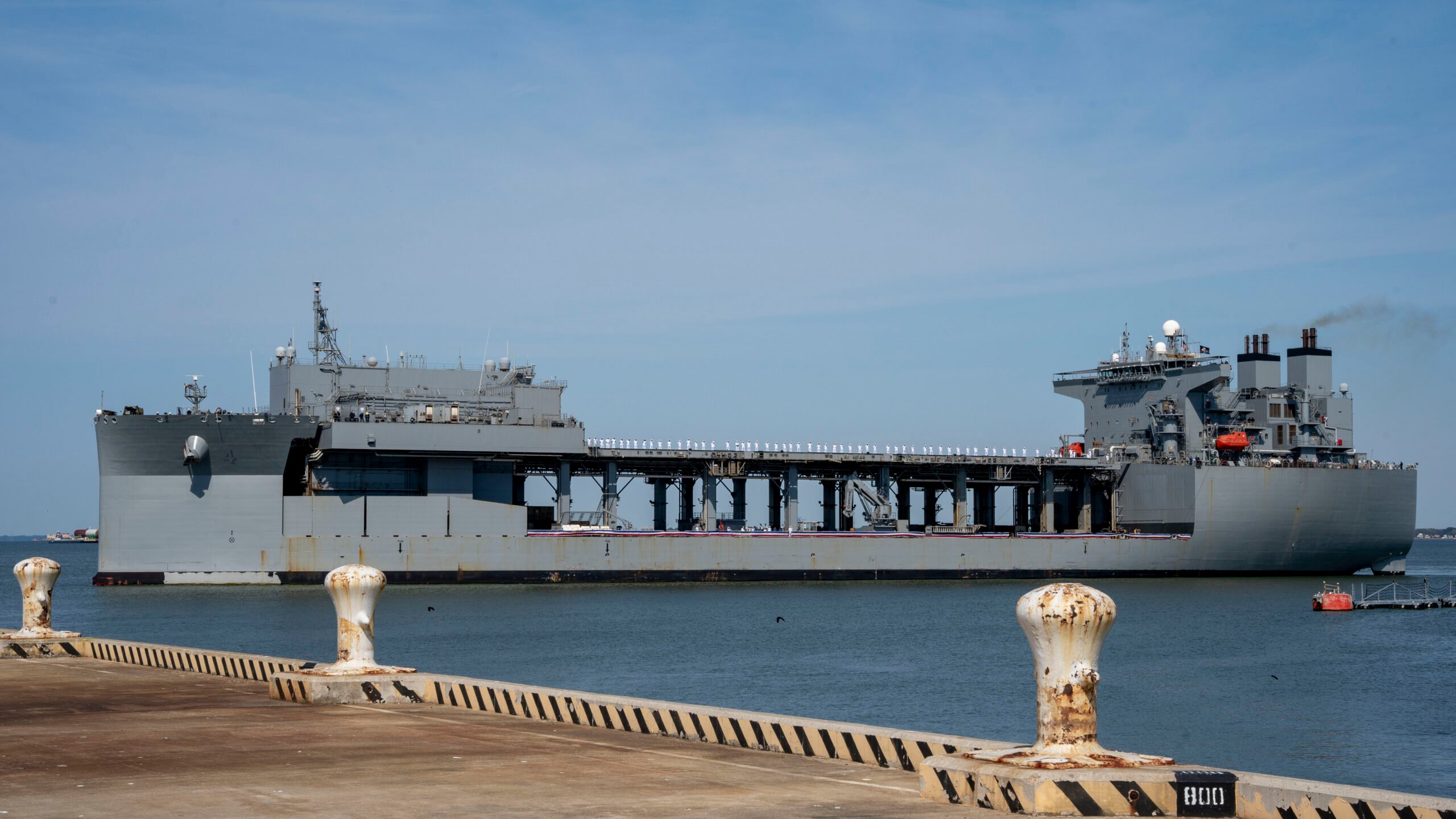
Lewis B. Puller-class expeditionary mobile base USS Hershel ‘Woody’ Williams (ESB-4) returns to Naval Station Norfolk, April 10, 2025. US Navy Photo
During its last patrol, Williams grounded off the coast of Gabon, which resulted in the removal of the ship’s commander.
The ESB regularly sailed off the coast of Africa, starting shortly after its initial deployment to the region, operating with smaller regional navies and coast guards that would otherwise not interact with a U.S. warship. The ship operated from Souda Bay with a hybrid crew of both Navy sailors and civilian mariners using alternating blue-gold crews like ballistic missile submarines, where two crews operate the same vessel to maximize operational time underway. “Williams will spend a week at Naval Station Norfolk, offloading her fuel before shifting to the East Coast Repair and Fabrication Shipyard in Newport News, Va., where she will be in lay berth awaiting her next tasking,” reads a statement from the Navy
The Navy has not announced a replacement for Williams.
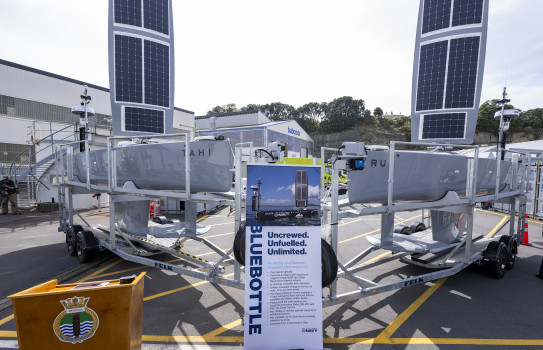
The New Zealand Defence Force (NZDF) and the New Zealand Customs Service have unveiled and named two new state-of-the-art Bluebottle uncrewed surface vessels (USVs) to help combat transnational serious and organised crime.
15 April, 2025
The two agencies have acquired the USVs to further enhance New Zealand’s ability to patrol and protect its maritime interests and security.
Minister of Customs Casey Costello, alongside Defence and Customs officials, attended a naming ceremony at Devonport Naval Base this afternoon. The USVs are named Tahi and Rua.
Built by Sydney-based Ocius Technologies, the USVs were purchased following a successful seven-month trial last year. During the trial a USV played a critical role in an operation to recover a steel box with 7kg of cocaine hidden on the hull of a commercial vessel heading to Auckland.
The 7.4-metre USVs use solar, wind or wave motion to power its monitoring systems and propulsion. It has a top speed of five knots and can operate at sea for a significant period of time before returning to shore. Its sensors include radar, electro-optic and infrared cameras.
Customs Deputy Chief Executive Operations Jamie Bamford says organised crime groups exploit the Pacific to smuggle drugs to New Zealand, and this additional capability helps counter that threat and protect our coastline.
“New Zealand’s maritime border faces growing threats from transnational serious and organised crime groups as they continue to focus on exploiting New Zealand and undermining the integrity of the international supply chain and trade routes.
“By investing in new technology that enhances our ability to monitor New Zealand’s vast maritime environment, and can operate at sea for extended periods, USVs represent a, practical, cost-effective and future-ready capability to help protect New Zealand’s interests.
“These vessels enable Defence and Customs to monitor in real time. This live intelligence strengthens our ability to better understand situations and enforcement requirements and enable faster decision-making. This allows Customs, Defence and our agency partners to respond more effectively.”
The two USVs, Tahi and Rua.
NZDF Maritime Component Commander, Commodore Shane Arndell, says the USVs are an important part of the Defence Force’s move towards smarter, more sustainable surveillance methods.
“From the outset, the success of the USV trials has come down to strong cooperation across agencies. The technology gives us a clearer maritime picture and helps improve safety and security in challenging environments.
“The addition of Tahi and Rua to the fleet will extend our reach and maintain a persistent watch over our waters and further afield.”
RFA Tidespring deployed on the CSG 21 deployment with HMS Queen Elizabeth, and will now join HMS Prince of Wales for CSG 25 (Picture: Royal Navy)
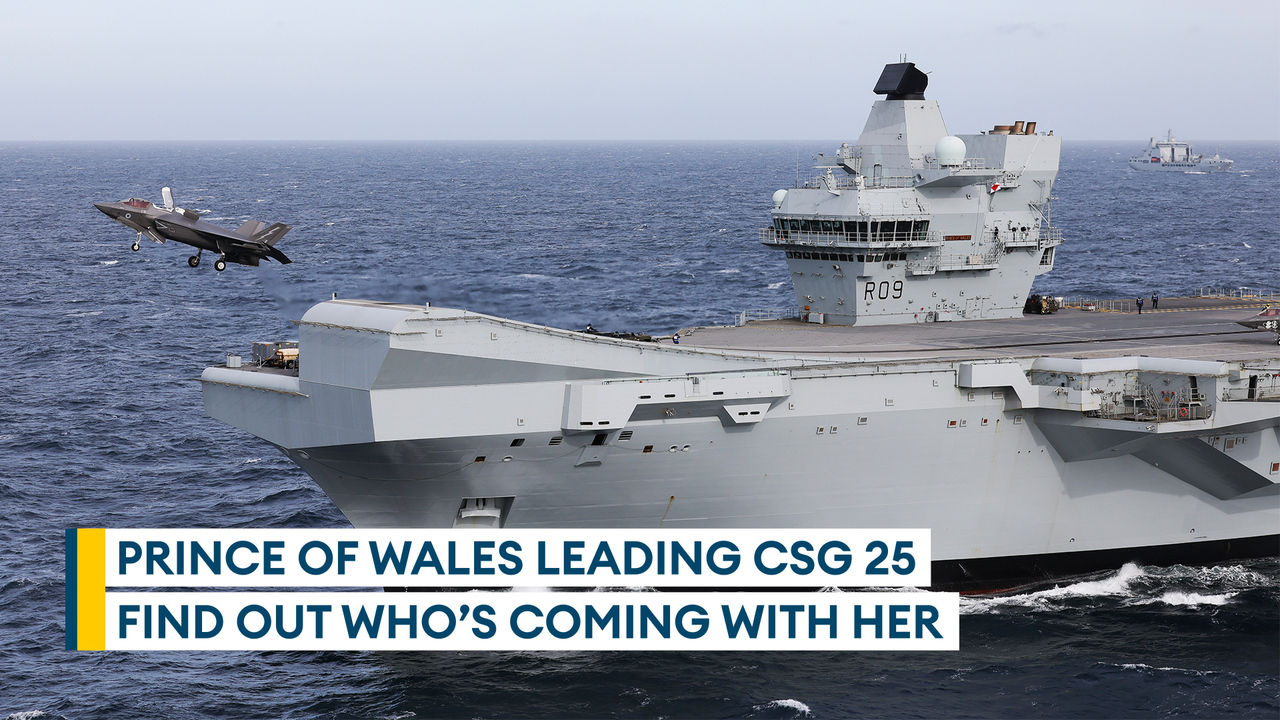
The crew of Royal Fleet Auxiliary tanker RFA Tidespring are getting ready to deploy alongside HMS Prince of Wales on the Carrier Strike Group 25 (CSG 25) deployment.
It is the Royal Navy’s biggest deployment for four years, and the Tide-class vessel, one of four large oilers built specifically for such missions, is assigned to the Carrier Strike Group.
HMS Prince of Wales will lead the deployment, heading for Japan and Australia during an eight-month-long mission.
RFA Tidespring is now part of the support element of the deployment, which also sees a Norwegian variant of the Tide ships, HNoMS Maud, joining the group.
The 39,000-tonne ship has spent most of 2025 in Birkenhead undergoing maintenance and upgrades to prepare her for the mission.
This includes specialist biofouling work on the hull to make sure no invasive species are transferred by the ship to other parts of the globe.
In addition, the ship and her crew have undergone extensive training off the south coast.
Commodore Sam Shattock, head of the RFA, said the service has a “proud history” of supporting operations for the Navy and partners, and this deployment will be no different.
“The RFA will play its part during the Carrier Strike Group deployment to sustain the UK’s expeditionary maritime and security capabilities in key strategic regions; reinforcing our nation’s presence and support to international partners,” he said.
“I wish the supporting RFA ships and people all the best for the deployment and look forward to welcoming them home at the end of the deployment.”
Watch: What we know about the vessels making up CSG 25
Without the RFA, the Navy would be largely confined to domestic waters, with warships relying on the auxiliary fleet for fuel, ammunition, spare parts, water, engineering support and much more.
This is all provided ‘on the go’, without the ships having to put into port every few days.
The ships and aircraft are expected to use 45 million litres of fuel, with the participating warships alone expected to sail more than 33,000 miles.
At 39,000 tonnes, the Tide-class ships are second only to the Royal Navy’s carriers in size and were built specifically to support the strike groups.
When fully laden, the tankers carry 19 million litres of fuel for ships and aircraft, more than enough to fill seven Olympic-sized swimming pools, and can deliver upwards of 800,000 litres in an hour – enough to fill the tanks of more than 14,500 family cars.
The ships also carry more than one million litres of fresh water and there is space for up to eight shipping containers of spare parts, disaster relief kits, and food.
The flight deck is large enough for all UK military helicopters and the hangar can accommodate a Royal Navy Merlin or Wildcat – they frequently embark to support frontline operations, which include submarine hunting, targeting drug smuggling and providing aid after a natural disaster.
And given the size of the deployment, the regular crew of around 60 will swell to more than 100 for much of the time away.
Instead of 1,300-plus meals per week, the team in the galley will be expected to serve up more than 2,100 at peak times.
In the later stages, the helicopter support vessel RFA Argus, which has the UK Armed Forces’ sole large hospital facility afloat, is also set to take part.