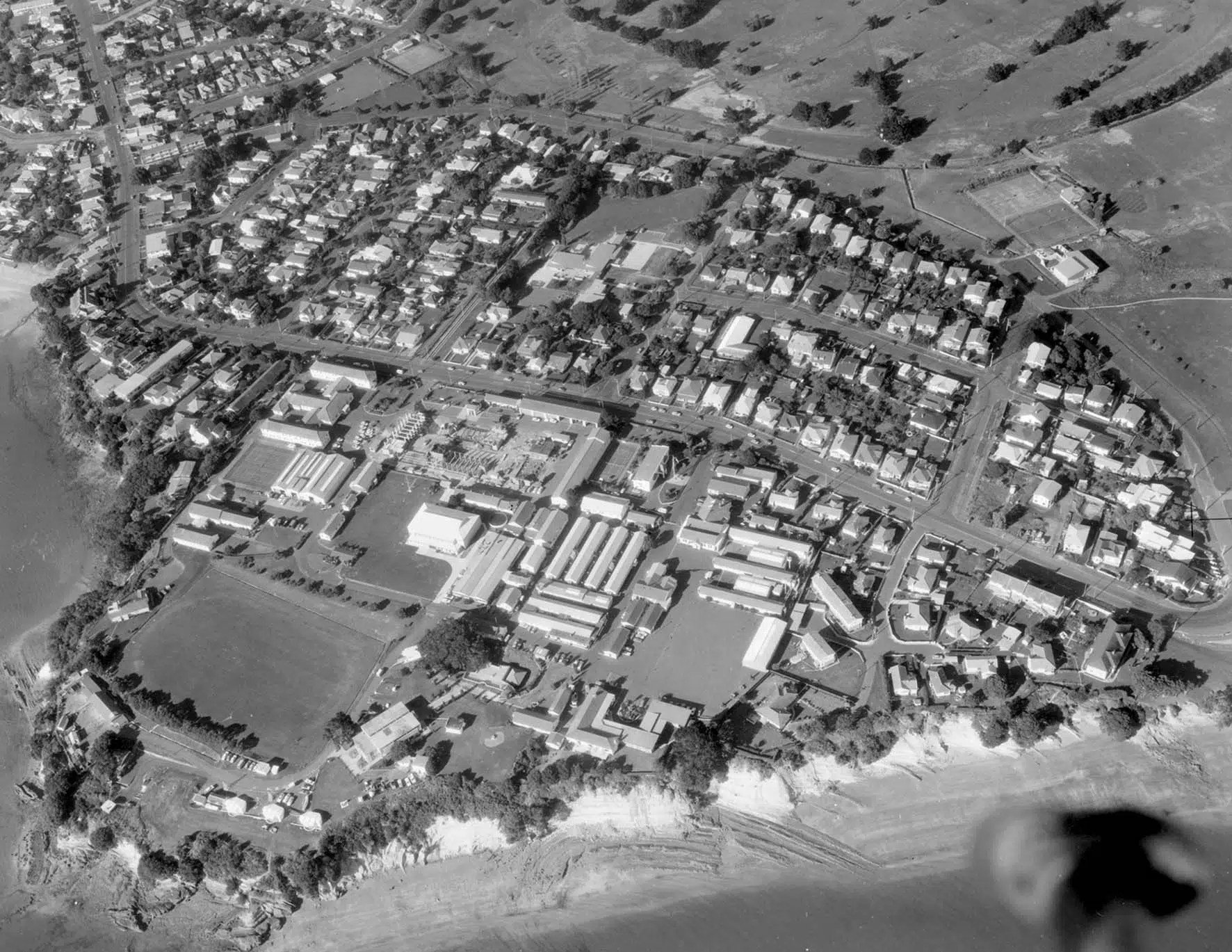
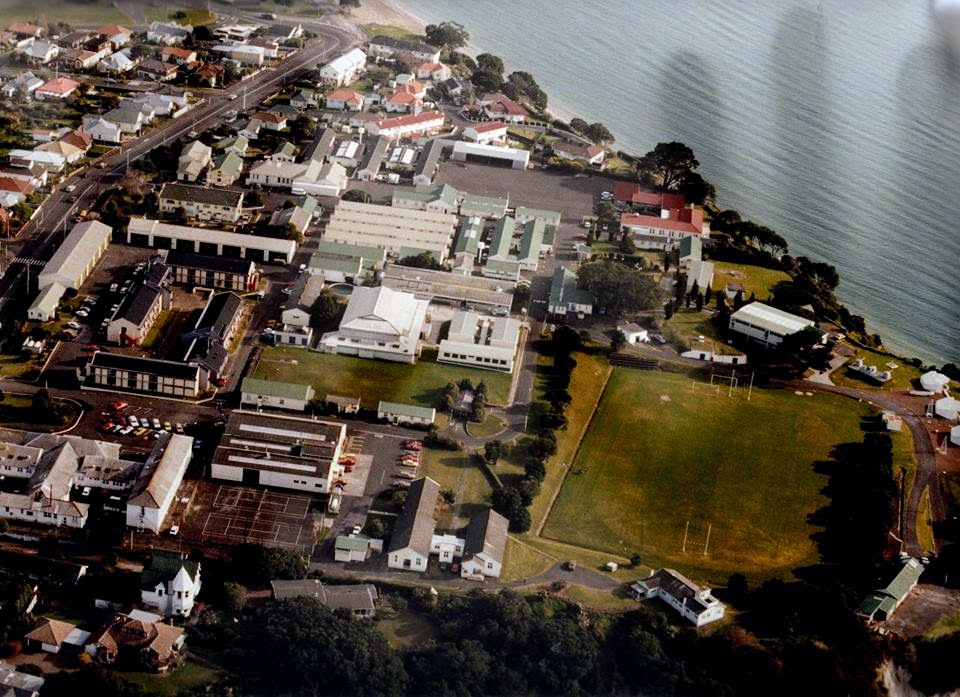
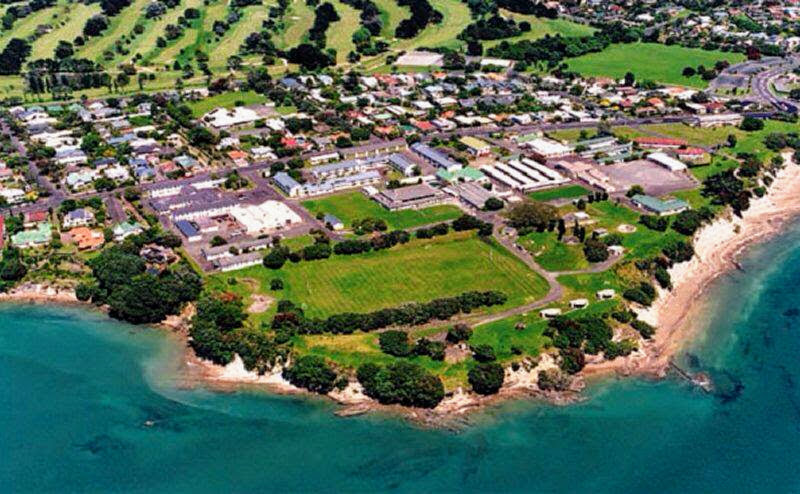
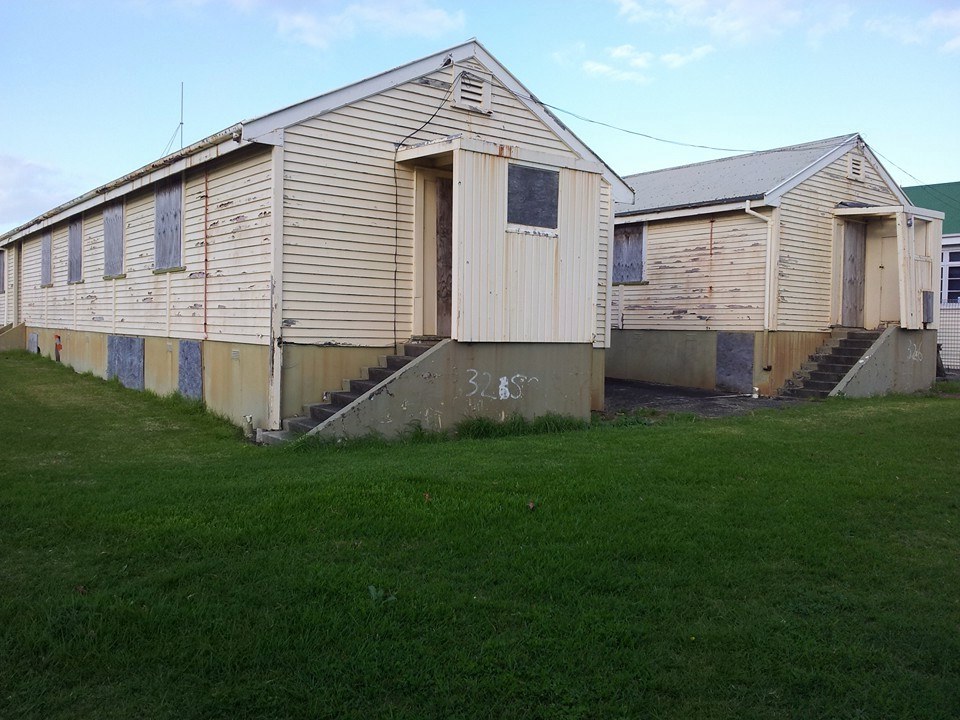
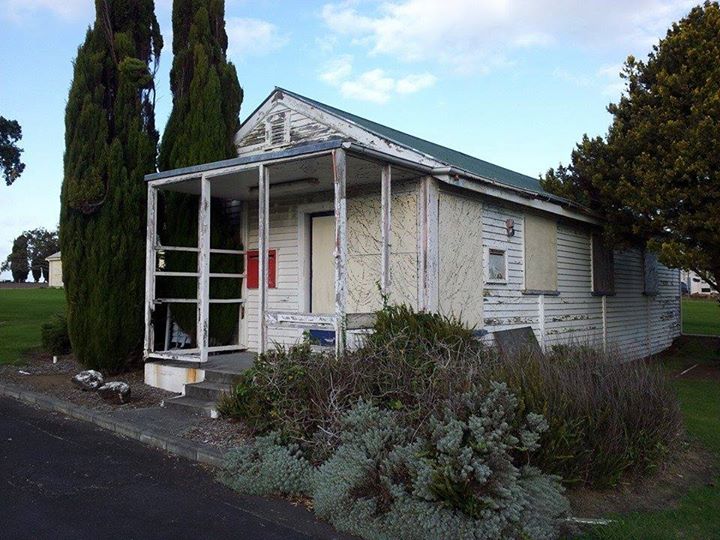
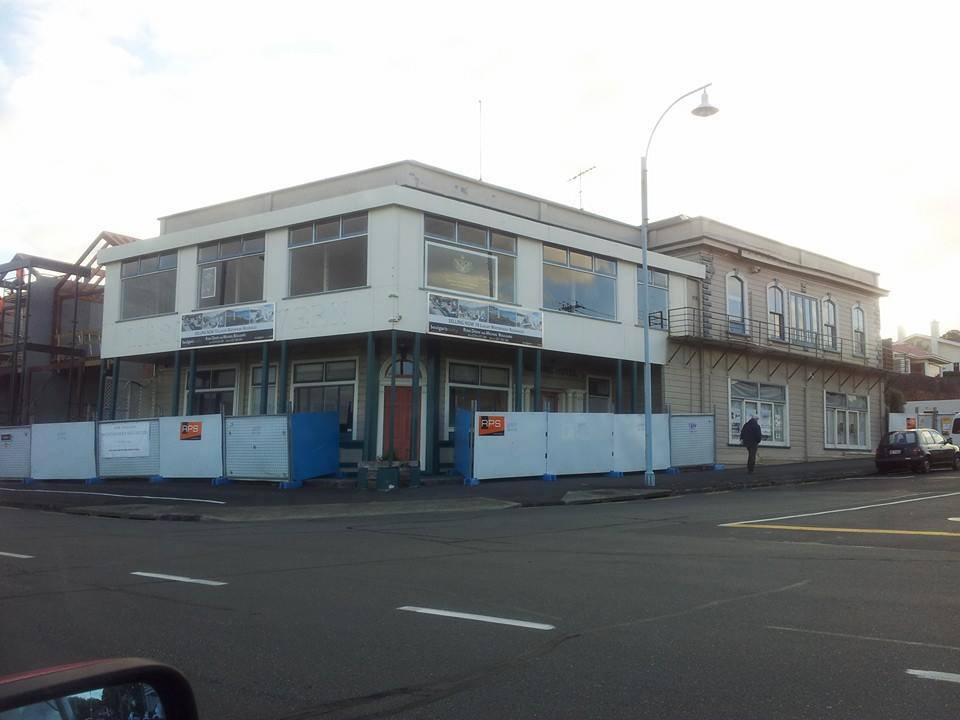
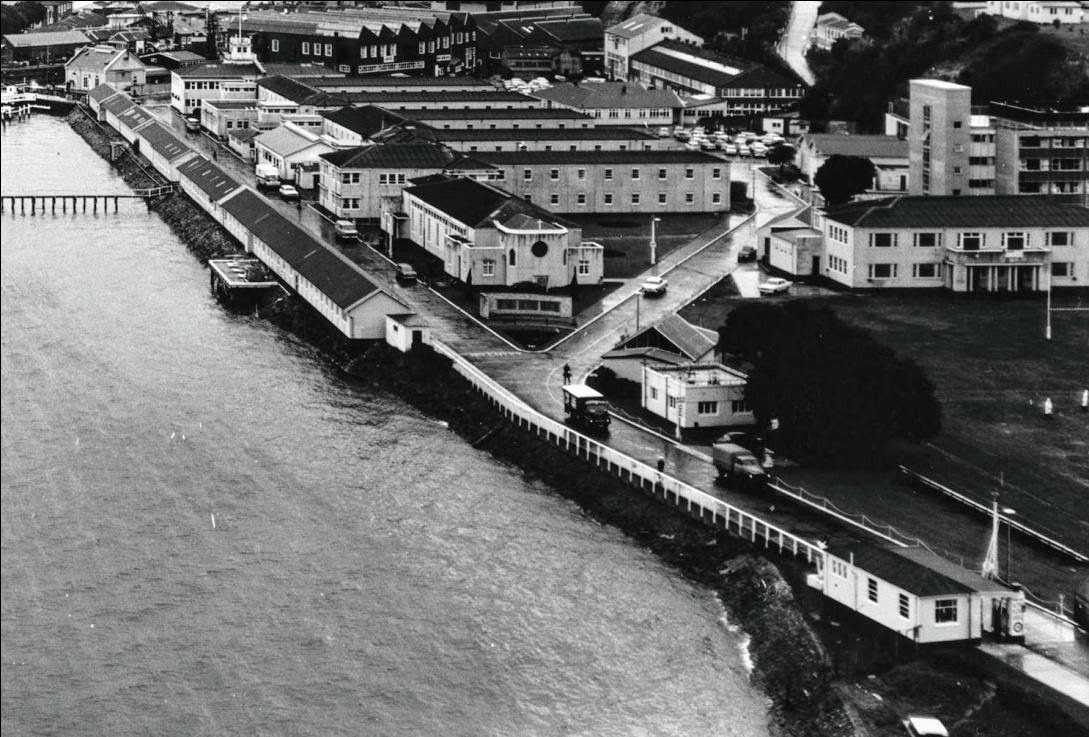
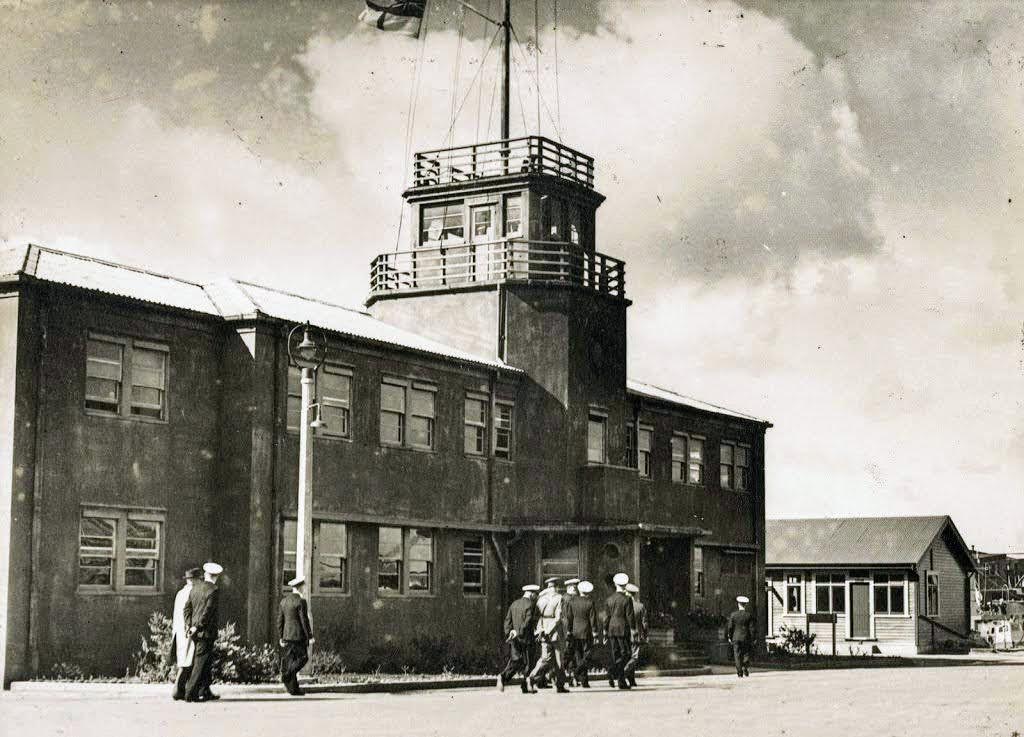
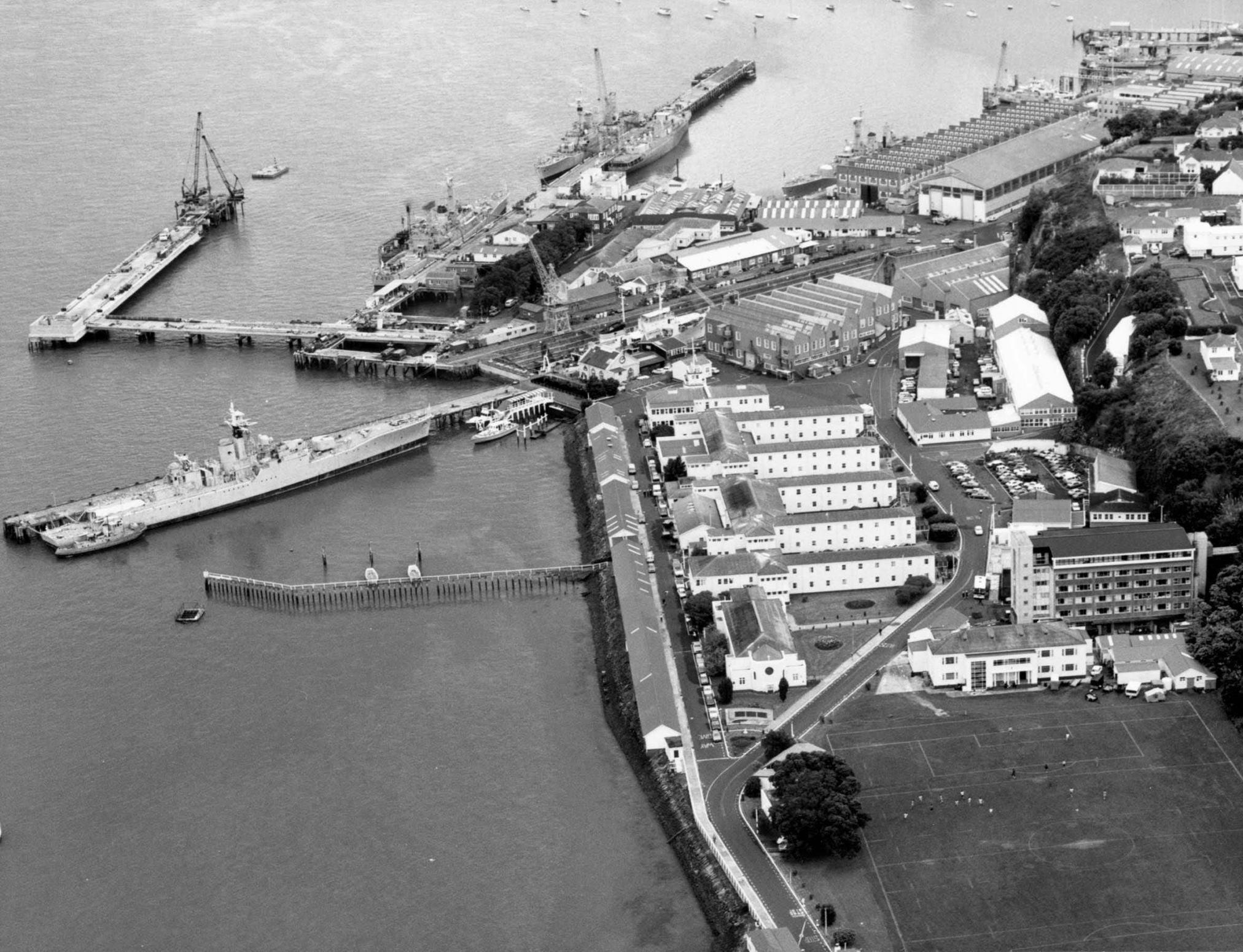
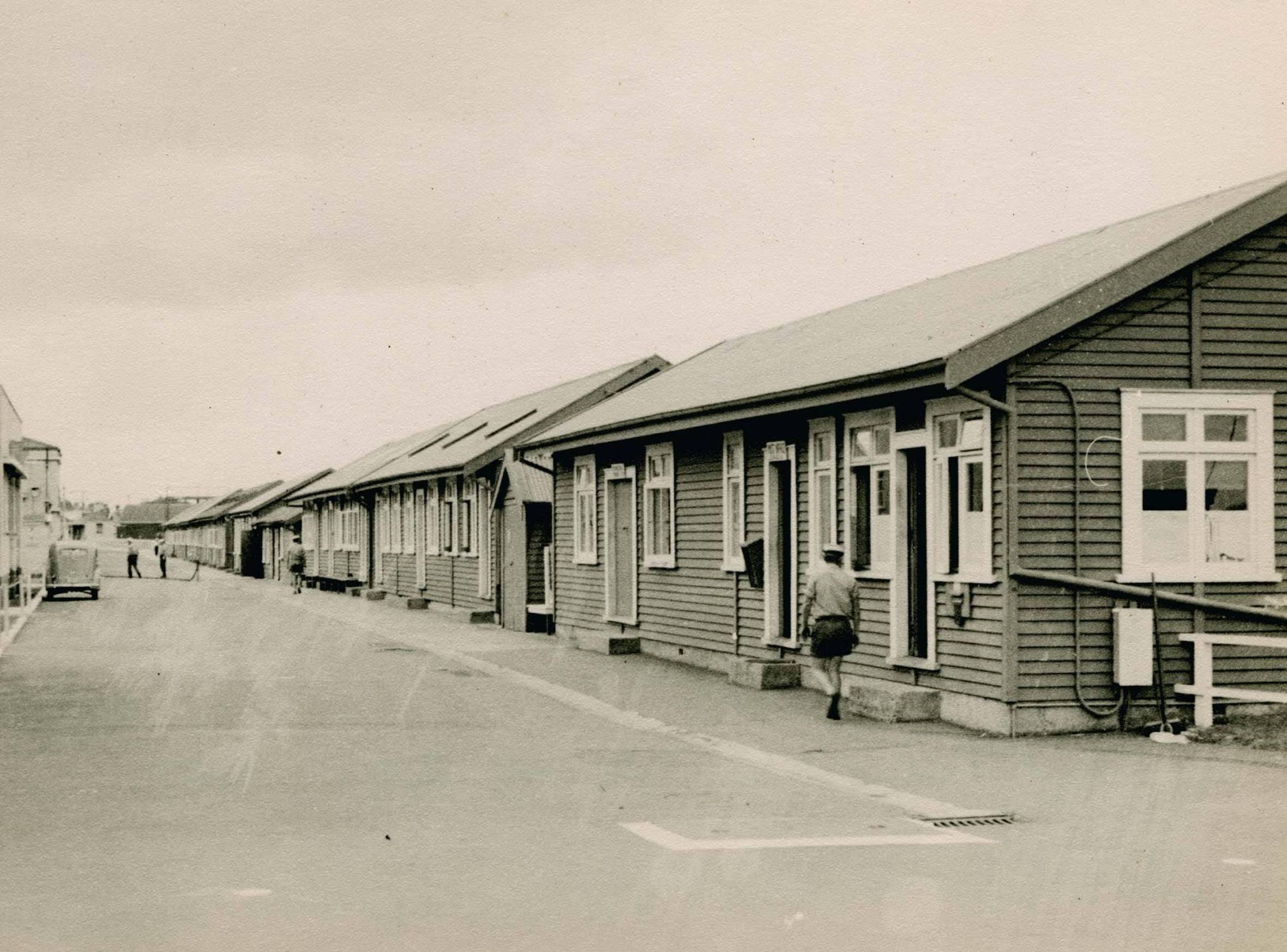
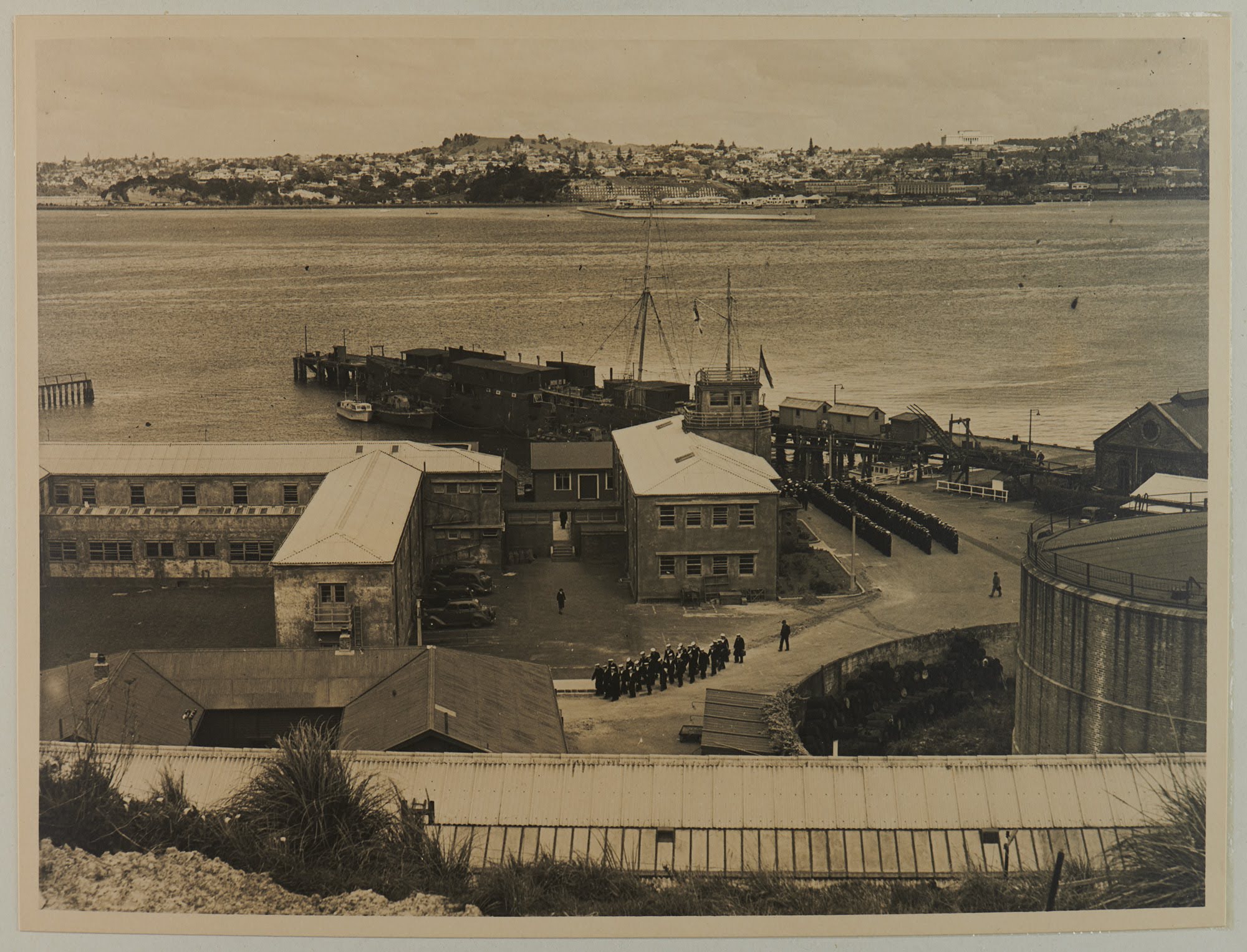
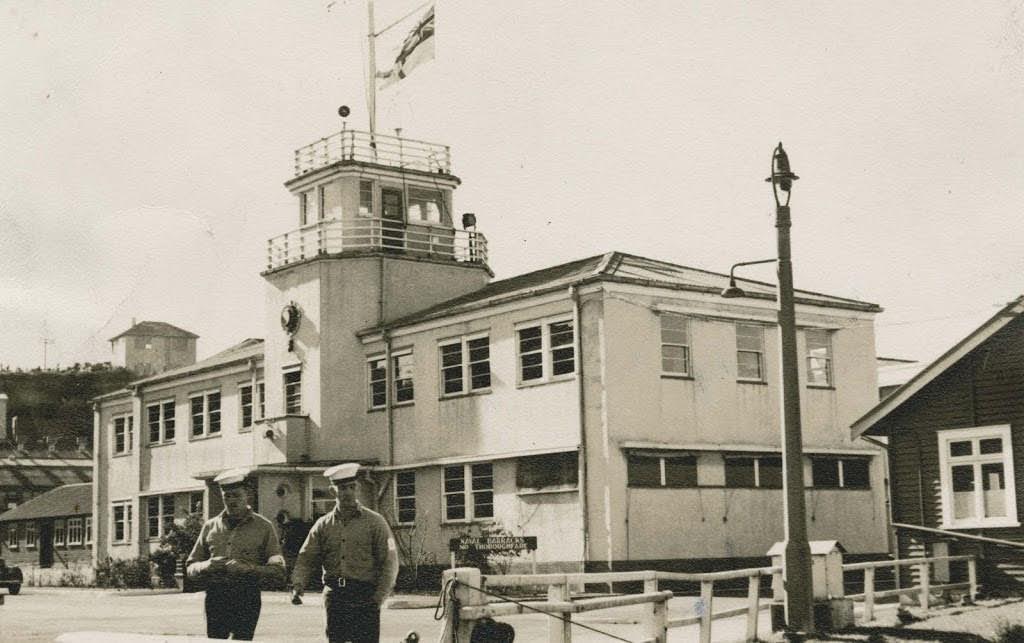
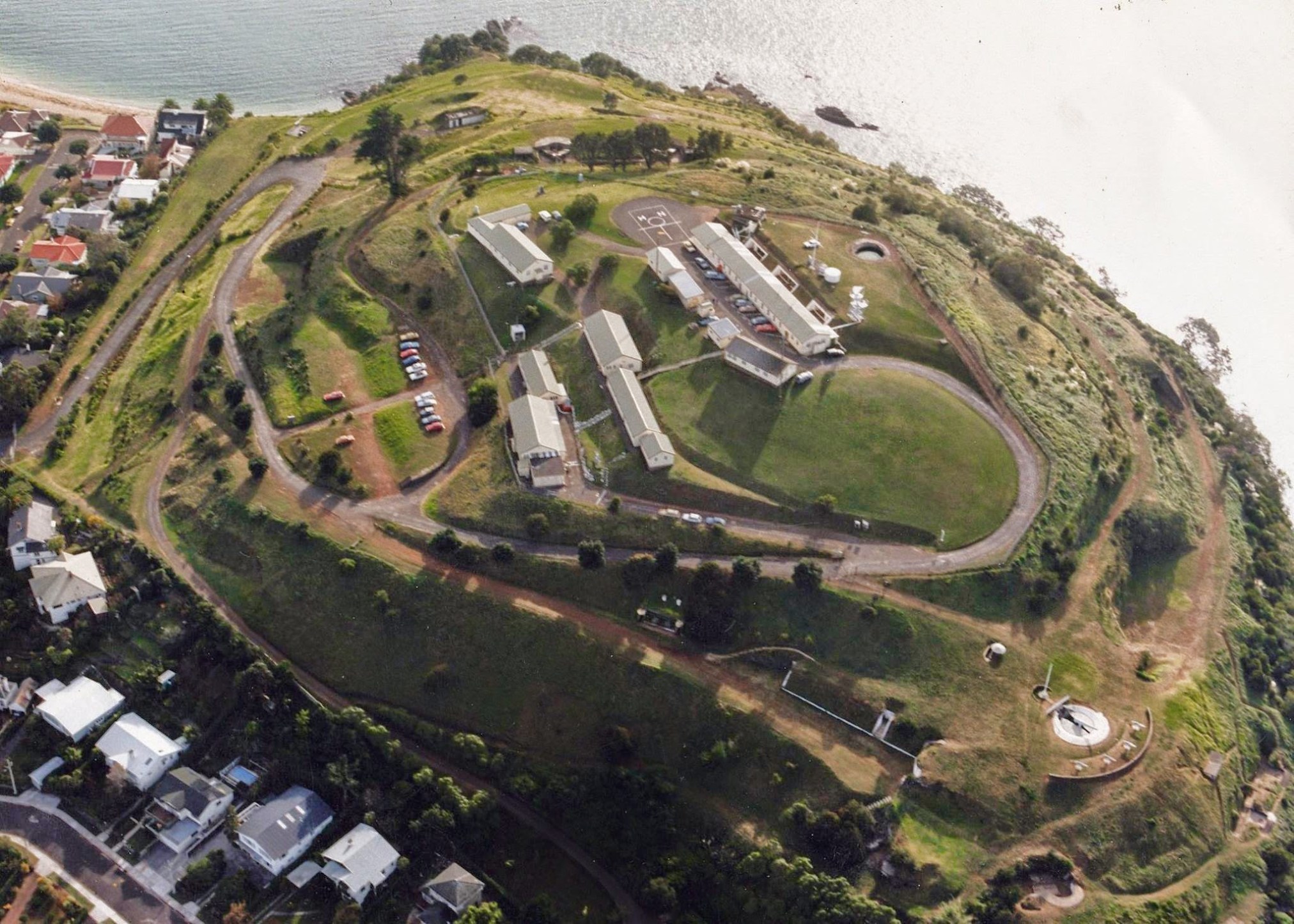
Aerial view of HMNZS Tamaki and Fort CautleyHMNZS Tamaki, Narrow Neck, AucklandDerelict dormitoriesHMNZS Tamaki – Narrow Neck – QM Lobby and Reg OfficeHMNZS Tamaki – Narrow Neck – The War Office (Masonic Hotel)
History of Fort Takapuna
The Royal New Zealand Navy’s real association with Narrow Neck dates from 1963, when the Training establishment, HMNZS Tamaki, moved into some surplus Army space.
At that time there was still a strong army presence, in fact during the flag raising ceremony on 26 September, of what was to become the Administration Block, just inside the main entrance, was still divided into flats and the slightly bemused residents watched the ceremony from their windows.
It was, however, a naval threat that caused this fort to be constructed. It was part of a series of defences erected at the main ports, to defend them against a possible raid by an enemy cruiser.
The result of such a raid was highlighted in a report published in The New Zealander, the major newspaper of the day, when it reported that Auckland had been shelled by a Russian cruiser, much damage had been done to the business district and Russian sailors had landed and looted shops.
In those days before the telephone and mass communications, this report caused considerable alarm and many thought the Empire would go to war.
That is until the phonetics of the name of the Russian ship were realised – it read “Case of Whisky”.
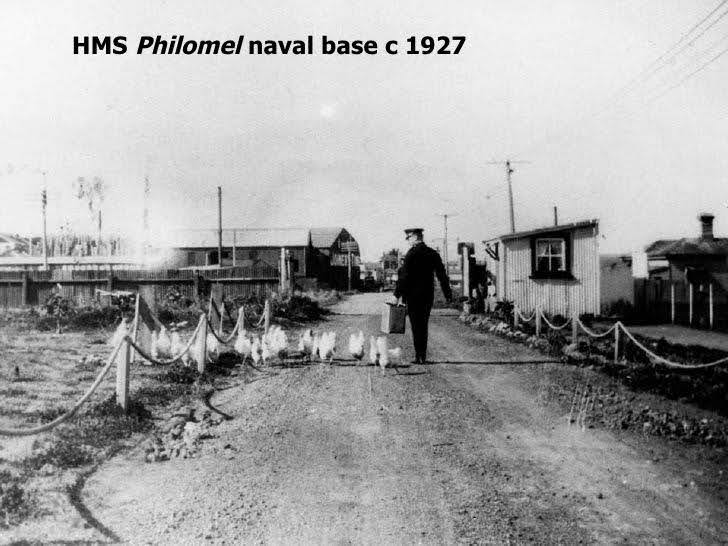
The Navy first came to Fort Takapuna in 1927. By that time the fort was obsolete and not required by the Army.
It was used to house ammunition for cruisers. Previously it had been stored at Mount Victoria and then North Head, but by then the storage of explosives at Mount Victoria was considered unacceptable by both the Defence Department and the residents, and the North Head magazines were required by the Army.
In addition to actually storing the explosives, there was a requirement to test various parts of the ammunition, and a proofing building was constructed alongside (under the Morton Bay Fig Tree).
As had been experienced from the first days of the fort, there were several drawbacks to using this facility. It is readily prone to flooding – even with the best of maintenance.
It was with much rejoicing that in 1936, the Navy moved its explosives to a new, purpose-built facility in a sparsely populated area of the North Shore – Kauri Point.
While the Navy moved, the Army remained.
During the Second World War there was much activity in the area surrounding the fort and over on the southern side of the playing field, a monitoring station for the fixed anti-submarine defences of Auckland – Station Puna – was built.
With the end of the war, the Navy again vacated the area returning in 1963.
At that time the old quarantine station on Motuihe Island, which had been built around the turn of the century was in urgent need of serious maintenance and rebuilding. With all factors taken into consideration, it was decided that Navy would share the surrounding facilities with the Army.
Although there were periodic conflicts of interest, the relationship was generally satisfactory. With periodic reorganisations of the Army, its presence was gradually reduced, until at last only the Officers’ mess remained an Army facility, although run entirely by the Navy.
For most of the time the fort itself was locked up, but for a short time it was used as a recreation space for some of the senior trainees.
Over the years there were several efforts to vest ownership of this fort to the local authority, but for a variety of reasons, this was not possible until 2000.
1958
Narrow Neck Military Camp renamed Fort Cautley – continued the name with vacation of the Army from North Head 1958
1963
The Royal New Zealand Navy relocated HMNZS Tamaki from Motuihe Island – flag shift 26 September. Base Jointly operated. Additional accommodation moved in to provide for Basic Common Trainees. Work was completed by Army Engineers.
1993
First RNZN units move to Ngataringa Bay . Basic Common Trainees to North Yard HMNZS Philomel.
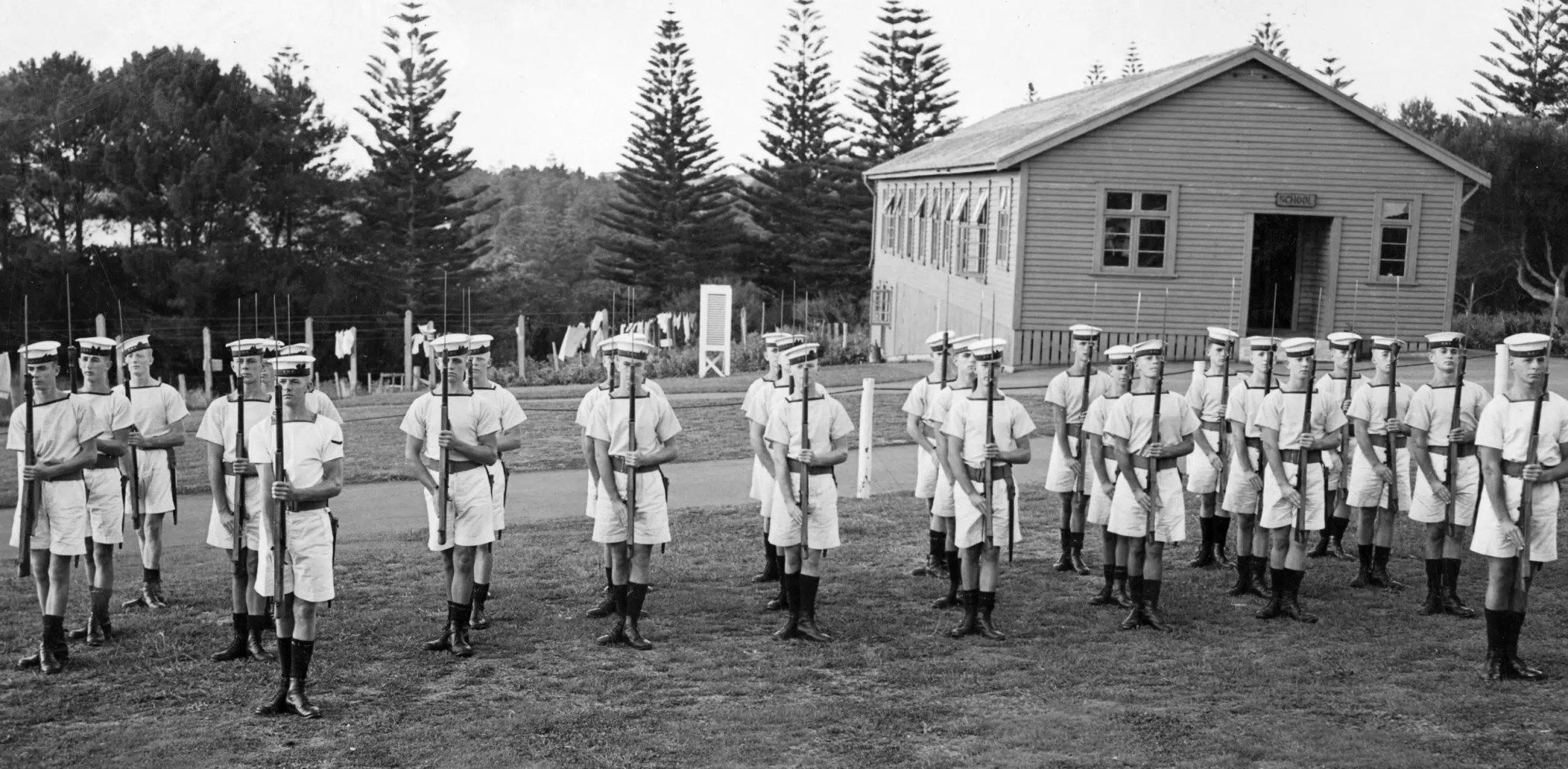
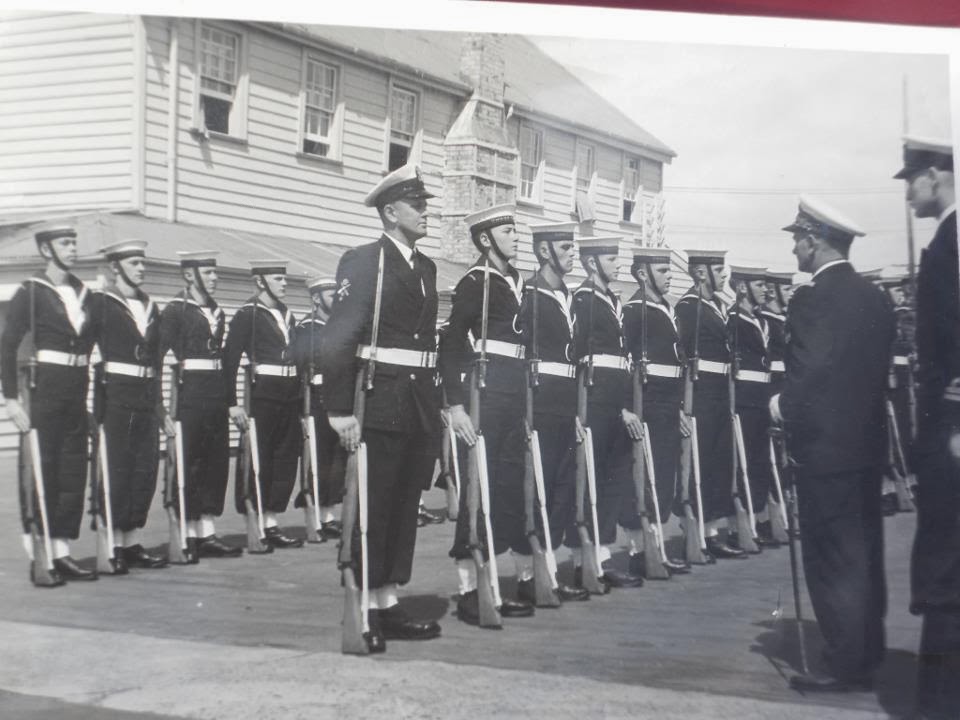
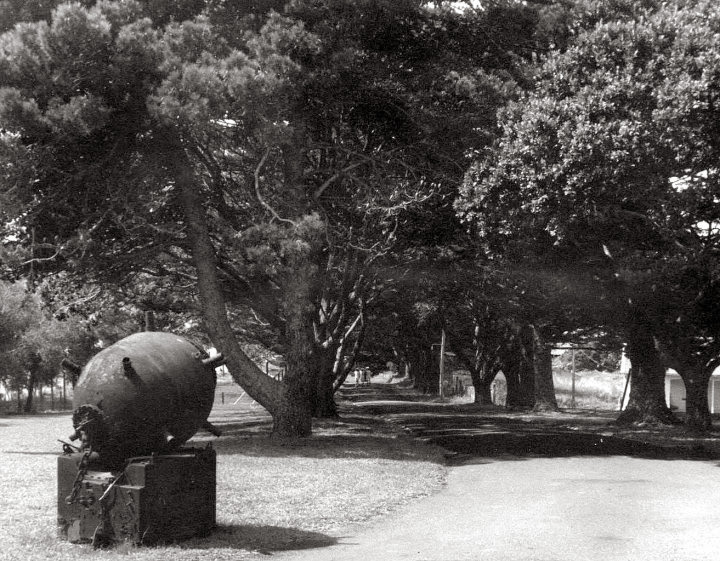
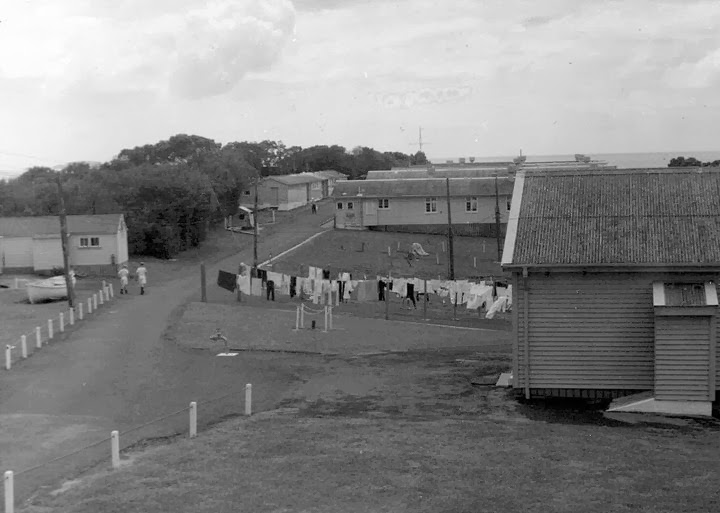
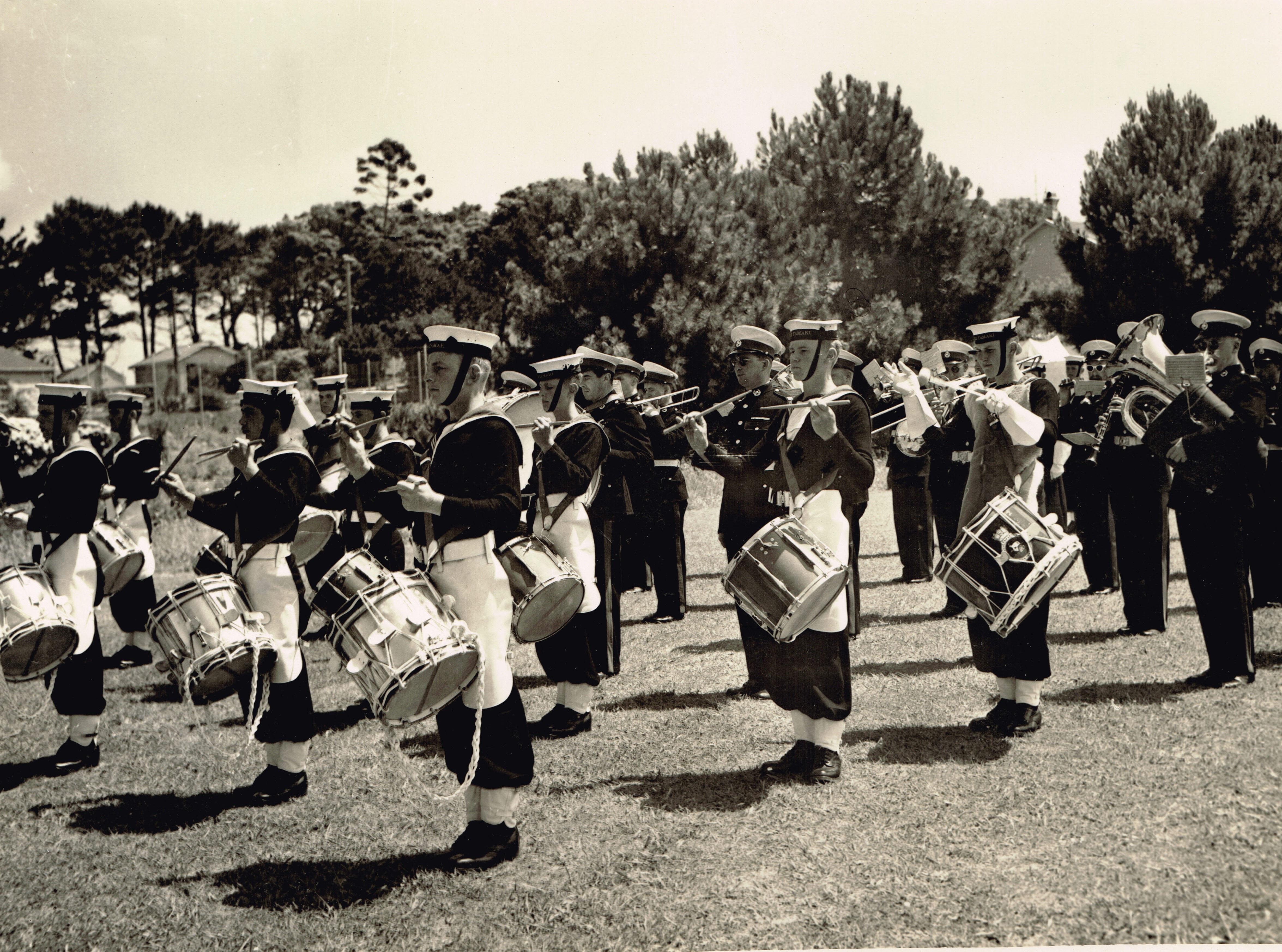
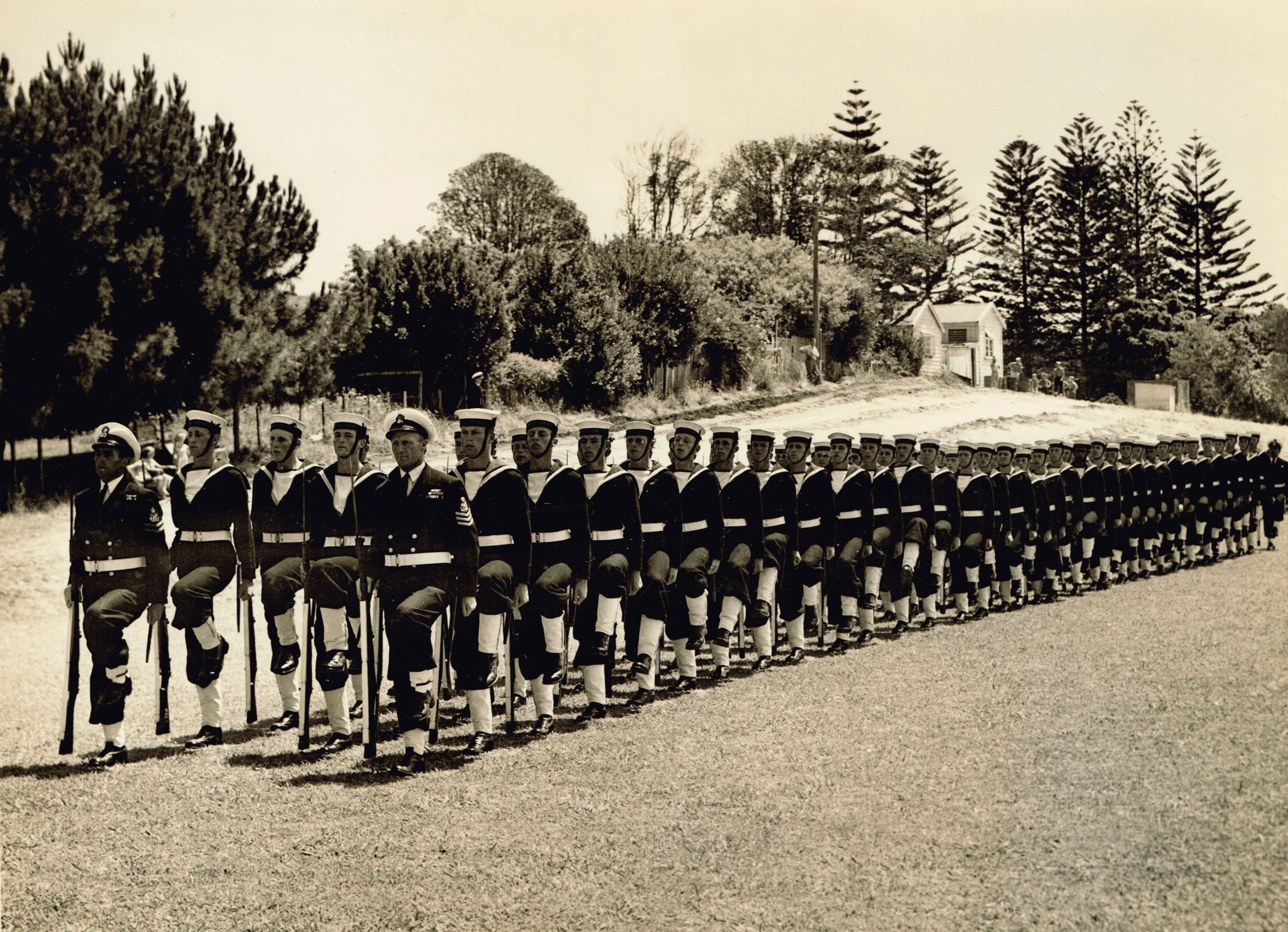
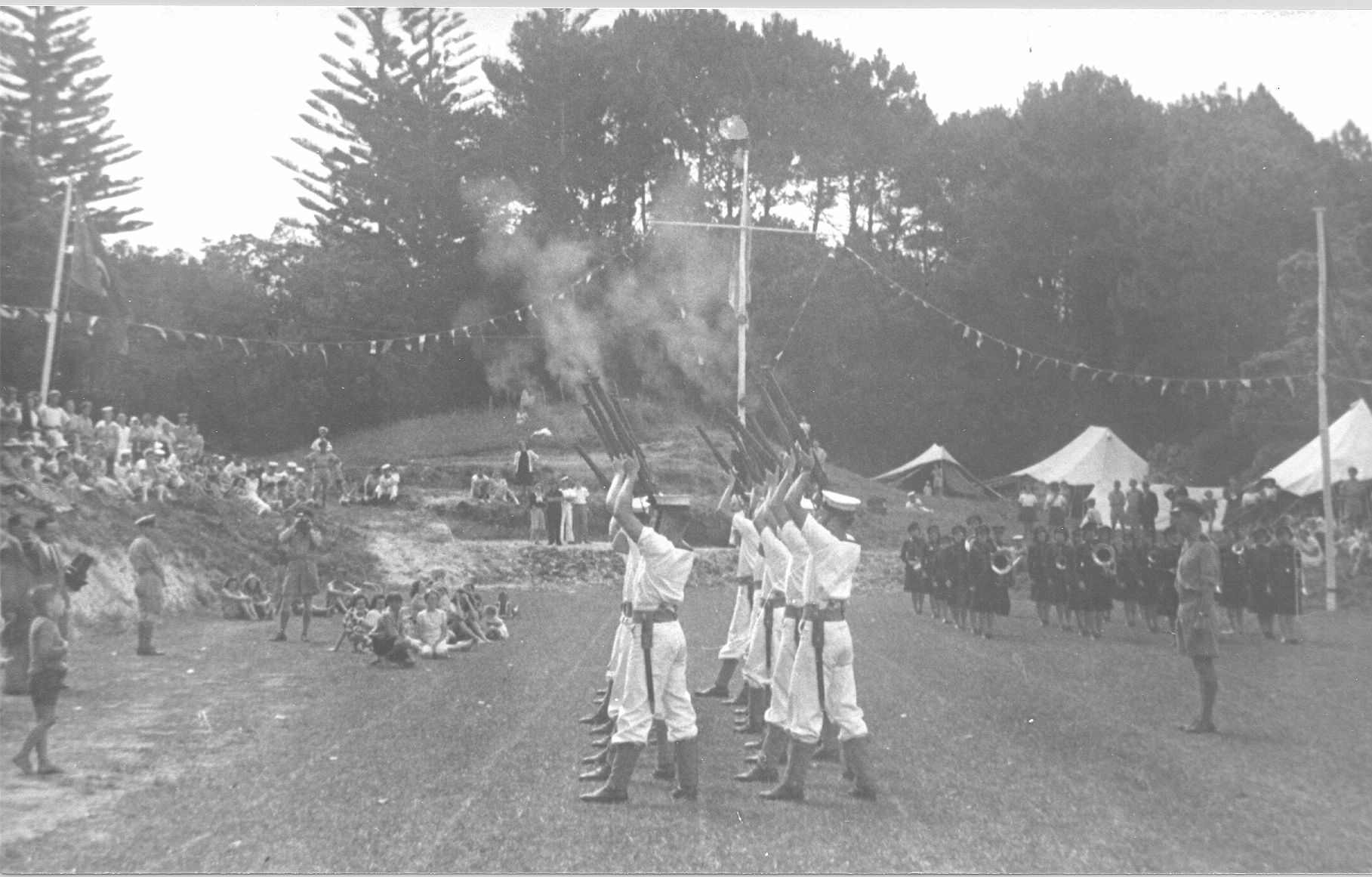
Seaman Boys Class 31 – 1945HMNZS Tamaki – Motuihe Island 1960, passing out Guard – Familiar faces and probably Jack Baigent the most familiar and of course Basil Rutherford, front and centreHMNZS Tamaki – Motuihe Island 1960, passing out Guard – Familiar faces and probably Jack Baigent the most familiarHMNZS Tamaki – Motuihe Island 1960, passing out Guard – Familiar facesHMNZS Tamaki – The Quarterdeck, HMNZS Tamaki on Motuihe Island, near Auckland New ZealandHMNZS Tamaki – A mine, at the bottom of the hill leading up to HMNZS TamakiHMNZS Tamaki – I was here in 1959,our dormitory (Nelson) was the second to last on the right – buildings far left were bathrooms
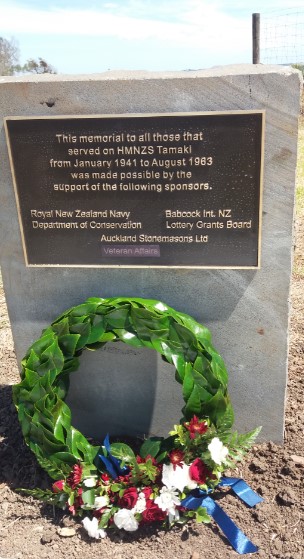
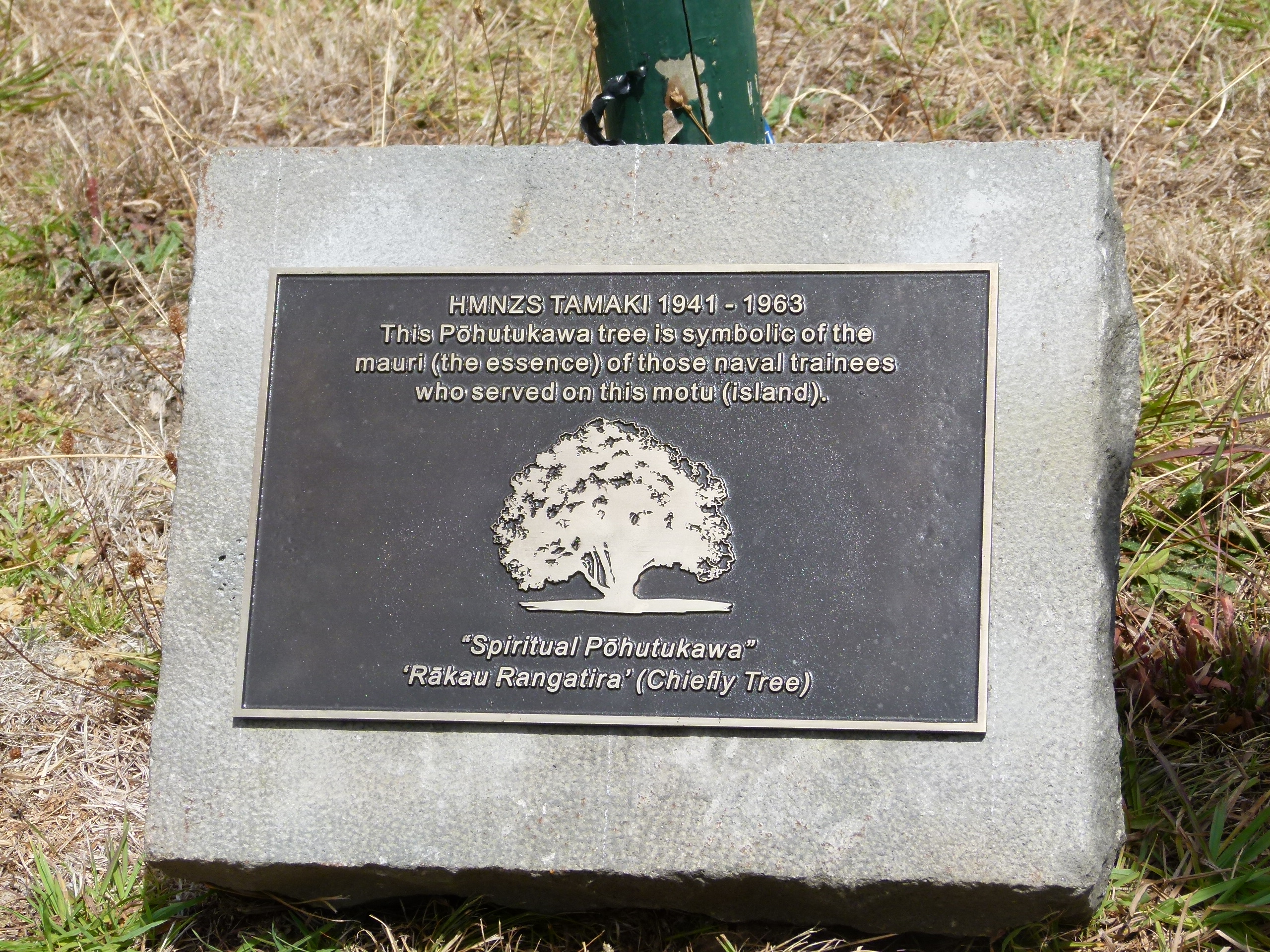
“The Rock” Reunion On 14 February 2020 an event was held on Motuihe to remember all the men who served in the Navy on Motuihe. A large group of veterans (approximately 250) traveled to the island on a vehicular ferry which landed them on Ocean Beach. They took part in a ceremony to unveil two memorial plaques honoring the men who served on the island. The plaques are located at the site of the original flag pole which was at the centre of the navy base. The men affectionately called Motuihe Island “The Rock”.
The two plaques commemorating the men who served in the navy on Motuihe. The bottom plaque has a pohutukawa tree in front of it planted as a living memorial. (click photo to enlarge)
Naval Period 1941-63
With the outbreak of World War II and the urgent need to train more naval personnel, the buildings at the northwest headland on Motuihe were converted into a navy training establishment during 1941, named HMNZS Tamaki.
Motuihe Island was considered an ideal site for a naval training establishment: it was close to Auckland, yet separate from its distractions, provided facilities, and had a beautiful physical setting.
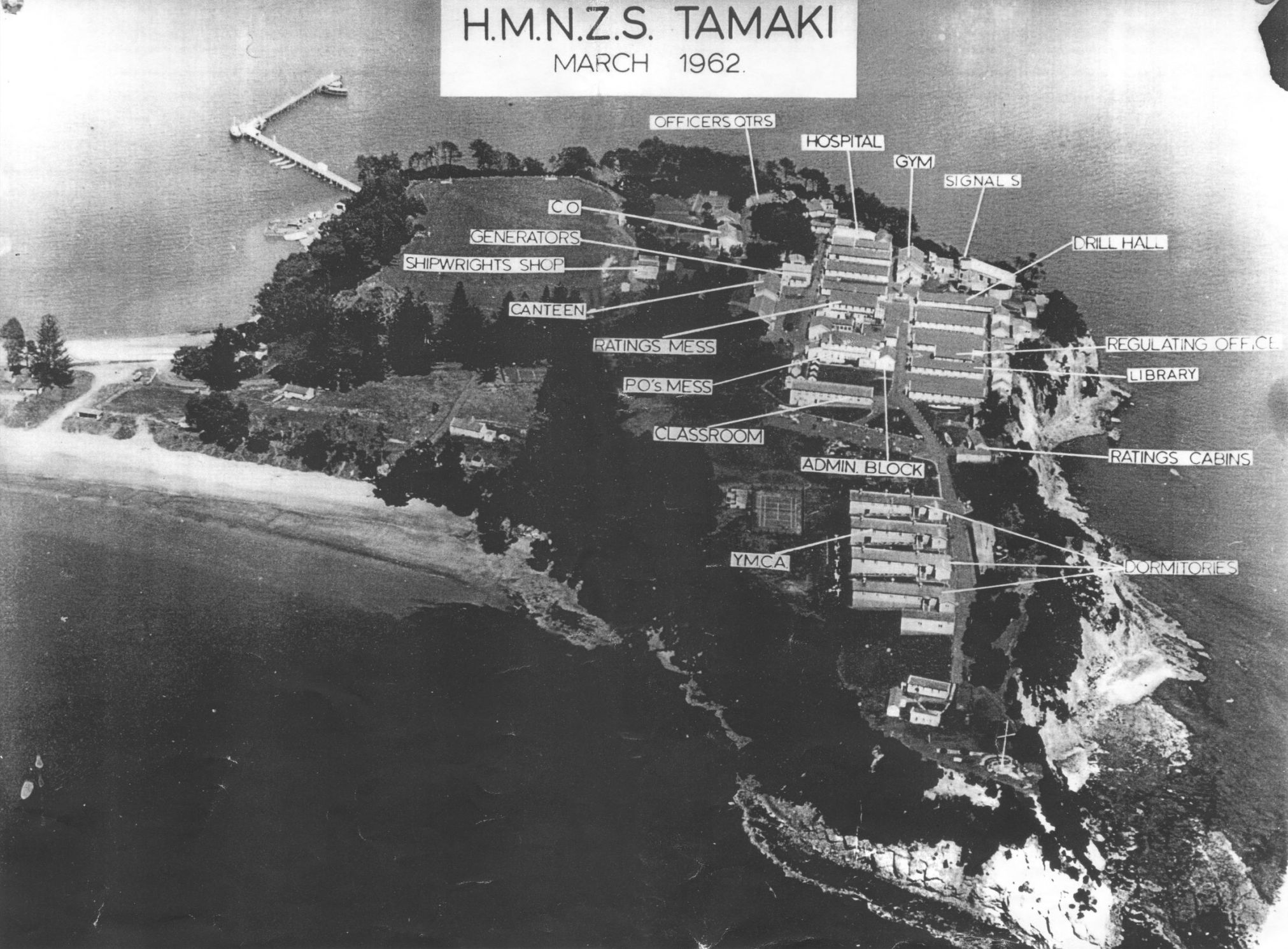
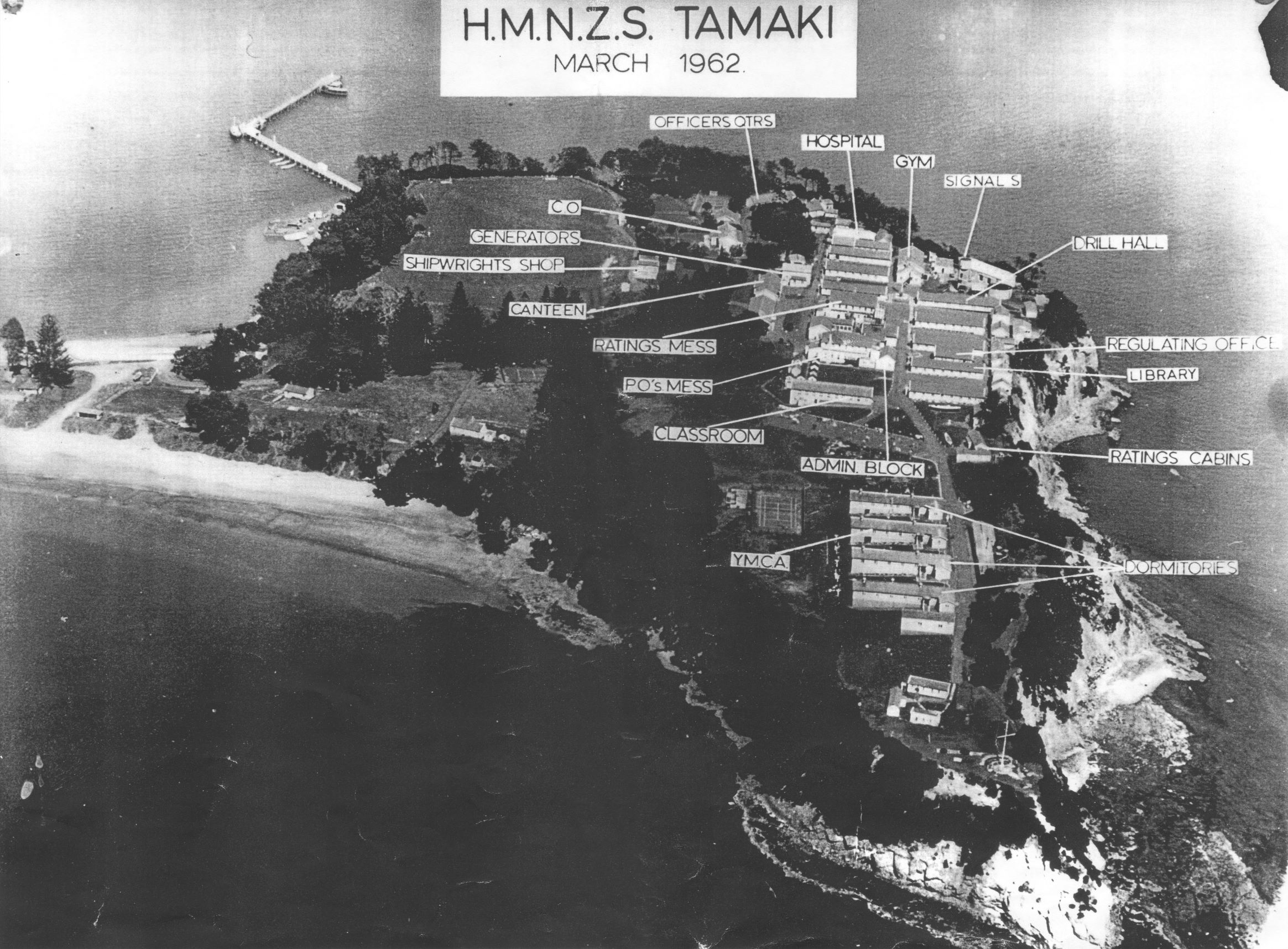
Navy Training base on Motuihe in 1962 (click photo to enlarge)
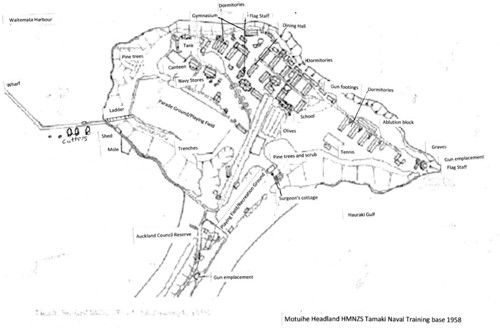
The twenty-two old quarantine buildings, which could accommodate 287 people, formed the nucleus of the facility. In order to accommodate more naval cadets, between 1941 and 1943, fifteen new buildings with a total floor area of 63,500 square feet were constructed including a provision store, a naval and clothing store, a canteen, a gymnasium and chapel, a school, a signal instruction building, a hospital, a dental clinic, and four large dormitories. Total accommodation was now 517.
Click on diagram to enlarge
Rehearsing for a parade December 1953 (click on pictures for larger view)
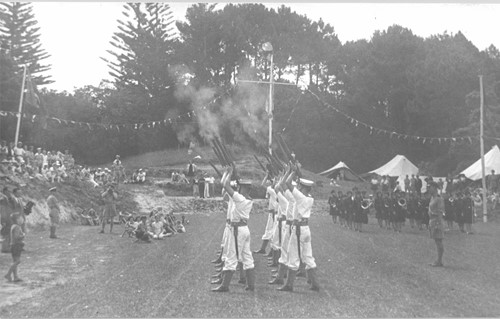
New Year celebrations
More than 6000 recruits passed through Tamaki during the 22 years it operated, including many who served in World War II.
Cadets typically stayed here for their 3 months initial training after entering the navy, during which time they were “broken in” to the navy way of life. Among other things, they sailed Whalers (large open boats), slept in hammocks and sometimes ate their food straight off the table – no plates. The fuel to run the base came from coal which was transported from the wharf using carts that ran on rails – still visible near wharf.
The navy base continued in peacetime to be used for basic training in seamanship, fitness and discipline. In 1963 HMNZS Tamaki moved to the North Shore and the base reverted to Domain Board control.
John Mills Navy Cadet shares his experience (link)
Jack Donnelly Warrant Officer shares his experience (link)
Des Townson, well know Auckland yacht designer and sailor, was a cadet on Motuihe in 1953. He describes his experience (link)
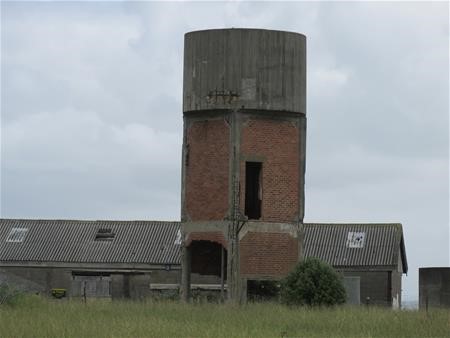
When the navy vacated in 1963, most of the approximately 70 buildings were demolished. Many were bulldozed over the cliff and remnants of cups and saucers could be found for many years on the rocks below. Some were also moved off the island. Les Chapman, a long time resident of Rakino Island, confirms that the public buildings on the wharf at Rakino came from Motuihe in the 1960s. They have been extensively rebuilt The cost of demolishing the water tower was considered too high so it was left standing. It could now be considered an historic feature, but its future remains in doubt given the danger it poses and the cost of preserving it. The concrete pads near the water tower are the site of the naval flagpole, shown on some of the photos.
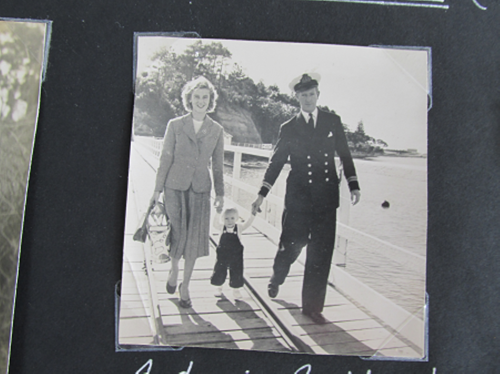
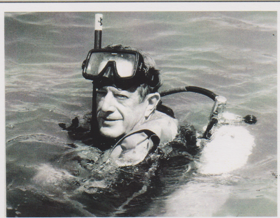
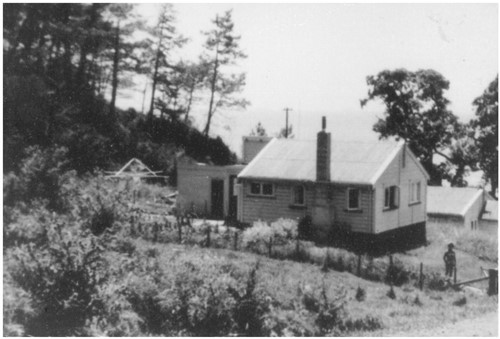
Tony Slark and his wife Eileen on Motuihe Wharf. Tony was the last Naval Surgeon and he and his family lived in the cottage. Tony was the first and only Patron of the Motuihe Trust. He became an expert in preventing the “bends” for divers.
During the navy period the larger portion of the island was farmed and maintained by sheep and fat cattle by farm manager Darryl Cotter on behalf of the Auckland City Council.
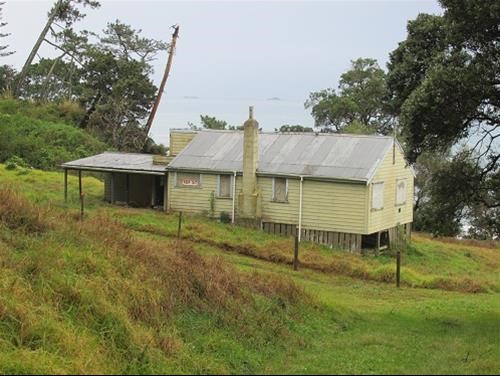
1968 – HMNZS Tamaki is gazetted a recreation reserve, and control of Motuihe passes to the Hauraki Gulf Maritime Park Board. The Farm house and Top House date from this period. In 2016 the only buildings remaining from the Navy time are the derelict naval surgeon’s cottage and the water tower which is in a dangerous state.
Motuihe Island (official name: Motuihe Island / Te Motu-a-Ihenga)[1] lies between Motutapu and Waiheke islands in the Hauraki Gulf of New Zealand, near Auckland. The island measures 179 ha (440 acres),[2] of which around 18 ha (44 acres) are remnants of coastal forest. The island is a recreation reserve controlled by the Department of Conservation (DOC) and administered by the Motuihe Trust. It is a popular spot for day trips, accessible from Auckland by seaplane or by private boat. The island is known for its beautiful beaches.[3][4]
The name comes from Te Motu-a-Ihenga, Māori for ‘Ihenga‘s Island’.[5]
In Tāmaki Māori traditions, the island was known as a location where the Tūrehu, a supernatural people, lived.[6] The island’s name Te Motu-a-Ihenga commemorates Ihenga, an ancestor of the Te Arawa people, who visited the island in the 14th century.[6] The island has extensive archaeological sites, including pā sites, karaka groves and food storage pits. The headland to the east of Ocean Beach, to the north of the island, is the location of Te Rae o Kahu, one of the most visible headland pā in the Hauraki Gulf islands area.[6]Gourds and taro are said to have been commonly grown on the island.[citation needed]
William Fairburn purchased Motuihe in 1839 from William Jowett, Ko Nuki and Te Manago: chiefs of Te Iwi Tutu, Ngāi Tai and Ngatiwaki respectively. They paid one heifer, twenty blankets, ten axes, ten hoes, ten spades, six gowns, two red blankets, 12 Dutch pipes, six iron pots and one shawl.[citation needed]
Very soon after arrival of the Europeans in the area, farming began in the 1840s. Groves of Norfolk pines and olive trees are remnants of this time.[5]
In 1872 the island was designated as a human quarantine station for smallpox victims.[7] A quarantine station was built on the western section of the island in 1873. It was used in 1874 for scarlet fever arriving on an inbound ship and operated for almost 50 years, slowly growing in size.[citation needed]
During the First World War, the station was used as an internment camp whose most famous prisoner was Count Felix von Luckner and his crew of the commerce raider SMS Seeadler.[5] Captured in September 1917, in December Luckner used a Christmas play as a ruse to organise an escape. He got provisions and seized the island’s launch,[8] a scow. Then sailing to the Kermadec Islands he was recaptured (and escaped again),[5] though not before becoming something of an odd type of hero in the eyes of many New Zealanders, for the fact that his numerous and daring wartime escapades had killed only a single person.[citation needed]
With the outbreak of World War II, the buildings became a naval training base, HMNZS Tamaki, and a number of newer buildings were added. The base remained a navy training ground until 1963, when its functions were moved to the North Shore mainland.[5]
The wharf on the southern side of the island, with the bay behind filled with day-tripper boats
The island’s trust organises an active programme of pest eradication and is gradually replanting sections of the island with native trees. Rats and mice were eradicated in 1996 and rabbits in 2004.[9] The conservation programme has reintroduced native species such as the North Island saddleback (tieke).[10] The Trust maintains a small conservation presence on the island, and usually has a number of volunteers working at the local tree nursery or in other conservation programmes.[citation needed]
In early 2008, rat footprints were found in a tracking tunnel (a device to check for the presence of certain animals) on the island. This set off a substantial effort by the trust and DOC to catch the rodent, which was feared to be part of a larger infestation. The Norwegian rat was eventually trapped by a special hunting dog, allowing plans to release native red-fronted parakeets (kākāriki) to continue as planned[9] in May 2008, when 31 were brought by helicopter from Little Barrier Island, where there is a relatively large population.[11]
In May 2009, 350 ‘agents’ of The Nikolai Organisation planted 22,400 native trees on Motuihe Island in just one day, which was 40% of the 2009 planting programme.[13][14][15] In 2017, Ricoh New Zealand employees and customers reached their goal of planting 20,000 trees across “Ricoh Valley”.[citation needed]
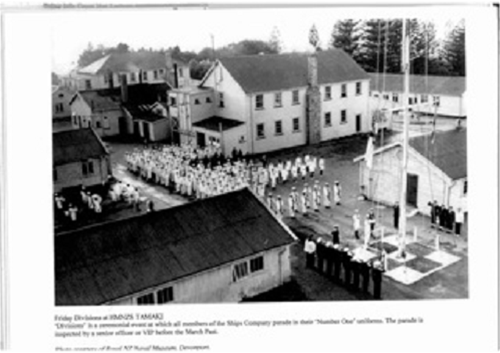
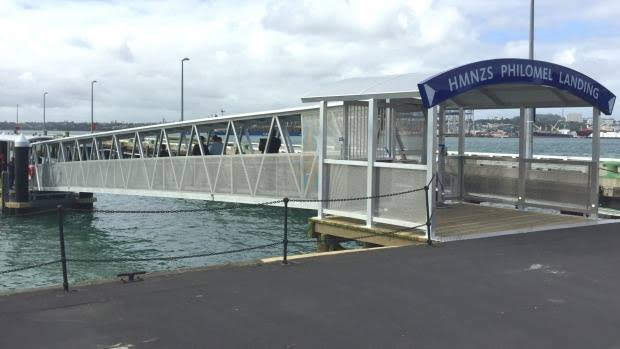
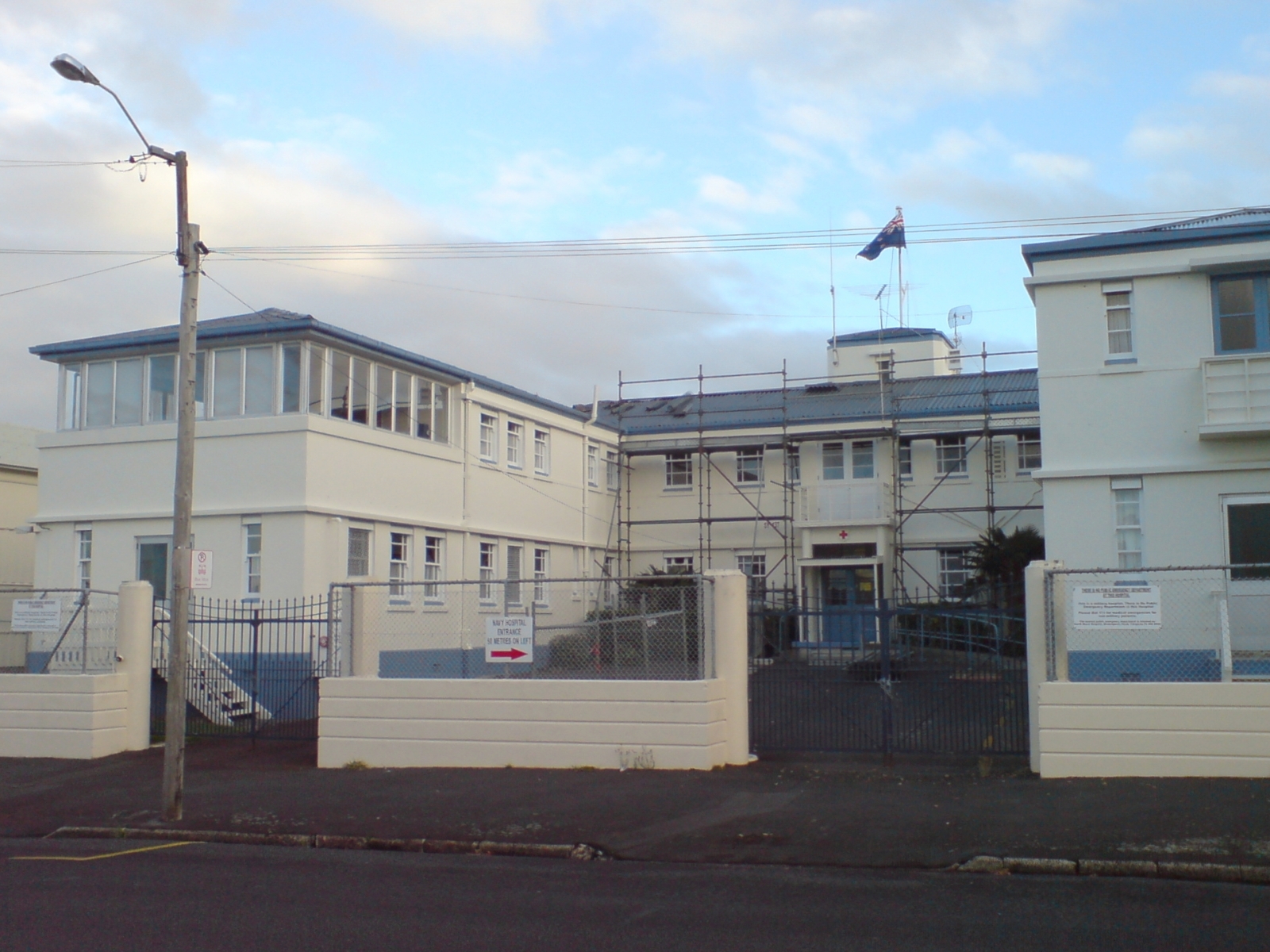
HMNZS Philomel Quarterdeck 1941-45HMNZS Philomel 1985HMNZS Phiomel – A reunion of Gunnery Intructors – John Currin in centre front with large stomachGunnery Class, late 1940’s Outside Gunnery School, HMNZS PhilomelFirst building on right was the Post Office, other buildings were used mainly as classrooms – 1957View from cliff above of HMNZS Philomel c 1942 – liberty menDivisions 1953HMNZS Philomel – Donkey mowerHMNZS Philomel 1950’sNorth Head, HMNZS PhilomelThe Navy Health Unit (previously known as the Navy Hospital or the Royal New Zealand Navy Hospital (RNZNH)) is the healthcare facility of the New Zealand Navy. It is located in Devonport, on Devonport Naval Base in Auckland. The hospital specialises in surgery and hyperbaric treatment.[1]
In October 1941, on the creation of the Royal New Zealand Navy, HMS Philomel was recommissioned as the training base HMNZS Philomel. Because of wartime demands for increased training many of her training functions were transferred, along with the ship’s main mast, to a new base HMNZS Tamaki situated at Motuihe Island.[2]
Over the years Philomel sprouted many creative additions on her decks in an effort to provide more space for her operations. These physical extensions then spilled over to the use of onshore buildings.
In January 1947 the boat Philomel was finally decommissioned and HMNZS Philomel became a land establishment. In 2000, HMNZS Tamaki was decommissioned with its functions absorbed again by HMNZS Philomel.
It is the home of the Naval Support Services, responsible for the logistics and organisation of Naval personnel, and for visits to the base by foreign ships. Its Naval Community Office provides support for families of naval personnel, and its Te Taua Moana Marae is the cultural home for all naval personnel, regardless of iwi or upbringing.[3] It incorporates the naval college Tamaki, formerly HMNZS Tamaki, which coordinates training within the naval base from new entry or officer training to damage control and command schools that everyone must attend at stages of their career. There are also schools for naval specialisations such as marine engineering, Officer of the Watch, hydrography and communications. The base includes a navy band and a fleet gymnasium.[4]
The first Royal New Zealand Navy museum was established in 1974 and was housed in a single room within HMNZS Philomel. It moved to a separate building in 1982. In 2010 it moved to new, larger facilities at Torpedo Bay, becoming the Torpedo Bay Navy Museum.