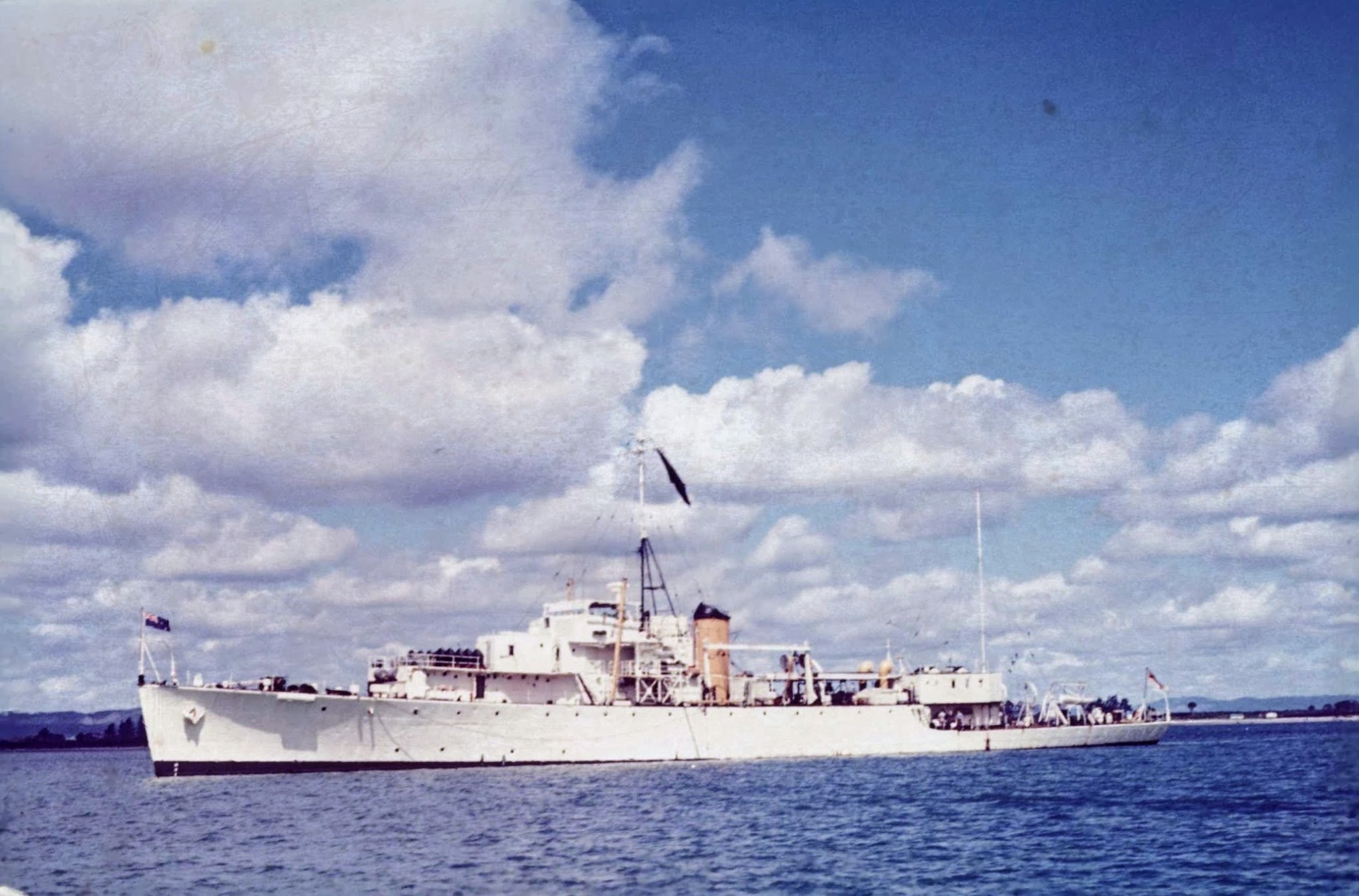
Survey Ships and Oceanographic Research – HMNZS Resolution (A14) 

HMNZS Resolution (A14) was a hydrographic ship of the Royal New Zealand Navy (RNZN)
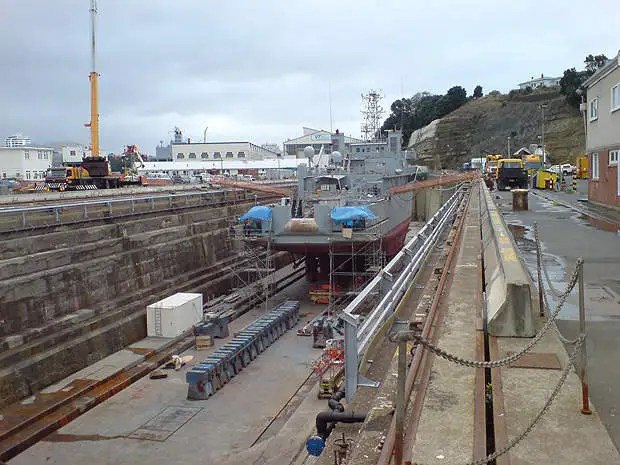
SAMSUNG DIGITAL CAMERA

Originally the United States Naval Ship USNS Tenacious (T-AGOS-17), the Stalwart-class ocean surveillance ship was used by the United States to locate and track Soviet submarines from 1989 to 1997, when she was transferred to the RNZN for use as a hydrographic survey ship. She served until 27 April 2012. She was subsequently sold to EGS Group, a private surveying company, and renamed RV Geo Resolution.

Construction[edit]

The ship’s construction contract was awarded 20 February 1987 to VT Halter Marine, Inc. of Moss Point, Mississippi, under then name Intrepid. Her keel was laid down 26 February 1988, she was launched 17 February 1989 and commissioned as USNS Tenacious on 29 September 1989. The renaming was prompted by protests from veterans of the Essex-class aircraft carrier USS Intrepid, who felt that the surveillance ship was not a fitting vessel to carry on the carrier’s name.[2]

Operational history[edit]

United States[edit]

Tenacious (foreground) and sister ship Contender tied up at Bishop’s PointPearl Harbor, in 1991

During the Cold WarOcean Surveillance Ships patrolled the world’s oceans searching for Soviet Navy submarines. Data was collected using the Surveillance Towed Array Sensor System (SURTASS), consisting of listening devices and electronic equipment that transmit the acoustic data via satellite to shore for analysis. SURTASS is a linear array of 8,575 feet (2,614 m) deployed on a 6,000-foot (1,800 m) tow cable and neutrally buoyant. The array could operate at depths between 500 and 1,500 feet (150 and 460 m).

Tenacious was stricken from the Naval Vessel Register and sold to New Zealand on 6 February 1997.

New Zealand[edit]

On commissioning into the RNZN on 13 February 1997, the ship was renamed HMNZS Resolution, after the sailing sloop HMS Resolution, used by James Cook during his second and third voyages of exploration, in recognition of the extensive hydrographic survey work done by Cook.[3] Resolution replaced HMNZ Ships Tui and Monowai as the navy’s primary survey and acoustic research vessel.[3] She undertook various marine survey tasks, including for the Land Information New Zealand agency.[1] SMB Adventure was operated by Resolution as a tender and survey motor boat.

Resolution sponsored a scholarship for under-privileged high school students to participate in a 10-day passage on the sail training ship Spirit of New Zealand. On occasion, university and high school students were embarked aboard Resolution as part of the ‘Students at Sea’ programme.[1]

On 22 February 2011, Resolution was underway off Christchurch when the 2011 Canterbury earthquake occurred. NZ Navy Today said later : ‘..the feeling onboard was that the engines had been set in full astern with associated shuddering and shaking. It was only when a dust cloud over Christchurch was observed and chatter on VHF soon alerted the bridge team of the enormity of the disaster. With Captain Dean McDougall (CTU 654.0.1, Captain Fleet Operational Support) in an established headquarters on HMNZS Canterbury in Lyttelton, Resolution reported for duty and was subsequently called in to conduct a hydrographic confidence survey of the main channel into the Port of Lyttelton.[4]

Resolution was decommissioned at Devonport Naval Base on 27 April 2012.[3] She was subsequently sold to EGS Group, a private surveying company, and renamed RV Geo Resolution. Following the sale she left Devonport Naval Base for the final time on 11 October 2014

Survey Ships and Oceanographic Research – HMNZS Monowai

HMNZS Monowai (A06) was a hydrographic survey vessel of the Royal New Zealand Navy (RNZN).

HMNZS Monowai

Built in 1960, the ship was originally used as a civilian supply and passenger vessel by the New Zealand Government, under the name GMV Moana Roa, before being acquired by the RNZN in 1974. She was commissioned into the RNZN in 1975 for the voyage to Scotland for conversion and commissioned into the RNZN in October 1977. She remained in RNZN service until April 1998, performing various duties such as coastal surveying, resupply, and surveillance. After being decommissioned she was sold to civilian operators in Britain in 1998 for conversion to a cruise ship, but was found unsuitable for the role and eventually sent to Spanish shipbreakers in 2002.

Construction and design[edit]

The ship was laid down by Grangemouth Dockyard in Scotland in 1960. The ship displaced 3,900 tons at full load, was 90.8 metres (298 ft) in length overall and 82.3 metres (270 ft) long at the keel, had a beam of 14.1 metres (46 ft) and a draught of 5.2 metres (17 ft). Propulsion machinery consisted of two 7-cylinder two-stroke TAD 36 Clark Sulzer diesels, which provided 3,640 horsepower (2,710 kW) to the CP propellers The ship had a top speed of 14 knots (26 km/h; 16 mph). In RNZN service, the ship had a crew of 126 and after 1980 was armed with two 20 mm Oerlikons for self-defence. In 1982, she was fitted out to carry a single Wasp helicopter.[citation needed]

Operational history

After being completed, the vessel spent the first part of her operational life as the New Zealand Government Island supply/passenger vessel GMV Moana Roa.[1] She was acquired by the Royal New Zealand Navy in 1974 and converted over a two-year period in Scotland 1975-77 to replace her predecessor, HMNZS Lachlan.[2] Monowai was the second of two ships with this name to serve in the RNZN. She was named after the glacial Lake Monowai. Monowai is a Māori word meaning “channel full of water”.

HMNZS Monowai – previously Moana Roa
The old girl when she was the Moana Roa prior to refit and commissioning as the Monowai

During her naval service she was known as the “Ghost of the Coast”,[2] as she quietly remapped most of the New Zealand coastline including the Chatham, Campbell, and Auckland Islands, as well as the many sub-Antarctic islands in New Zealand’s responsibility.[citation needed] She also acted as a resupply vessel carrying stores and equipment to Campbell and other sub-Antarctic islands and served as an “official residence” for VIPs and dignitaries at Pacific Island conferences.[citation needed]

Other tasks included monitoring Chinese missile splashdown tests, responding to the 1987 Fijian coups d’état to assist in the evacuation of New Zealand citizens,[3] participating in the ANZCAN cable route survey,[2] and assisting in international searches for sea mounts and shoals.[citation needed] She carried a helicopter and undertook rescue or aid missions, saving the lives of eight people during the New Zealand to Tonga Yacht Regatta.[2]

Decommissioning and fate[edit]

Monowai was replaced in 1998 by HMNZS Resolution, formerly USNS Tenacious.[2] She was sold to British buyers, Hebridean Island Cruises, for conversion into a cruise ship in 1998. She was laid up at Lowestoft in England after being found unsuitable for her intended use until 2002 when she was finally sent to Spanish shipbreakers.

Survey Ships and Oceanographic Research – HMAS/HMNZS Lachlan

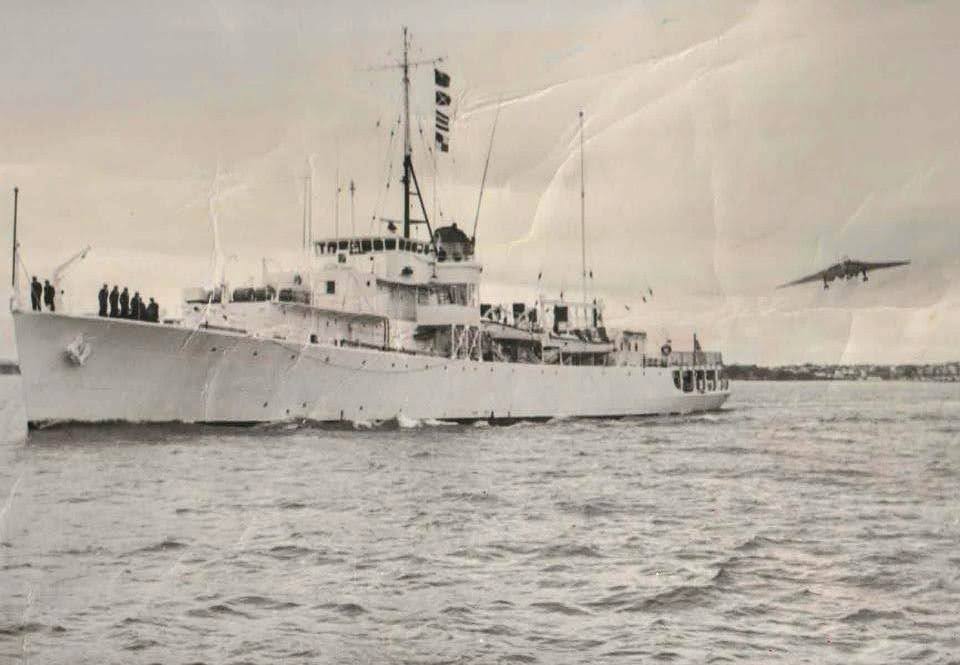
HMNZS Lachlan and V bomber

HMNZS Lachlan as a survey ship in Tamatea / Dusky SoundSouth Island

HMAS Lachlan (K364/F364) (later HMNZS Lachlan (F364)) was a River-class frigate that served the Royal Australian Navy (RAN) from 1945 to 1949. The vessel was later transferred to the Royal New Zealand Navy serving as surveyor until 1975 and was eventually scrapped in 1993.

Construction and design[edit]

Lachlan was laid down by Mort’s Dock & Engineering CompanySydney on 22 March 1943 and launched on 25 March 1944 by Sarah McNamara Scullin, wife of former Australian Prime Minister James Scullin, and commissioned on 14 February 1945. It was named after the Lachlan River in New South Wales[citation needed]

Operational history[edit]

Australian service[edit]

During 1945, Lachlan was used during the opening of the Captain Cook Graving Dock; her bow was used to cut the ribbon across the drydock‘s mouth. In 1949, shortly before her decommissioning, she found the wreck of the SS Yongala, which sank with all 122 aboard in a cyclone in 1911. Her wreck was thought to be a shoal at that time. [1]

Lachlan was paid off on 31 May 1949. She was transferred to the Royal New Zealand Navy, renamed HMNZS Lachlan, and was a survey and Antarctic supply ship until February 1975. She was used as a “Refit Barge” with many workshops onboard until the late 1980s when she was sold to Chile to continue work as floating workshops for ships being refitted.[citation needed]

New Zealand Service[edit]

HMNZS Lachlan as a survey ship in Tamatea / Dusky SoundSouth Island

In 1948, the New Zealand government sought a survey ship to use temporarily until a new one could be built in Britain. After negotiations, Lachlan was offered on loan for an initial time of three years and on 31 May 1949 was paid off from RAN service and was immediately given to the Royal New Zealand Navy the next day. Following trials through September 1949, on 5 October 1949 HMNZS Lachlan was commissioned into the Royal New Zealand Navy.[2]

The ship was fully disarmed at the dockyard at HMNZS Philomel and the ship’s chart room enlarged for surveying. The ship was rushed into service so quickly that some of the finishing touches were done at sea. Her first survey was started on 18 November 1949 surveying the Wellington Harbour entrance, taking three weeks to complete with assistance of a survey motor boat from Australia. To assist with the creation of the hydrographic service, on earlier voyages part of the ships company included personnel from the Royal Australian Navy and Royal Navy.

HMNZS Lachlan surveyed over fifty percent of New Zealand’s coastline over her twenty years in commission. Some of her service included surveys in Australia and the rest of the Pacific, and she helped clear mines around the Gilbert & Ellice Islands from World War II. Her bow was damaged in a collision with the Napier wharf in October 1954. In 1963 the New Zealand government purchased the vessel for £16,000. By 1970, she was due to be decommissioned but in May 1970 the Royal New Zealand Navy was ordered by the government by an extra five years.

In 1975, HMNZS Lachlan was painted all grey and docked at HMNZS Philomel to house ship’s companies whose frigates were undergoing refits. In September 1975, her engines were removed and sold, and in 1993 the hulk was sold to a Philippines company for scrapping.

Frigates – Type 12 Whitby Class- HMS/HMNZS Blackpool (F77)

HMS/HMNZS Blackpool was a Whitby-class or Type 12 anti-submarine frigate of the Royal Navy/Royal New Zealand Navy.

HMNZS Blackpool

Service history[edit]

Blackpool was leader of the 6th Frigate Squadron between 1958 and 1960 and was commanded by Edward Ashmore.[1] Between 1962 and 1964 she was part of the 25th Escort squadron consisting of HMS Rothesay (Capt Place VC) (Capt D), HMS Cavendish, HMS Brighton, HMS Blackpool and HMS Llandaff (Canteen boat). Twelve months east of Suez, six months at home, and another six months in the Far East. Between 1964 and 1966 she was leader of the 28th Escort Squadron.[2]

She was leased to the Royal New Zealand Navy between 7 June 1966 and 30 June 1971. In 1969, Blackpool was present at the Melbourne-Evans collision.

New Zealand

HMNZS Blackpool
This Whitby-class Type 12 frigate was designed for the RN in the early 1950s for ASW against the Warsaw Pact submarines. Blackpool was the last Whitby to be constructed and was loaned to the RNZN while HMNZS Canterbury was being built. In 1963-64 Blackpool went a major refit at Chatham and was commissioned for service with the Far East Fleet on 9 December 1964. Upon the decision being made to loan this ship to the RNZN, Blackpool returned to Plymouth on 16 February 1966. She was commissioned into RNZN service on 16 June 1966 at Chatham under the command of Commander J.I. Quinn. During her initial trials she suffered a boiler failure and had to return for repairs. In July she had a shakedown cruise around Cowes. This was followed by a Harbour training week at Portland and then she had her first sea week from 28 July to 1 August 1966. After a maintenance period she shifted to Portsmouth arriving 12 August 1966. She did a trip from there to Amsterdam, Guernsey and returned on 31 August. In early September she spent in dock and returned to Portland. She had a Flag Officer Sea Training (FOST) sea inspection in late September and also carried out Replenishment at Sea (RAS) with RFA Retainer and then went to Portsmouth.

She left Portsmouth on 9 October 1966 and voyaged through the Mediterranean stopping at Gibraltar and Malta. While at Malta she met HMNZS Santon returning to the UK and did a RAS[L] at sea with RFA Wave Ruler on 22 October. She transited the Suez Canal and at Aden met HMNZS Hickleton in company with HMS Picton both returning to the UK. She arrived at Gan on 2 November and did another RAS[L] with RFA Tidereach. On 8 November 1966 she arrived at Singapore and took up station and began participation in exercises. During this time she visited Hong Kong, Pulau Tioman and Bangkok. From 24 February 1967 to 6 March 1967 she took part in FOTEX 67. Later that month she undertook exercises off Subic Bay. She was released from the Far East station and departed Singapore on 21 April 1967. Going via Darwin and Brisbane she arrived in Sydney on 10 May 1967. While there a crack was found in the keel and there were problems with the main and auxiliary feed pumps. She was in dock for repairs from 15-20 May. She first arrived in Auckland on 25 May 1967. Unlike HMNZS Otago & Taranaki she did not have her armament upgraded when in RNZN service and retained the weapons she was commissioned with.

Upon arrival, she took part in AUCKEX and then on 28 July she took part in Longex through to 9 August. She then went to Gisborne and was on the way to Picton when she was sent to Raoul Island to undertake a medivac. She returned to Auckland and then went to Dunedin and Piction as planned. On 19 October 1967 she went into refit through to 29 April 1968. Towards the end of the refit Commander D.J. Cheney took over as CO from 18 March. In May 1968 she went to Sydney for Command Team training at Jervis Bay. While at Sydney in June, a helo crashed on 5 June. She then took part on LONGEX 68 to 14 June and returned to Wellington. In July 1968 she took part in AUCKEX. She went to LONGEX on 28 July but this was curtailed on 1 August. She escorted HMNZS Inverell back to harbour after her collision with USS Caliente. ON 5 August she sailed to assist SS Gothic which has suffered a fire in her accommodation spaces that cost seven lives.

In late August to early October she took part in Exercise CORAL SANDS in Australia. After returning to Auckland, she departed again for passage to Pearl Harbour in company with an RN group. While in Hawaii, she took part in Exercise CONVEX 3/68 in November. After completing her final battle problem on 13 December, she departed Pearl Harbour for Singapore via Midway, Guam and Hong Kong arriving 24 January 1969. Once again she was posted to the Far East Station. She left Singapore on 31 March and took passage to Bangkok and then on to Hong Kong. On 2 May she assisted in a RAF helicopter medivac from the Russian vessel Never. She then went on to Japan and then to Manila for Exercise SEA SPIRIT. This was curtailed when HMAS Melbourne collided with USS Frank E. Evans. She then took passage back to Auckland arriving 30 June 1969. In August she took part in LONGEX 69. In October she was present in Gisborne for the Cook Bicentenary and returned to Auckland. On 15 October Commander I.H.D. Tyler took over as CO. In November she returned to Jervis Bay for JUC/LONGEX. She then returned via Ship Cove, Wellington, Lyttleton, and Wellington arriving in Auckland on 18 December 1969.

On 3 February 1970 she left Auckland for Waitangi for the celebrations in company with HMNZS Inverell & Kiama. Upon return to Auckland she went into another refit through to August. Commander R.E. Lawry took over as CO from 6 July. After post-refit trials, she departed Auckland on 5 October with FOF2 embarked as escort for HMS Charybdis with HRH Prince Charles embarked. She was at Suva from 8-12 October for the Fiji independence celebrations. After leaving Suva she took passage to Raoul Island and returned to Auckland on15 October. For the rest of the month she was part of RNZNVR training for Ngapona & Olphert divisions. In November she trained personnel from RNZNVR Pegasus & Toroa divisions returning to Auckland on 29 November 1970. This was her last active deployment for the RNZN. In January 1971 she acted as guardship for the One Ton Cup trials. She was then put into reserve as preparations were made to return her to the RN now that HMNZS Canterbury was ready to e be commissioned into service in the UK. Blackpool left Auckland on 22 April 1971 and was returned to the RN at Portsmouth in June 1971. The ship’s company was transferred to HMNZS Canterbury. Blackpool went into reserve and was sold for breaking up in 1978.

Isles Class – HMNZS Scarba (T175)

HMNZS Scarba
7 February 1944, five Fairmile ‘B’ Class patrol craft ML 401-404 and 406 departed Auckland for the Solomon Islands. They travelled via Whangaroa Harbour (to top up fuel), Norfolk Island, Noumea, Espiritu Santo before reaching their destination at Renard Sound in the Russell Islands.
The first group of four Fairmiles had already departed in January. The Fairmiles were organised into two six-craft flotillas the 80th ML (Motor Launch) and 81st ML under the operational control of the US Navy. The launches were used for anti-submarine patrols off Guadacanal, Tulagi and the Russell Islands. Additional duties included escorting vessels.
The minesweeper HMNZS Scarba (background) escorted the Fairmiles as far as Noumea.
HMNZS Scarba – Lt CDR Finch and Lt Blair and Tabs the Cat

JCs Royal New Zealand Navy Ships and New Zealand Defence, Also other World Defence Updates

Ships and Defence News Past and Present

Skip to content ↓