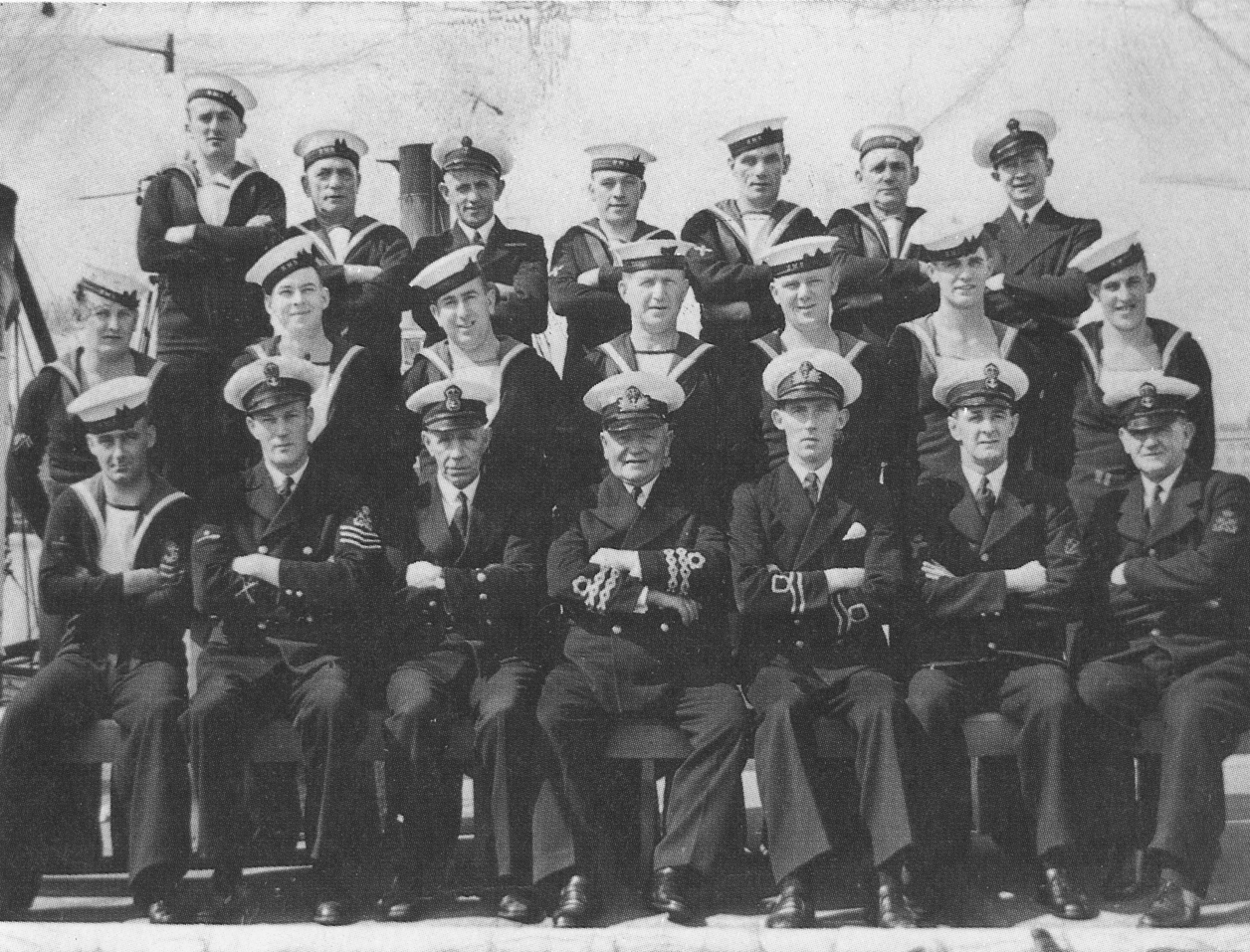
Converted Trawlers – Thomas Currell (AK1438, AK1, T11, AK3, WN10, WN122) Strath-class trawler

HMNZS Thomas Currell, auxiliary minesweeper , RNZN 1939-1945
HMNZS Thomas Currell, auxiliary minesweeper , RNZN 1939-1945, is this week’s RNZN Ship Of The Week.
This is another of those little ships where I suspect there is probably a lot of local knowledge out there somewhere, but not easy for a distant outsider the access.
Originally constructed as a Strath Class minesweeper for the Royal Navy in 1919, the 204 tons gross trawler Thomas Currell was one of three requisitioned from Sanford Ltd of Auckland in October 1939, and decommissioned in November 1945. I’ll edit in any further details as I find them, but as one of the smaller auxiliaries I think her duties were confined to local waters – not sure at present.
As for her later career, the one trace I find is this second photo posted by Phil NZ on flickr in 2006, which shows her wrecked but still very recognisable at Port Hutt on Chatham Island. There is a passing reference to her having been a ‘freezer,’ presumably a refrigerated vessel in the fishing fleet.
http://www.worldnavalships.com/forums/showthread.php?t=4073
HMNZS Thomas Currell, auxiliary minesweeper , RNZN 1939-1945

SS Thomas Currell was a Strath-class trawler built for the United Kingdom for use as a fishing trawler. She was purchased by Sanford Ltd in 1921 for use in New Zealand. She would be used as a minesweeper during World War II, and is currently wrecked at Port Hutt, Chatham Island.

Early operational history
Originally built as the Enrico, she was built by R Williamson & Son, located at Workington for use as a fishing trawler.[1] In 1921, Sanford was expanding its fleet of fishing vessels, having heard of several trawlers in the United Kingdom, Sanford sent several representatives to look over the vessels.[1] The Enrico seemed to fit the needs of the company and was purchased for £5,500 and had her name changed to Thomas Currell.[1][2] Before her voyage to New Zealand, she received a few alterations and was given spare equipment, including a spare propeller and shaft.[1][2] The voyage to Auckland would take three months, arriving in February 1922, and was put into service shortly after her arrival.[1]

World War II

Thomas Currell as a minesweeper during World War II
At the outbreak of World War II, Thomas Currell was on a usual fishing trip, and was unaware of the declaration of war due to a lack of radios on board, and was unable to be contacted.[2][3] She would return to Auckland, one week after war was declared, she discharged her catch and would be shifted to the Devonport Naval Base, as it had been commandeered by the government.[3] Along with the other Sanford trawlers, James Cosgrove and the Humphrey, they were converted for minesweeping duties and fitted with 4-inch (102 mm) guns, depth charges, and minesweeping equipment, also being given a wireless telephone and telegraph equipment.[3] The Thomas Currell was commissioned for the Royal New Zealand Navy on 10 October 1939, serving at Auckland.[3][4][5] On the morning of 19 June 1940, a distress signal was received from the passenger ship RMS Niagara, reporting it had struck a naval mine between Bream Head, and the Moko Hinau Islands and was sinking.[4] The James Cosgrove and Thomas Currell were ordered to sea, steaming at full speed towards her, arriving at 12:50 PM with minesweeping gear being deployed at 2:48 PM.[4] She and the James Cosgrove would discover two contact mines which had been laid recently, both were destroyed by rifle fire.[4] Thomas Currell would be paid off in September 1944, with work to convert her back into a fishing trawler completed by late 1945
https://en.wikipedia.org/wiki/SS_Thomas_Currell

Converted Trawlers – HMNZS South Sea (T22/T08)

HMNZS South Sea (T22/T08) 1941–1942 Previously HMT Ferriby of the Royal Navy, launched as a civilian trawler in 1913. Sunk 19 December 1942 in collision with inter-island ferry Wahine in Wellington Harbour
HMNZS South Sea – gunnery practice

Converted Trawlers – HMNZS Humphrey (8)/(T6)Strath-class minesweeper.

Humphrey before being given the pennant number T06.
Humphrey after World War 2 as a steam trawler owned by Sanford LTD. When she was scrapped she was owned by “McCallum Bros”

HMNZS Humphrey
Ship details:
Type: Converted trawler – minesweeper

Pennant No.: 8 1939-40, T06 after November 1940

Taken Over: 5 September 1939 by the NZ Division of the Royal Navy

Commissioned: 16 October 1939 as HMS Humphrey

Decommissioned: 18 April 1944

Displacement: 206 grt

Dimensions: 35.3 x 6.7m

ON: 143961

Port: Auckland

Owner: Sanford Ltd., Auckland

Built: 1918 by I.J. Abdela & Mitchell.

Built as: Strath-class minesweeper

Machinery: coal-fired triple expansion ihp 430 single shaft = 10 knots

Complement: 21-24 officers and ratings

Armament:

1 x 4-inch [102mm] gun

2 x machineguns [Lewis or Bren]

Depth charges

History:

This vessel was built to an Admiralty trawler pattern for the Royal Navy at the end of the First World War as a Strath-class minesweeper. It does not appear to have had any wartime or post-war service with the Royal Navy and was put up for sale as a fishing vessel. It also appears as if the original name was Robert Farecloth but was changed to Humphrey. In 1928 it was purchased by a New Zealand fishing company Sanford and brought to New Zealand for service as a fishing vessel.

By 1939 it was still under the ownership of Sanford in Auckland and working as one of its fishing fleet. The Marine Department under wartime regulations requested Sanford release its trawlers under charter to the Navy. Humphrey was the second vessel taken up and was taken over to the Devonport Naval Base to be fitted out as a minesweeper which took five weeks. A 102mm gun was fitted along with minesweeping gear. She was commissioned formally on 16 October as HMS Humphrey. She was one of three vessels of Sanford’s taken up from commercial service for use as minesweepers at the outbreak of the Second World War. There other two vessels were James Cosgrove and Thomas Currell which was of the same class as Humphrey. At the start of the war, the New Zealand Division of the Royal Navy only had one minesweeper HMS Wakakura in commission and was ordered to take up vessels for minesweeping duties as soon as possible. The government did not want a repeat of the situation in the First World War when it had to scramble for vessels after discovering mines had been laid in New Zealand waters by the raider SMS Wolf. Because of the need for minesweepers, the civilian crew of Humphrey was kept on and the master given a temporary naval rank and Volunteer Reservists joined the ship to complement the civilians. In order for more financial control, the government purchased Humphrey from Sanford in November 1940 for the sum of £22,500. This nullified the costly charter that benefited Sanford.

Initially Humphrey saw little service. In February 1940 she had to tow HMS James Cosgrove back to Auckland after she developed a serious engine fault. This changed in 1940 when the German raider HKS Orion laid mines in the Hauraki Gulf. At the time Humphrey was in refit in Auckland at the Naval Base. On 19 June 1940 the RMS Niagara struck a mine and sank in the Gulf taking with her a shipment of gold. Along with HMS Wakakura, Humphrey and her sister ships swept the approaches to Auckland and disposed of the German mines located. After the first deployment in the Gulf, Humphrey was sent to sweep off Wellington and then Lyttelton [Christchurch]. She then moved on to Cape Farewell and Cape Campbell in the South Island. During this time she never came across any enemy mines. In August 1940 Humphrey recovered a mine that was found drifting off Red Mercury Island. After the explosive was removed and destroyed the minesweeper towed the mine back to the Naval Base.

In November 1940 the First Minesweeping Group was formed in Auckland consisting of Wakakura & Humphrey. This was not a fixed location as in 1941 the minesweepers would be deployed wherever needed. By 1942 permanent locations were allocated and the sister ship Thomas Currell joined the Auckland based Group. In 1942 Humphrey was temporarily detached and sent to the Third Minesweeping Group based at Lyttelton but was back in Auckland by October. From 1940 to early 1944 the Groups were constantly sweeping the shipping channels off the main ports.

In early 1944 HMNZS Humphrey was sent to Wellington for conversion into a Boom Gate Vessel as New Zealand-built Castle-class minesweepers were coming into service. The project was abandoned as the war situation improved and she was tied up in Wellington. At this time the wartime government was under pressure from the fishing companies to return their vessels so they could resume pre-war fishing operations. On 21 May 1944 Humphrey returned to Auckland from Wellington and paid off from service in the Royal New Zealand Navy. In July she was sold back to Sanford, refitted, and resumed her working life as a fishing vessel. In 1954 she was sold by Sanford and was dismantled in Auckland. By 1956 she was hulked as a shingle bin near Waikauri Bay, Takatu north of Kawau Island. In 1970 the hull was towed back to Auckland and scrapped.

Converted Trawlers – HMNZS Humphrey

HMNZS Humphrey (8) before being given the pennant number T06, also crew

Converted Trawlers – HMNZS Futurist (T09)

HMNZS Futurist (T09) 1941–1944 Functioned as a boom gate vessel 1944

The sad demise of Futurist – She sank 19 March 1949

Converted Merchant Ships – HMNZS Gale (T04)

HMNZS Gale (T04) was a coastal cargo boat which was requisitioned by the Royal New Zealand Navy (RNZN) and converted into a minesweeper. She was the first New Zealand vessel to go into action against Japan

HMNZS Gale
HMNZS Gale – crew member
HMNZS Gale (T04) was a coastal cargo boat which was requisitioned by the Royal New Zealand Navy (RNZN) and converted into a minesweeper. She was the first New Zealand vessel to go into action against Japan.
Gale was owned by the Canterbury Steam Shipping Company. She was one of four ships requisitioned as a consequence of the German auxiliary cruiser Orion’s minefield and the loss of the liner Niagara, the others being Matai, Puriri and Rata. She was taken over on 10 October 1940 and handed to the dockyard for conversion. She was a sister ship to Breeze.
Operational history
Gale joined the 25th Minesweeping Flotilla in April 1941, sweeping for German mines in the Hauraki Gulf. On 14 May, she rescued the survivors of the Puriri sinking. Later in 1941, the flotilla swept suspected minefield areas such as near Cuvier Island and Farewell Spit. In December 1941 Gale detached to relieve Viti in Fiji. She returned to New Zealand for refit in February 1942.
In June 1942, Gale was deployed to Noumea for port minesweeping duties where she was the first New Zealand vessel to deploy with COMSOPAC, the United States Navy’s South Pacific Command, then taking over command of the 25th Minesweeping Flotilla. On 5 August, Gale located a missing US amphibious aircraft, rescued the crew, and towed it back to Noumea. The ship subsequently received a US commendation. Gale sailed back to New Zealand on 30 October 1942; she was then assigned to Wellington as a port minesweeper with the Second Minesweeping Group.
In February 1943, Gale rejoined the 25th Minesweeping Flotilla at Tulagi in the Solomons. In April 1943, her sister ship Breeze arrived at Tulagi, at which point Gale, Breeze and Matai were formed into the 9th Auxiliary Minesweeping group. They carried out night-time patrol and escort duties under COMSOPAC control. The Japanese were largely well to the north by this time, but occasionally made sudden attacks into American strongholds around Guadalcanal.
From time to time flotilla boats would return to Auckland for refit, usually escorting freighters bound the same way. By mid-1944, the owners were demanding the return of Gale and her twin Breeze. COMSOPAC released her on 20 September 1944.
Fate
Gale was sold by Canterbury Steam Shipping Company in December 1962[1] to Cia de Transportes Sylvia S.A. of Panama and renamed Jasa. She was scrapped in Singapore in 1970
Gale

Gale was owned by the Canterbury Steam Shipping Company. She was one of four ships requisitioned as a consequence of the Orion‘s minefield and the loss of the liner Niagara, the others being MataiPuriri and Rata. She was taken over on 10 October 1940 and handed to the dockyard for conversion. She was a sister ship to Breeze.

Operational history[edit]

Gale joined the 25th Minesweeping Flotilla in April 1941, sweeping for German mines in the Hauraki Gulf. On 14 May, she rescued the survivors of the Puriri sinking. Later in 1941, the flotilla swept suspected minefield areas such as near Cuvier Island and Farewell Spit. In December 1941 Gale detached to relieve Viti in Fiji. She returned to New Zealand for refit in February 1942.

In June 1942, Gale was deployed to Noumea for port minesweeping duties where she was the first New Zealand vessel to deploy with COMSOPAC, the United States Navy‘s South Pacific Command, then taking over command of the 25th Minesweeping Flotilla. On 5 August, Gale located a missing US amphibious aircraft, rescued the crew, and towed it back to Noumea. The ship subsequently received a US commendation. Gale sailed back to New Zealand on 30 October 1942; she was then assigned to Wellington as a port minesweeper with the Second Minesweeping Group.

In February 1943, Gale rejoined the 25th Minesweeping Flotilla at Tulagi in the Solomons. In April 1943, her sister ship Breeze arrived at Tulagi, at which point GaleBreeze and Matai were formed into the 9th Auxiliary Minesweeping group. They carried out night-time patrol and escort duties under COMSOPAC control. The Japanese were largely well to the north by this time, but occasionally made sudden attacks into American strongholds around Guadalcanal.

From time to time flotilla boats would return to Auckland for refit, usually escorting freighters bound the same way. By mid-1944, the owners were demanding the return of Gale and her twin Breeze. COMSOPAC released her on 20 September 1944.

Fate[edit]

Gale was sold by Canterbury Steam Shipping Company in December 1962[1] to Cia de Transportes Sylvia S.A. of Panama and renamed Jasa. She was scrapped in Singapore in 1970

JCs Royal New Zealand Navy Ships and New Zealand Defence, Also other World Defence Updates

Ships and Defence News Past and Present

Skip to content ↓