The ferry Duchess (The future HMNZS Duchess), alongside the H.M.S. New Zealand, Nelson, June 1913. Probably taking visitors out to view NZ’s gift to UK


The ferry Duchess
Ships and Defence News Past and Present


HMFS Viti
1941 December 16 Came under the control of the Royal New Zealand Navy
http://www.nzmaritime.co.nz/viti.htm
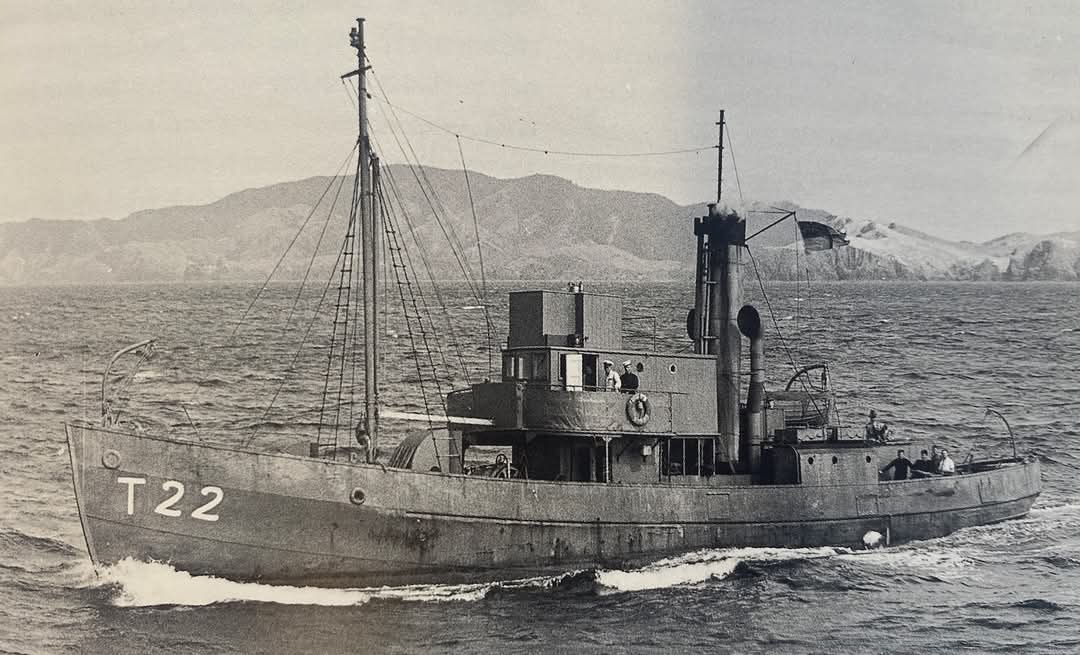
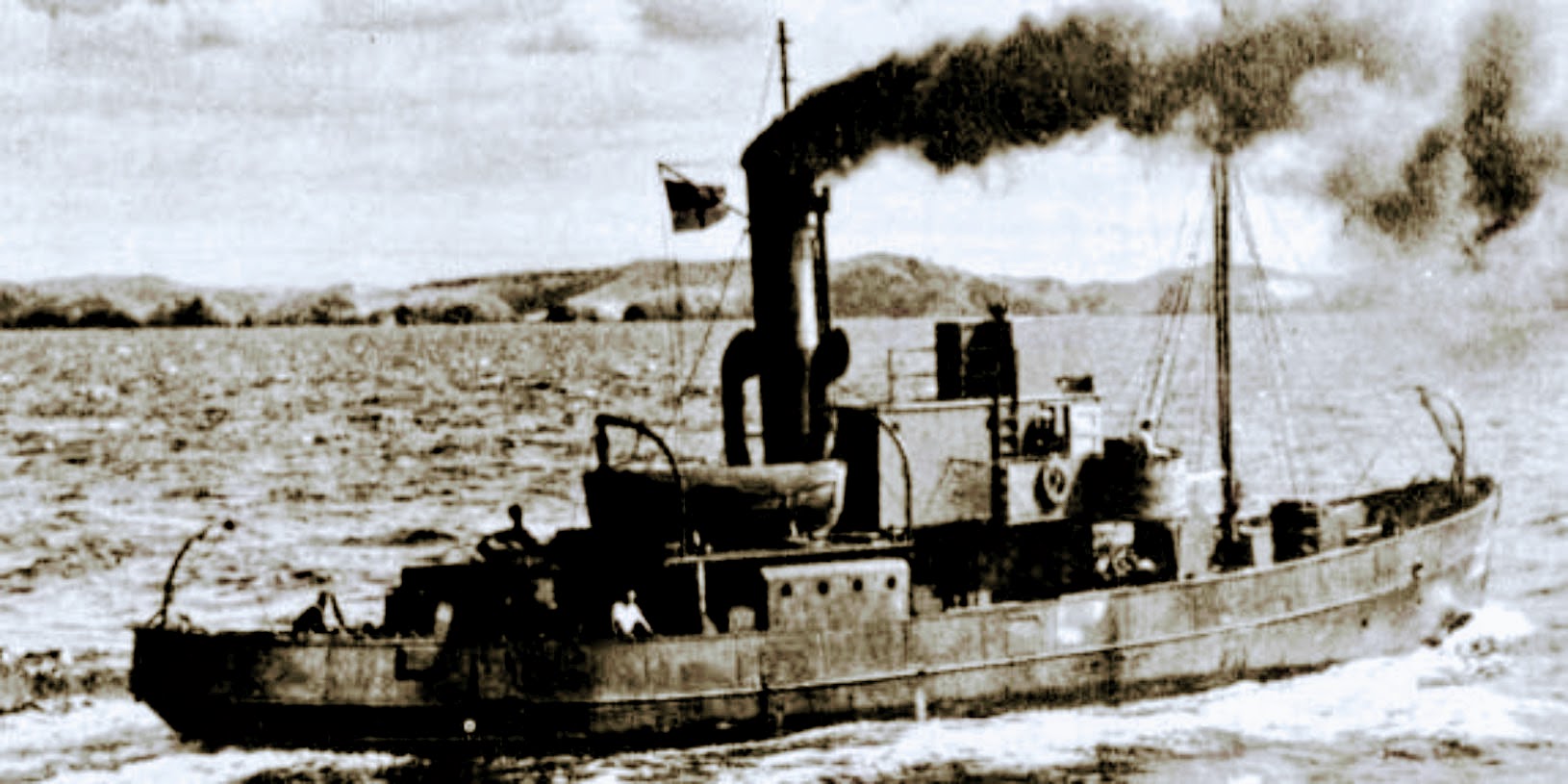
Built: Seattle Construction Co., USA 1912
Type: Danlayer
Pennant No.: T22
Displacement: 148 tons gross, 67 tons net
Length: 96.1 ft./29.3 m Beam: 19.5 ft./ 5.9 m Draft: 2.8 ft./0.8 m
Propulsion: Steam recip., ihp 350, single screw coal fired
Speed: 9 knots.
Armament: 2 x light MG
Complement: 14
Phyllis was built as a whale chaser built for the Norwegians named Star III, and worked from Stewart Island. She was laid up there in 1929, sold to a NZ buyer, renamed Phyllis and used as a trawler.
The ship was purchased from the Canterbury Steam Trawling Co. Ltd.of Christchurch on 3 September 1942 and fitted out at Lyttelton as a danlayer, the intention being to employ her at Auckland. A danlayer is a small vessel employed in minesweeping operations to lay dan-buoys to mark the limits of the channels swept through a minefield.
She was commissioned on 11 January 1943 as HMNZS Phyllis and sailed for Auckland but was delayed by engine trouble in Wellington. Inspection at Auckland revealed numerous defects and she prove unsatisfactory as a danlayer. Repairs were not completed and little or no use was made of Phyllis: she paid off in 28 February 1944 and was sold.
http://www.worldnavalships.com/forums/showthread.php?t=4073&page=9

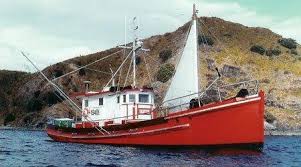
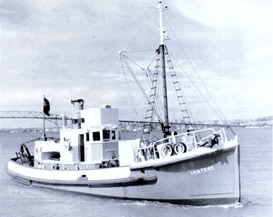
HMNZS Waipu (T32)
HMNZS Coastguard (T12)
HMNZS Ikatere
HMNZS Kaiwaka (T14)
HMNZS Nora Niven (T23)
HMNZS Phyllis T22
HMNZS Waiho (T34)
HMNZS Waima (T33)
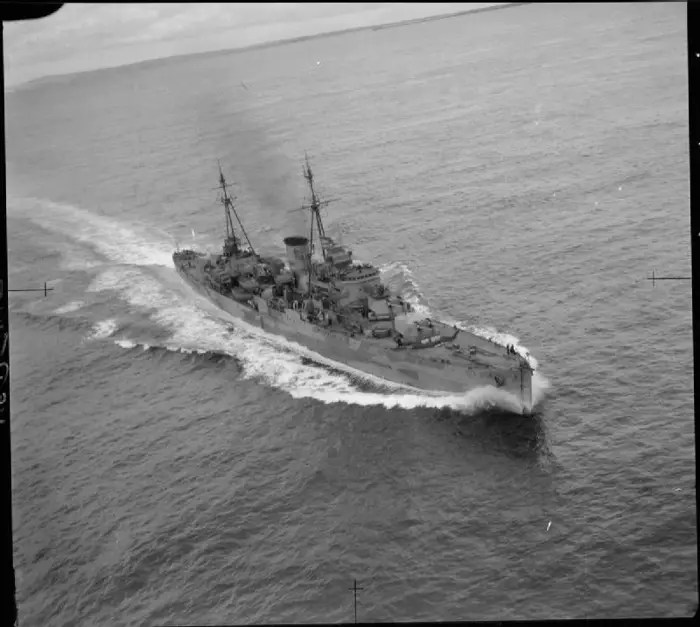
HMS Neptune was a Leander-class light cruiser which served with the Royal Navy during World War II. Early in 1941 the New Zealand Government responded to an Admiralty request for sailors to man an additional cruiser. Neptune was selected and was expected to leave the United Kingdom for New Zealand in May. However, because of the loss of cruisers during the Crete campaign Neptune was instead attached to Admiral Cunningham’s Force K, based on Malta. On 19 December 1941 she was sunk by mines. Only one crewman survived.[1]
150 of those lost were New Zealanders, 80 of them had served in the Naval Reserve before the outbreak of war. The loss of Neptune was the greatest single tragedy New Zealand Naval Forces have experienced.
The sole survivor, Norman Walton, spent 15 months in an Italian prisoner of war camp. In 1991, Walton travelled to the small city of Nelson, New Zealand, to unveil a memorial to Neptune. Of the 764 that perished, 150 were New Zealand sailors, including four from Nelson.[10] A memorial service to Neptune and her crew is held each year in Nelson.
HMS Neptune was a Leander-class light cruiser which served with the Royal Navy during World War II. Neptune was the fourth ship of its class and was the ninth Royal Navy vessel to carry the name.
[edit]
Built by Portsmouth Dockyard, Neptune was laid down on 24 September 1931, launched on 31 January 1933, and commissioned into the Royal Navy on 12 February 1934 with the pennant number 20.
[edit]
During World War II, Neptune operated with a crew drawn predominantly from the New Zealand Division of the Royal Navy. The ship also carried a large contingent of seconded South African personnel.[3]
In December 1939, several months after war was declared, Neptune was patrolling in the South Atlantic in pursuit of German surface raider heavy cruiser Admiral Graf Spee. Neptune, with other patrolling Royal Navy heavy units, was sent to Uruguay in the aftermath of the Battle of the River Plate. However, she was still in transit when the Germans scuttled Graf Spee off Montevideo on 17 December.
Neptune was the first British ship to spot the Italian Fleet in the battle of Calabria, on 9 July 1940, marking also the first time since the Napoleonic Wars that the Mediterranean Fleet received the signal “enemy battle fleet in sight”.[4] During the subsequent engagement, she was hit by the Italian light cruiser Giuseppe Garibaldi.[5][6] The 6-inch shell splinters struck the aircraft catapult and damaged her floatplane beyond repair, its wreckage being thrown into the sea.[7] Minutes later, Neptune‘s main guns scored three hits on the heavy cruiser Bolzano, inflicting some damage on her torpedo room, below the waterline and the “B” turret.[8] During 1941, she led Force K, a raiding squadron of cruisers. Their task was to intercept and destroy German and Italian convoys en route to Libya. The convoys were supplying Rommel’s Afrika Korps in North Africa with troops and equipment.
[edit]
Force K was sent out on 18 December 1941, to intercept a convoy bound for Tripoli, right after the brief fleet engagement at sunset known as First Battle of Sirte.
On the night of 19–20 December, Neptune, leading the line, struck two mines, part of an Italian minefield laid by an Italian cruiser force in June 1941. The first struck the anti-mine screen, causing no damage. The second struck the bow hull. The other cruisers present, Aurora and Penelope, also struck mines.[9]
While reversing out of the minefield, Neptune struck a third mine, which took off her propellers and left her dead in the water. Aurora was unable to render assistance as she was already down to 10 knots (19 km/h) and needed to turn back to Malta. Penelope was also unable to assist.
The destroyers Kandahar and Lively were sent into the minefield to attempt a tow. The former struck a mine and began drifting. Neptune then signalled for Lively to keep clear. Kandahar was later evacuated and scuttled with a torpedo by the destroyer Jaguar, to prevent her capture.
Neptune hit a fourth mine and quickly capsized, killing 737 crew members. Initially some 30 others survived the sinking, but they also died of wounds and exposure in the subsequent days. As a result, only one was still alive when their carley float was picked up five days later by the Italian torpedo boat Generale Achille Papa. The sole survivor, Norman Walton, spent 15 months in an Italian prisoner of war camp. In 1991, Walton travelled to the small city of Nelson, New Zealand, to unveil a memorial to Neptune. Of the 764 that perished, 150 were New Zealand sailors, including four from Nelson.[10] A memorial service to Neptune and her crew is held each year in Nelson.
Ships and Defence News Past and Present


