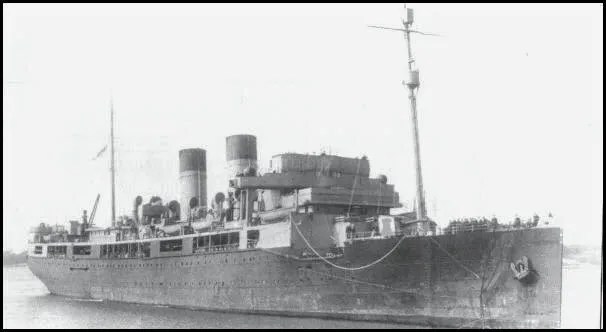
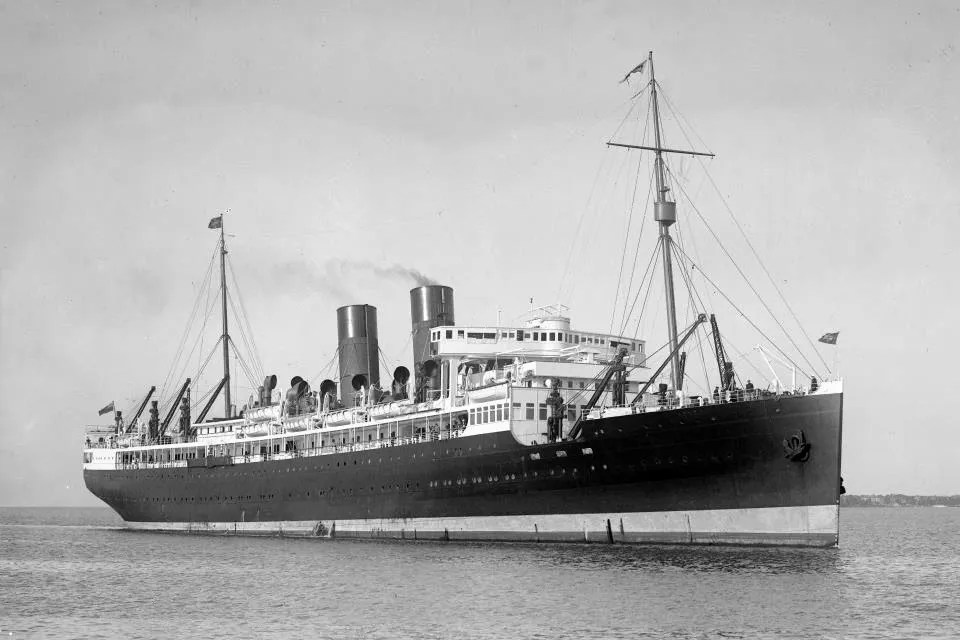
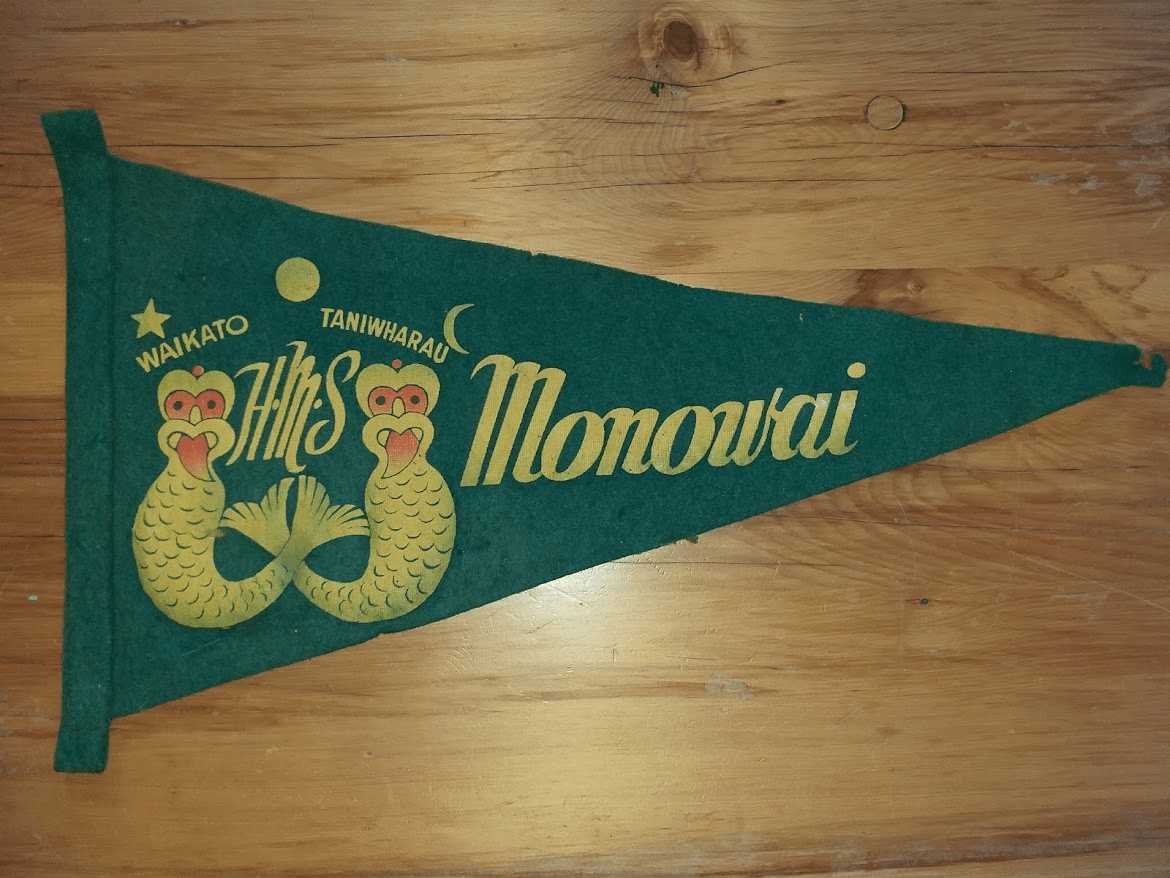
She subsequently became HMS Monowai, a Landing Ship, Infantry and mostly operated as a troopship. In 1946 she returned to her old trade as a passenger ship.
Civilian career
SS Razmak was built at Greenock yard for P&O by Harland & Wolff, launched in 1924 and completed on 26 February 1925.[1] She was designed for service between Bombay and Aden and spent several years in the Mediterranean Sea. When demand on her original route dried up, she was offered for sale and transferred to the antipodes.
The Union Steam Ship Company, part of the P & O group, took her on in 1930 as their second SS Monowai and she ran a subsidized service from Wellington to Vancouver via several Pacific stops. From 24 November 1932 she ran mostly from Wellington to Sydney.
Conversion to armed merchant cruiser
Guns suitable for Monowai had been ordered and stored at the Devonport Naval Base in Auckland. Monowai was requisitioned by the Royal New Zealand Navy on 21 October 1939 and was prepared for mounting the guns. Then followed a period of indecision, and in February 1940 work on her was suspended for over four months. After construction was completed in August 1940, she was commissioned.
Monowai was the first of two ships with this name to serve in the Royal New Zealand Navy. She was named after the New Zealand glacial lake Monowai. Monowai is a Māori word meaning “channel full of water”.
Conversion to LSI
As surplus, in 1943 she was transferred to Liverpool in the United Kingdom and handed over to the British Ministry of War Transport. Monowai went to Glasgow for conversion to an “Landing Ship, Infantry (Large)” or LSI(L). From June 1943 to February 1944 she was refitted with completely different armament, capacity for up to 1,800 fully equipped troops, and 20 Assault Landing Craft. She was used during the Normandy landings.
In the later period of the war she was used as a troopship transporting soldiers and after the end of the war in repatriation.
On 31 August 1946 she was returned to her owner. She resumed merchant service in January 1949 after extensive repair. In 1960 she was sold for breaking up in Hong Kong.
HMNZS Black PrinceHMNZS Black PrinceHMNZS Black Prince – HMCS Ontario, HMS Ceylon and HMNZS Black Prince at Hobart in February 1954 with Royal Yacht Gothic (not in pic). HMAS Quadrant can just be seen behind Ontario. Four different shades of grey. Picture scanned from original slide taken by Reg Wilson – Courtesy of Russell PriestHMNZS Black PrincePhotograph of British light cruiser HMS Black Prince, under tow on the Tyne.HMS Black Prince was a Dido-class light cruiser of the Royal Navy, of the Bellona subgroup.
HMS Black Prince was a Dido-classlight cruiser of the Royal Navy, of the Bellona subgroup. The cruiser was commissioned in 1943, and served during World War II on the Arctic convoys, during the Normandy landings, and as part of the British Pacific Fleet. In 1946, the cruiser was loaned to the Royal New Zealand Navy, becoming HMNZS Black Prince. The cruiser was docked for modernisation in 1947, but in April, her sailors walked off the ship as part of a series of mutinies in the RNZN. The shortage of manpower resulting from these mutinies meant that the modernisation had to be cancelled, and Black Prince was placed in reserve until 1953. She returned to service after refitting with simplified secondary armament with a single quad “pom pom” in Q position and eight Mk3 40mm Bofors guns. The ship was decommissioned again two years later, and returned to the Royal Navy in 1961. Black Prince did not re-enter service, and was towed from Auckland to Osaka for scrapping in 1962.
“Black Prince” was a modified Dido design, sometimes called Dido Group 2, or the Bellona subgroup with only four 5.25-inch mounts instead of five, and improved anti-aircraft armament. She was built by Harland & Wolff of Belfast, Northern Ireland, with her keel being laid down on 2 November 1939. [2][3] She was launched on 27 August 1942,[2][3] and completed on 20 November 1943.[2][3]
After commissioning, Black Prince served on Arctic convoys and then came south in preparation for the invasion of Europe, being employed on offensive sweeps against German coastal convoy traffic. On the night of 25 and 26 April 1944, accompanied by Canadian destroyers, she was involved in the action which sank the torpedo boat T29 and damaged T24 and T27 off the north Brittany coast.
On 16 January 1945, she sailed as part of the British Pacific Fleet, seeing action off Okinawa and in the final bombardments of the Japanese mainland before withdrawing to repossess Hong Kong in September.
After the Japanese surrender, she remained in the Far East, and was transferred to the Royal New Zealand Navy on 25 May 1946. During 1947, the cruiser was docked for modernisation, but this was cancelled following a series of mutinies in April (which included the sailors from Black Prince), as the RNZN no longer had the manpower to operate her.[8]Black Prince was placed in reserve. Work on reactivating the ship began in January 1952, to reduce crew the two multiple Pom Pom AA mounts were temporarily removed and 8 of the unique RNZN 40 mm single electric Toadstool CIWS, installed, in place of Mk 5 twin Oerilikons and she was recommissioned in February 1953.[9] In the same year she took part in the Fleet Review to celebrate the Coronation of Queen Elizabeth II.[10]
The cruiser was decommissioned again in August 1955, and after the decision in the British 1957 Defence White Paper to strike the remaining Royal Navy Dido and Improved Didos as too outdated to be used again or modernized, Black Prince was reduced to extended 3rd class reserve,[11] and used as an accommodation ship[12] for refitting warships and spare part source for Royalist‘s 1960-1 refit, before reverting to Royal Navy control for disposal in line with its loan terms.
THE GOVERNMENT of Samoa has told its New Zealand counterpart it now sees no need to salvage the sunken HMNZS Manawanui.
The vessel sank on the morning of 6 October 2024, after hitting a reef it was in the process of surveying, the previous evening. An initial finding by an official inquiry highlighted a misunderstanding of the auto-pilot system on board, which had not been switched off.
Since mid-January the NZ tug Kurutai and barge Cronus have been operating between the port of Apia and the wreck site outside Tafitoala on the South Coast of Upolu, removing fuel and other pollutants. The operation has been regularly interrupted by bad weather and the NZDF has not issued any updates this month.
However, Samoan media has reported NZ Minister for Defence Judith Collins announcing the Samoan Government wants the Manawanui wreck to remain off the coast, despite ongoing concerns about residual oil slicks and pollution.
Ms Collins says most of the oil has been removed, and the wreck could eventually become a tourist attraction.
“The Samoan government has decided it wants it to stay where it is. It suits the government for that to happen; it’ll become a great part of the reef, and it’ll be probably an excellent diving spot at some stage,” Mrs Collins said.
The Samoa Observer reported the Samoa Conservation Society has backed the idea provided all environmental hazards are removed.
“As long as all the oil and any other toxins are removed from the hull and the boat is stable and won’t move around in storms then it will be a good addition to reef life and a good dive site for Samoa. Corals will grow up on the wreck very fast and it will be claimed by nature so I am for it,” SCS president James Atherton told the paper.
Owners of the Sina PJ Beach Fales in Tafitoala have also welcomed the idea. For them, this would mean an increase in business.
The operation is still at a standstill. The business is based on surf operations but the area where surfing takes place is inside the restricted two-kilometre zone to safeguard the salvage works that is being currently carried out.
Last month, the fishing village of Safata reported continued fuel odours in the region, despite the precautionary ban being lifted, allowing villagers to resume fishing near the disaster site. The Embassy of the People’s Republic of China has given $50,000 to the Safata District to be used to help families whose livelihood had been affected by the fishing ban, according to media reports.
The ship lies just off the reef at Tafitoala at a depth of 35 metres and would make “”an idyllic diving spot”.
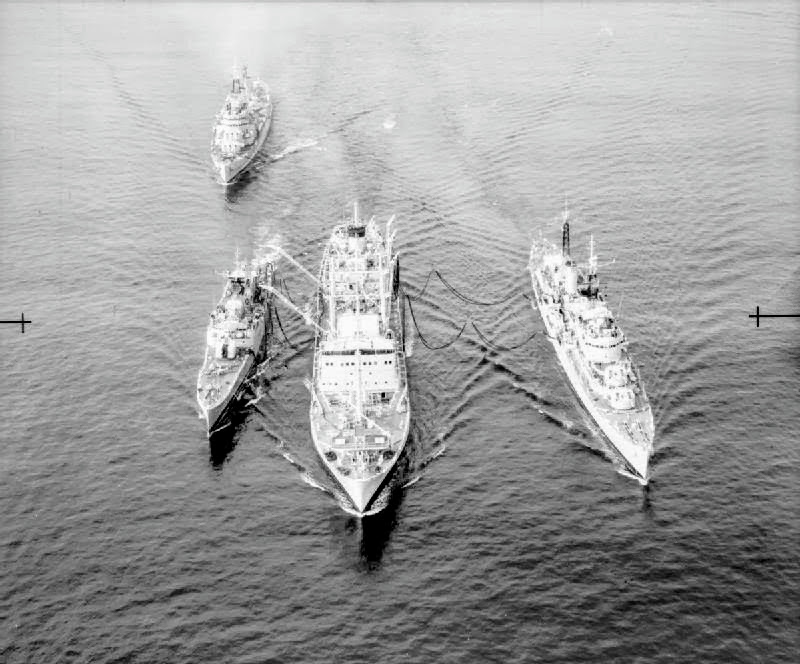
HMNZS Royalist flying her paying off pennant – Nov 8th 1965HMNZS Royalist – GuamRAS: HMS Yarmouth, RFA Tidereach, HMNZS Royalist, HMS Belfast astern. Off Japan 1957
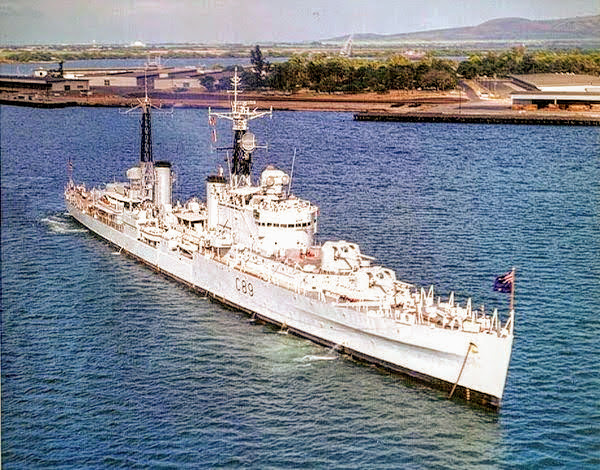
After her commissioning in 1943, Royalist was modified with extra facilities and crew for operating as a flagship in aircraft carrier operations. Initially, she operated in the North Sea before transferring to the Mediterranean for the invasion of southern France. Royalist remained in the Aegean Sea until the end of 1944 before sailing to the Far East in 1945 where the ship served until the end of the war.
Royalist was then put into reserve until 1953, when the Navy decided to proceed with plans to refit the ship. The high cost of reconstruction and new governmental policy forced the RN to transfer the vessel to the Royal New Zealand Navy (RNZN) in 1956. In return, New Zealand covered the reconstruction costs of Royalist. After ten years of service with the RNZN, which included involvement in the Suez Crisis and the Indonesia–Malaysia confrontation from, she was scrapped in 1967.
In 1943, the Royal Navy (RN) intended to use the Bellona-class as flagships in escort carrier/cruiser groups during the Invasions of France as well as during joint Royal Navy-US Navy operations in the Pacific. Within months of her commissioning, Royalist‘s design diverged from the rest of her class. She was fitted with two extra rooms that further enabled her to communicate with aircraft carriers and Fleet Air Arm aircraft. In addition, she was modified with the incorporation of one of the first implementations of an “Action Information Office” (AIO). The AIO was a early operations room, in which computers and manual plotting allowed a force to be managed efficiently. The AIO allowed her to operate as a command ship in the northern Atlantic, primarily in hunting German warships Tirpitz and Scharnhorst. The specialized equipment pushed crew members to their limits, as only minimal space remained for sleeping and comfort.[1] Compared to her base design requiring a crew of 484, Royalist’s compliment was 600, adding to the aforementioned problems of cramped conditions. All together, Royalist was designated as a ‘Carrier Flagship’ when she was mounted with radar.[2]
Royalist was built by Scotts Shipbuilding and Engineering Company of Greenock who laid her keel on 21 March 1940. She was launched on 30 May 1942, and commissioned on 10 September 1943. She returned to the dockyard for alterations in November which were not complete until February 1944. Her French motto, Surtout Loyal, translates to “Loyal above all”.[2]
Following her commissioning, Royalist spent several months working up, in which she underwent repairs for trial defects and for further alterations and additions. These included aforementioned modifications for service as a carrier flagship.[2] In March 1944, Royalist joined the Home Fleet and served for a short period in the Arctic theater. In this capacity, she was flagship of Operation Tungsten, the carrier raid in April 1944 against the German battleship Tirpitz at anchor in a fjord in Norway.
After Tungsten, Royalist escorted carriers for attacks on shipping off Norway before entering dock for a refit.[3] After completion of the work in June, Royalist was ordered to the Mediterranean to support the Operation Dragoon landings in the south of France in August 1944. Royalist was the flagship (Rear Admiral Thomas Hope Troubridge) of the RN/USNTask Force 88 that was tasked with maintaining air superiority over the beaches and support of landing operations.
Following the Dragoon landings, Royalist joined the Aegean Force, tasked with preventing enemy evacuation from the islands in the Aegean Sea. On 15 September, Royalist and destroyer HMS Teazer sank transports KT4 and KT26 off Cape Spatha. She was stationed in the Aegean until late 1944 before a refit in early 1945 at Alexandria. After her stint in the Mediterranean, she was transferred to the East Indies and joined the East Indies Fleet.
Scottish author Alistair MacLean served on Royalist during the war, and used his experiences as background for his acclaimed first novel HMS Ulysses (1955) as well as for some of his subsequent works.[citation needed]
Royalist was withdrawn from the East Indies after the end of the war and returned home to be mothballed and dehumidified in 1946.
Concerned about the growth and threat of the Soviet Navy, the Admiralty board ordered a modernization of four Dido-class cruisers in 1950.[b][4][5]Royalist was planned to be the first of four to six Dido/Bellona-class cruisers to be modernized under the program, with work planned to start in January 1953.[6] The ships were chosen as they were modern, economical, and could be easily modified with new radars and fire control systems.[7][8][failed verification] The importance of the refits increased when other attempts to do the same to Colony-class and Swiftsure-class cruisers were canceled.[9]
The modernization required the construction of a new superstructure and the addition of a fire control system, with the work planned to only extend the cruiser’s lifespan by 6 years. In March 1953, reconstruction of Royalist began.[5]
Following the Conservative victory in the general election of 1951, attitude towards the RN changed. Newly re-elected Prime MinisterWinston Churchill supported the Royal Airforce at the cost of the navy, and its budget was cut in 1952.[10] The shift in policy undermined naval expansions by the outgoing Attlee government, and the Navy was forced to cancel upgrades of many ships.[11][12] Under these financial cuts, plans to refurbish Royalist and her sister ships were postponed by three years. In 1954, a review of the Royal Navy found that the cruiser conversions lacked “dual war and peace, [and] cold war capabilities required” for the Navy, and the program was further deprioritized.[13][14]
In 1955, the RN was looking to offload the half-renovated and obsolete Royalist. The offer was accepted by New Zealand Prime MinisterSid Holland, who offered that his nation would pay for the rest of her reconstruction.[15]
Royalist‘s transfer occurred when the Royal New Zealand Navy (RNZN) was at a crossroads about its future. Internal factions within the RNZN and New Zealand government disagreed regarding the roles and doctrine of its Navy, with many unsure how a nuclear-era force should function and the importance of anti-submarine frigates.[16][17]Royalist‘s refurbishment cost of £4.5 million indicated the position of the Navy, as the RNZN chose to refurbish the cruiser rather than build two frigates with the same funds.[18][19]
Those in favor of a new cruiser believed a ship like Royalist would be able to serve an anti-aircraft role in supporting allied operations in the Pacific, alongside the RN and Royal Australian Navy.[20][21]Royalist was faster, more armed, and had better range then the Whitby-class frigates proposed to be bought instead. Furthermore, concern about Soviet cruisers raiding shipping in the South Pacific gave her the edge over the primarily ASW ships.[22]
New Zealand only covered her reconstruction costs, and did not out-right buy the ship. This was due to the RN only ‘loaning’ the vessel, as the RNZN was not seen as being an independent force within the British Empire. When her modifications were complete, New Zealand refused to accept the vessel, stating that the poor World War II-era sleeping arrangements and lack of ABC equipment were unsatisfactory. This soured relations between the two navies, as the RN did not appreciate perceived refusal from a subordinate.[20][21]
The ship was handed over to the Royal New Zealand Navy on 9 July 1956 following the completion of the work. Controversy over her purchase (and governmental stance) persisted, with the ship being viewed as either a white elephant or the most modern and capable vessel of the RNZN.[23]
As part of the Kiwi half of her refurbishment, Royalist was fitted with a new radar, fire control system, and three ‘STAAG 2’ 40 millimeter anti-air guns.[24]
After working up in British waters, Royalist was assigned to the British fleet in the Mediterranean. In August 1956, New Zealand Prime Minister Sidney Holland was persuaded by British Prime Minister Anthony Eden to keep her in the Mediterranean as a deterrent to Egyptian or Israeli aggression.[25][26][27] Despite not operating her, the RN wanted to keep the cruiser on station due to her anti-air capabilities and the threat of hostile aircraft. Following diplomatic negotiations between the two respective governments, the New Zealand Cabinet agreed not to recall the cruiser under the condition that she did not participate in combat.[citation needed]
As New Zealand figured out the nation’s stance on the crisis, the cruiser operated with the RN fleet as an air defenseradar picket, rescue ship for downed pilots, and as a method to coordinate British aircraft on bombing runs.[32][29] Later on during the crisis, the New Zealand Cabinet met again to discuss Royalist. Due to the cruiser forming an important part of the RN’s anti-air defense in the area, and not wanting to harm relations further, the cabinet “decided not to decide” on her presence within the RN fleet. As such, she remained with the Royal Navy fleet yet did not participate further in Operation Musketeer.[29]
Royalist continued to operate with allied navies in the 1950s, and her anti-air capabilities were proven when she outperformed RN cruisers during exercises.[33][34] As part of New Zealand involvement in the Malayan Emergency, she was used to repeatedly shell the MNLA in Johore.[35]
By 1960, the cruiser was expected to serve another 2 and a half years, and the Navy began searching for a replacement. At the time, the RN was short of loanable cruisers, so the destroyer HMS Duchess (D154) was transferred to cover the decommissioning of both Royalist and the recently sunk HMAS Voyager.[36][37]
In 1962, while sailing in rough weather in the Tasman Sea, the cruiser’s keel twisted out of alignment. It was found that her captain ran the ship at excess speed into a head sea in an attempt to make it back to land to watch a Rugby match between the Wallabies and All Blacks.[38]
Between 1963 and 1965, she operated with the British Far East Fleet during the Indonesia–Malaysia Confrontation. She joined British vessels in making provocative passages between Indonesian Islands in an attempt to deter Indonesian attacks on Malaysia. During these deployments, her age began to show, as captains described unserviceable equipment, structural degradation, and below-deck overheating; by now, the ship was already beyond her lifespan and overdue for retirement. [39]
Many in the RNZN doubted that the ageing ship could deploy again. Despite these concerns, she spent two months being refitted to allow her to rejoin the overstretched Far East Fleet in 1965. Following this work, it was estimated that the ship’s steam turbines could be kept operational for 15 more months.[40][41] For her last ever deployment, she was ordered to Peral Harbor for further maintenance before being sent to Hong Kong and Singapore to relieve the British fleet.[42] Once in Singapore, she conducted anti-infiltration patrols, boarded boats, deployed shore patrols, served as a simulated “enemy Sverdlov cruiser“[42] in exercises, and provided air defense for HMS Bulwark off Borneo.[43]
While returning to New Zealand, a boiler and turbine broke down, canceling her Waitangi Day tour of the country and ending her career five months early.[citation needed]
Royalist was paid off on 4 June 1966 and, after eleven years in the RNZN, reverted to Royal Navy control in 1967. She was sold for scrap to the Nissho Company of Japan in November 1967. She was towed from Auckland to Osaka on 31 December 1967 and scrapped upon arrival.
Gambia was conceived in the 1938 Naval Estimates and was laid down on 24 July 1939, at Swan Hunter‘s Yard at Wallsend. She was launched on 30 November 1940, by Lady Hilbery and commissioned on 21 February 1942.
The cruiser saw active service in the East Indies with the British Eastern Fleet, and was involved in the Battle of Madagascar in September 1942. She then carried out trade protection duties in the Indian Ocean, but returned to home waters, calling at the territory of the Gambia on the way, where West African Chiefs in full regalia led thousands of their subjects to visit the ship named after their colony.
She refitted at Liverpool between June and September.
Because New Zealand‘s two other cruisers of the time, HMNZS Leander and HMNZS Achilles were damaged, it was decided in discussions with the Royal Navy Admiralty that Gambia would be recommissioned as HMNZS Gambia, for the use of the Royal New Zealand Navy.
The New Zealand Official History writes: “… HMNZS Gambia was commissioned at Liverpool on 22 September 1943 under the command of Captain William-Powlett, DSC, RN. A few of the officers and three-quarters of the ratings were New Zealanders.”[1] On 3 October 1943 the New Zealand High Commissioner visited the Gambia and addressed the ship’s company. After sea trials, shaking down, and ten days attached to the 1st Cruiser Squadron in Scapa Flow, she arrived at Plymouth “… on 5 December 1943 to work with HM ships Glasgow and Enterprise under the orders of the Commander-in-Chief, Plymouth.”[1] With these ships she commenced anti-blockade runner patrols in the Bay of Biscay in December, as part of Operation Stonewall. Of particular note was the pursuit of the German blockade-runner Osorno, and the pursuit and destruction of another blockade-runner under Captain William-Powlett’s overall command, but without actual involvement: “Under the circumstances,” wrote William-Powlett, “Gambia, the senior of the four cruisers, was unable to take part in the successful and exciting operation carried out by Glasgow and Enterprise: she could merely play the part of an exasperated listener-in …’
Gambia subsequently served with the British Pacific Fleet and participated in attacks on Japanese positions throughout the Pacific. In February 1944 she searched for blockade runners in the Cocos Islands area. She also supported a series of carrier raids against oil installations and airfields. She saw action off Okinawa, Formosa and Japan and took part in the bombardment of the Japanese city of Kamaishi on 9 August. She was attacked by a Japanese kamikaze aircraft [2] as a ceasefire was announced, and fired some of the last shots of World War II.
Gambia was returned to the Royal Navy at Portsmouth on 27 March 1946. She underwent a refit and was recommissioned on 1 July 1946 for the 5th Cruiser Squadron with the Far East Fleet. She returned to the UK on 6 January 1948, and in January 1950 she was assigned to the 2nd Cruiser Squadron in the Mediterranean, later serving with the 1st Cruiser Squadron on the same station until October 1954. In 1953, she and her sisterBermuda brought aid to the Greek island of Zakynthos when it was struck by the Ionian earthquake. Greek officials would later comment, “we Greeks have a long-standing tradition with the Royal Navy and it lived up to every expectation in its infallible tradition of always being the first to help”.[3] In the same year she took part in the Fleet Review to celebrate the Coronation of Queen Elizabeth II.[4]
In 1955 she became flagship of the 4th Cruiser Squadron on the East Indies Station, but the decision not to continue the refit of the battleshipVanguard, meant funds were available for a life extension of Gambia and Bermuda, with additional finance and equipment from US assistance to NATO.[5] The refit gave them a final light anti-aircraft (AA) armament of nine twin 40 mm Bofors, refitted in positions than gave wider angles of fire and US Mk 63 and SPG-35 radar fire control[6] for the 4 inch mounts. This was similar to that being fitted to the remaining United States NavyBaltimore-class cruisers in 1956–57, although the twelve twin 3-inch/50 calibre guns on the US cruisers were far more accurate and effective than the Royal Navy Mk 5 Bofors or X1X twin 4-inch guns.
In May 1957 Gambia sailed again for the Persian Gulf, becoming the last flagship for the Commander-in-Chief, East Indies, Vice Admiral Hilary Biggs,[7] and returned to Rosyth on 19 September 1958. On 4 November 1958 she recommissioned for the 1st Cruiser Squadron in the Mediterranean. She deployed to the Far East on 4 December 1959 to relieve the cruiser Ceylon in the Red Sea. The ship returned to the UK via South Africa with a visit to Freetown and the Gambia, before arriving in Portsmouth in July 1960. The last months of 1960 she served in the South Atlantic and the Home Fleet before entering the reserve in December of that year, her crew largely going to the new cruiser Blake.
Gambia was paid off to reserve in December 1960. She remained in reserve at Portsmouth until she was put on the disposal list and sold to Thos. W. Ward for scrapping. She left Portsmouth under tow on 2 December 1968 and arrived at Inverkeithing for breaking up on 5 December.