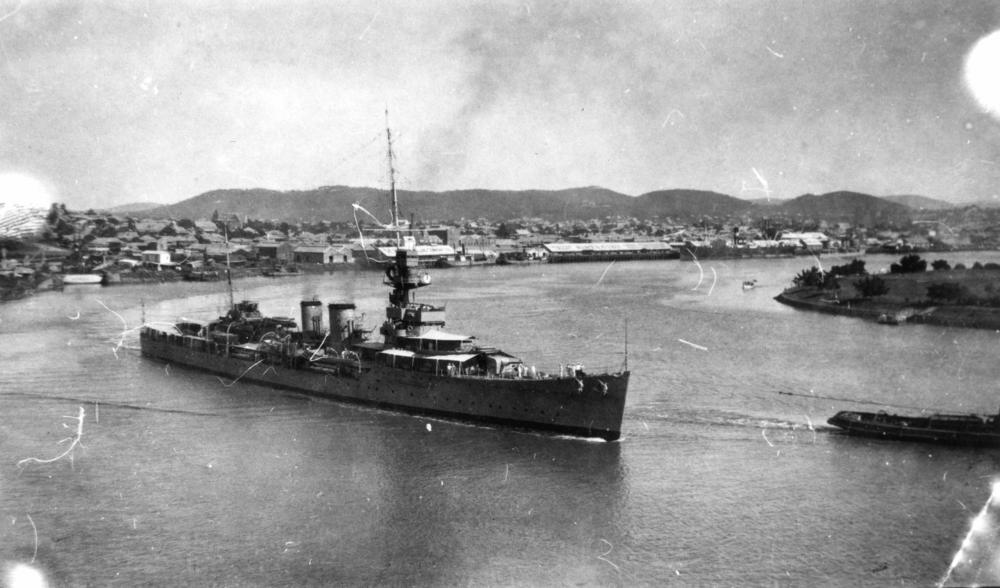
HMS Dunedin – The Dunedin turning into Gardens Reach on the Brisbane River. South Brisbane wharves in background. (Description supplied with photograph).
She was launched from the yards of Armstrong Whitworth, Newcastle-on-Tyne on 19 November 1918 and commissioned on 13 September 1919. She has been the only ship of the Royal Navy to bear the name Dunedin (named after the capital of Scotland, generally Anglicised as Edinburgh).
In early 1940 Dunedin was operating in the Caribbean Sea, and there she intercepted the German merchant ship Heidelberg west of the Windward Passage. Heidelberg‘s crew scuttled the ship before Dunedin could take her. A few days later, Dunedin, in company with the Canadian destroyer Assiniboine, intercepted and captured the German merchant ship Hannover near Jamaica. Hannover later became the first British escort carrier, Audacity. Between July and November, Dunedin, together with the cruiser Trinidad, maintained a blockade off Martinique, in part to bottle up three French warships, including the aircraft carrier Béarn.
On 15 June 1941, Dunedin captured the German tanker Lothringen and gathered some highly classified Enigmacipher machines that she carried. The Royal Navy reused Lothringen as the fleet oiler Empire Salvage. Dunedin went on to capture three Vichy French vessels, Ville de Rouen off Natal, the merchant ship Ville de Tamatave east of the Saint Paul’s Rocks, and finally, D’Entrecasteaux.
Dunedin was part of the escort of Convoy WS 5A when it was attacked by the German heavy cruiserAdmiral Hipper.on 25 December 1940. The attack was repulsed by other ships of the escort, without losses to the convoy.[1]
Dunedin was still steaming in the Central Atlantic Ocean, just east of the St. Paul’s Rocks, north east of Recife, Brazil, when on 24 November 1941, at 1526 hours, two torpedoes from the German submarine U-124 sank her. Only four officers and 63 men survived out of Dunedin‘s crew of 486 officers and men.
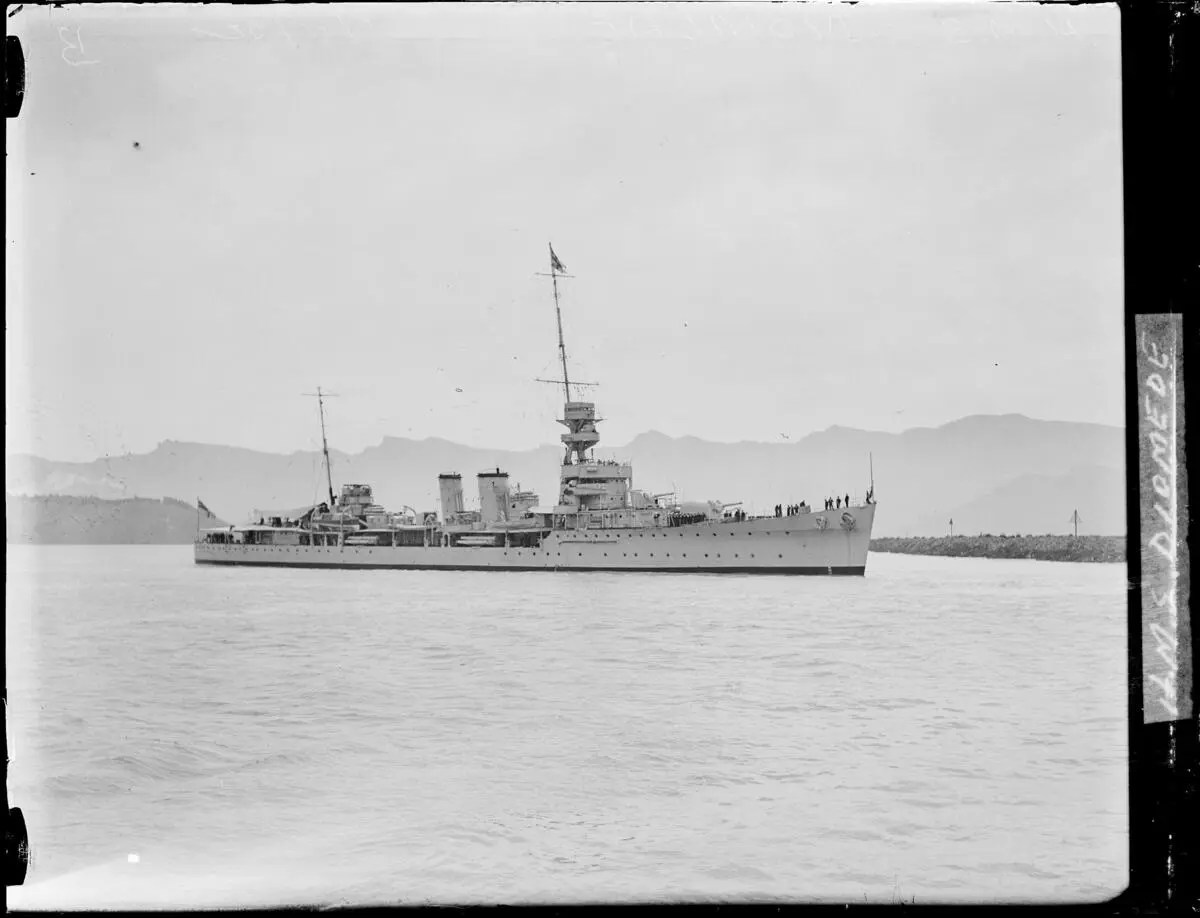
Between the wars, she served on the China Station, Pacific waters, East Indies Waters and from 1936 onwards, in reserve. In World War II she performed four years of arduous war duty, during which time she captured the German blockade runner Idarwald. Between 22 July 1942 and 24 September 1943 she was converted to a training ship at Rosyth Dockyard. In 1945 she was placed in reserve and scrapped a year later. Early career Upon commissioning Diomede joined the 5th Light Cruiser Squadron on the China Station in 1922. In 1925 she was transferred to the New Zealand Division of the Royal Navy at Devonport where she served until 1935, apart from a refit in 1929-1930. In 1931 she rendered assistance to the town of Napier, New Zealand after the devastating Hawkes Bay earthquake, supplying medical personnel, equipment, guards and firemen, along with her sister ship Dunedin. Afterwards Diomede escorted the beach-damaged HMS Veronica to Auckland. The Executive officer at the time (1930-1933) was Commander, later Admiral Victor Crutchley, who was to later become entwined with the Pacific Campaign of World War II. Upon the notification that the two cruisers of the New Zealand Division were to be replaced by Leander class cruisers, in 1935 Diomede started her voyage home to Britain to be paid off into the reserve. En route the Abyssinian Crisis broke out and she was diverted to the 4th Light Cruiser Squadron, part of the East Indies Fleet based at Aden for possible action against the Italians. Upon relief by HMS Achilles on 31 March 1936 she was paid off and spent the next three years in the reserve fleet or as a troop ship. http://en.wikipedia.org/wiki/HMS_Diomede_(D92)
Allan C. Green – State Library of Victoria – Allan C. Green collection of glass negatives.
lHMS Achilles and HMS Leander 1938 HMS Philomel alongside training jetty
Achilles crew members returning aboard at Rio de Janeiro
HMS Achilles, USS Louisville, Melb Feb. 1930’s
The 7000 ton light cruiser HMNZS Achilles at Malta. The Achilles belongs to the Leander class, the first modern light cruiser class of the Royal Navy. She was fitted with New Zealand-made radars, her crew comprised of mostly New Zealanders.
On this day, March 17 in 1946, HMNZS Achilles arrived in Auckland ending her service with the British Pacific Fleet. Read about HMNZS Achilles on our website: https://navymuseum.co.nz/…/by-collections/ships/achilles/ Image: AAF 0197 HMNZS Achilles 1946
Supermarine Walrus on board HMNZS Achilles
She was launched in 1931 for the Royal Navy, loaned to New Zealand in 1936 and transferred to the new Royal New Zealand Navy in 1941. She became famous for her part in the Battle of the River Plate, alongside HMS Ajax and HMS Exeter and notable for being the first Royal Navy cruiser to have fire control radar, with the installation of the New Zealand-made SS1 fire-control radar in June 1940.[2]
After Second World War service in the Atlantic and Pacific, she was returned to the Royal Navy. She was sold to the Indian Navy in 1948 and recommissioned as INS Delhi. She was scrapped in 1978.
She was the second of five ships of the Leander-class light cruisers, designed as effective follow-ons to the York class. Upgraded to Improved Leander-class, she could carry an aircraft and was the first ship to carry a Supermarine Walrus, although both Walruses were lost before the Second World War began. At one time she carried the unusual DH.82 Queen Bee which was a radio-controlled unmanned aircraft, normally used as a drone.
Achilles was originally built for the Royal Navy, and was commissioned as HMS Achilles on 10 October 1933. She would serve with the Royal Navy’s New Zealand Division from 31 March 1936 up to the creation of the Royal New Zealand Navy, into which she was transferred in September 1941 and recommissioned HMNZS Achilles. About 60 per cent of her crew was from New Zealand.
At the outbreak of the Second World War, Achilles began patrolling the west coast of South America looking for German merchant ships, but by 22 October 1939 she had arrived at the Falkland Islands, where she was assigned to the South American Division under Commodore Henry Harwood and allocated to Force G (with Exeter and Cumberland).
Achilles as seen from Ajax at the Battle of the River PlateHMS “Achilles” in Battle of the River Plate , a painting by Frank Norton, is part of the National Collection of War Art held by Archives New Zealand
In the early morning of 13 December 1939, a force consisting of Achilles, Ajax and Exeter detected smoke on the horizon, which was confirmed at 06:16 to be a pocket battleship, thought to be the German battleship Admiral Scheer but which turned out to be Admiral Graf Spee. A fierce battle ensued, at a range of about 11 nautical miles (20 km). Achilles suffered some damage. In the exchange of fire, four crew were killed, her captain, WE Parry, was wounded; 36 of Graf Spee‘s crew were killed.
The range reduced to about 4 nautical miles (7.4 km) at around 07:15 and Graf Spee broke off the engagement around 07:45 to head for the neutral harbour of Montevideo which she entered at 22:00 that night, having been pursued by Achilles and Ajax all day. Graf Spee was forced by international law to leave within 72 hours. Faced with what he believed to be overwhelming odds, the captain of Graf Spee, Hans Langsdorff, scuttled his ship rather than risk the lives of his crew. An ensign flag flown by HMS Achilles in the Battle of the River Plate was donated to Christ Church Cathedral in the Falkland Islands and is still on display hanging on the south wall of the Cathedral at Port Stanley.[3]
While operating off Guadalcanal Island with US Navy Task Force 67 on 5 January 1943, she was attacked by four Japanese aircraft. A bomb blew the top off X turret, killing 13 sailors. Between April 1943 and May 1944 Achilles was docked in Portsmouth, England for repairs and modernisation. Her single 4-inch AA guns were replaced by the dual-purpose QF 4 inch Mk XVI naval gun in four twin mountings, modern radar was fitted, and the damaged X turret was replaced by four QF 2 pom poms in a quadruple-mount. The work was delayed by a dockyard explosion that killed 14 men. Stoker William Dale was awarded the Albert Medal for Lifesaving for his actions in saving the lives of several dockyard workers.[6]
Sent back to the New Zealand Fleet, Achilles next joined the British Pacific Fleet in May 1945 for final operations in the Pacific War.
After the war, Achilles was returned to the Royal Navy at Sheerness in Kent, England on 17 September 1946. She was then sold to the Indian Navy and recommissioned on 5 July 1948 as INS Delhi. She remained in service until decommissioned for scrap in Bombay on 30 June 1978. In 1968 she was present at the granting of independence to Mauritius representing the Indian Government together with the Royal Navy frigate Tartar under Captain Cameron Rusby.[7] As part of the scrapping her Y turret was removed and presented as a gift to the New Zealand government. It is now on display at the entrance of Devonport Naval Base in Auckland.[8] On 22 January 1979, Admiral Jal Cursetji, the Indian Navy Chief of the Naval Staff, presented Achilles’s builder’s plaque, steering wheel and engine room telegraph to Admiral Terence Lewin, the First Sea Lord and Chief of the Naval Staff of the Royal Navy.[9]
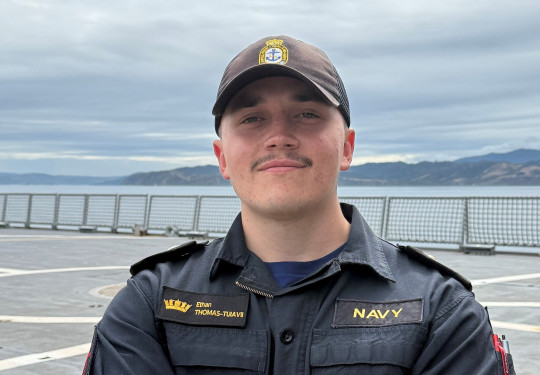
Midshipman Ethan Thomas-Tuiāvi’i can thank his family for pushing him into a career with the Royal New Zealand Navy and he is now also chasing the achievements of his great-grandfather as a naval aviator.
11 March, 2025
Midshipman Thomas-Tuiāvi’i, from Porirua, was among 11 officers and 68 sailors who recently graduated at Devonport Naval Base after completing their 22-week junior officer and basic common training.
As a warfare officer, the 19-year-old is now logging sea time aboard HMNZS Canterbury, including a mission to New Zealand’s Sub-Antarctic Islands. He will then move into Officer of the Watch training ashore and aboard inshore patrol vessel HMNZS Taupo.
After finishing Aotea College, Midshipman Thomas- Tuiāvi’i attended university for a year. His uncle, who worked as a civilian in the Navy, inspired him to join.
“Growing up in a household which reinforced my Samoan heritage and values allowed me to express myself as a social, hard-working and caring being, which are some of the traits my uncle recognised as being perfect for serving.”
“I also envied the endless opportunities that come with the Navy in terms of serving and travelling.”
He kept his family and friends in mind during the tougher parts of officer training.
“There is nothing I wouldn’t do to make them proud of what I am able to accomplish, particularly my mother, nieces and nephews.
“All my motivation came from me wanting to be the best son I could be, but also the best mentor for my nieces and nephews as they grow up and being a proper and respectable role model for them.”
He also has a cousin and grandfather who served in the New Zealand Army, and he understands his great-grandfather was an aviator in the Navy. It’s inspired him to pursue an aviation career one day.
“I don’t know too much about my great-grandfather. I’ve only heard stories from my grandfather about how brave of a man he was.
“But I’ve always been interested in aviation. Becoming a Navy pilot is my ultimate goal and something I would take great pride in carrying out on a day-to-day basis.”
His first advice to Year 13s at his old school was to make sure they completed the year.
“And contact as many New Zealand Defence Force personnel as you can.
“Talk to them, hear their stories and experiences. Do plenty of research and see what floats your boat.
“Don’t rush it. It takes time to gain an understanding of what it is the Navy has to offer in terms of career pathways, training, qualifications as well as some of the benefits such as tertiary studies.”
Another view of the Commonwealth Jubilee Exercises off the coast of Tasmania in Feb.-March 1951. Here we see a flight of 10 aircraft – seven Hawker Sea Furies and three Fairey Fireflies from HMAS SYDN EY over the 5,950-7,200 ton New Zealand Modified Dido Class cruiser HMNZS BELLONA.
In a way this is a physical manifestation of postwar New Zealand naval policy, in that the RNZN Dido Class anti-aircraft cruisers were obtained by loan and acquisition after WWII specifically to operate with Australian aircraft carriers, making a strong combined regional force.
Again, these were the exercises during which, on Feb. 26, 1951, a practice rocket [or rockets, we’re not sure] fired by a Sea Fury from SYDNEY struck the quarterdeck of HMNZS BELLONA, fortunately without major damage or casualties.
BELLONA was towing a target astern, but as we have previously reported, a little facetiously, the Sea Fury pilot, Lt Peter Seed – a New Zealander, like many in the RAN’s FAA squadrons then – had insisted before an enquiry that he had not pressed the rocket firing button, and the plane’s rockets had streaked off independently, and inadvertently.
Noone quite accepted that at the time, although it was clearly as accident. It was only later, during SYDNEY’S tour of duty in Korea that it was discovered that powerful low frequency radio transmissions from the carrier had the capacity to spontaneously ignite the under-wing rockets on her aircraft aloft. Indeed it was found to be a problem on other carriers also, and arming procedures for the ordnance had to be changed.
Subsequently, in somewhat different circumstances, it was a spontaneous under-wing rocket firing from an an electrical surge that caused the huge deck fire on the U.S. super carrier USS FORRESTAL in the Gulf of Tonkin on July 27, 1967. The consequences in that case were truly tragic, with 134 men killed and 161 injured, as explosions and fire spread among fuel and bomb-laden aircraft on the giant carrier’s crowded flight deck. Details of that incident are here.
en.wikipedia.org/wiki/1967_USS_Forrestal_fire
By the way, we had a wonderful Allan C. Green portrait of HMNZS BELLONA at Entry NO. 5317, here:
This photo: ADF Serials website, RAN aircraft section, with permission. With a magnificent collection of photographs and aircraft log and tracing information, you can find the ADF Serials website here:
She was the first of the fourth group of Dido-class cruisers. Built to a modified design (“Improved Dido”) with only four twin 5.25-inch turrets, but with remote power control for quicker elevation and training, combined with improved handling and storage of the ammunition. The light AA was improved over earlier Dido cruisers, with six twin 20mm Oerlikons and three quadruple 40mm “pom pom”.
Entering service in late 1943, the cruiser operated during World War II as an escort for the Arctic convoys, and as a jamming ship to prevent the use of radio-controlled bombs and in support of the Omaha Beach landings.
In 1946 the cruiser was loaned to the Royal New Zealand Navy. Although not involved in the 1947 Royal New Zealand Navy mutinies, at the start of the month, 140 sailors elected to not return to the ship in protest at the poor pay and working conditions and how their colleagues had been treated. Fifty-two sailors were eventually marked as deserters while the others were charged with various lesser offences.
Bellona was returned to the Royal Navy in 1956. She did not re-enter service and was scrapped two years later.
She was built by Fairfield Shipbuilding and Engineering Company (Govan, Scotland), with the keel being laid down on 30 November 1939. She was launched on 29 September 1942 and commissioned on 29 October 1943. All of the Bellona class used the High Angle Control System (HACS) and they were all fitted with Remote Power Control, allowing the HACS to remotely control their 5.25-inch (133 mm) guns.
Bellona was named after the Roman goddess of war. Her motto was ‘Battle is our Business’.
Bellona participated in several Arctic convoys supplying the USSR, both before and after the invasion of France. She took over the Channel patrol at the start of 1944 as a replacement for the cruiser Charybdis, which had been sunk off the Channel Islands by torpedo boats in the Battle of Sept-Îles. On arrival at Plymouth, Bellona was fitted with equipment for jamming the radio signals that controlled bombs. Bellona and seven destroyers were involved, including Tartar. The codename for the patrol force was ‘Snow White and the seven dwarfs’.
During the day the force anchored in Plymouth Sound, as air defence for Plymouth. At dusk, under cover of darkness and maintaining radio and radar silence, the force would proceed at full speed to the French coast to keep the German Narvik-class destroyers bottled up in Brest. The force would return to Plymouth by daylight. By day the RAF would patrol the Channel and by night, Plymouth.
A Force 12 plus gale was blowing when this picture was taken from the bridge as HMS Bellona plunged through mountainous seas on a convoy to Russia. Note the huge wave in front of the ship
On 6 June Bellona‘s duty was to help to support Omaha Beach, in the American sector, where she was placed along with US battleships USS Texas and USS Arkansas under the command of Rear admiral Carleton F. Bryant. As the army advanced, Bellona fired her guns inshore at targets spotted by aircraft and forward observation officers off-shore. On several occasions Bellona returned to Plymouth to get more ammunition and change her gun barrels because of wear. At night Bellona went close inshore to provide supporting fire.
In July 1944 Bellona covered the carrier raids against the German battleship Tirpitz but the following month was back in the Channel, attacking German convoy traffic in the Bay of Biscay and off the Brittany coast.
Bellona returned to northern waters for the remainder of the war, sailing on Arctic convoys and accompanying carrier and cruiser sweeps along the Norwegian coastline before arriving in Copenhagen in time for the German surrender in May 1945.
After the war she was part of the 10th Cruiser Squadron until 1946 when she was loaned to the Royal New Zealand Navy.
During March and April 1947 Bellona was involved in training exercises with the Royal Australian Navy.[1] During gunnery practice a sailor, Gordon Patten, was injured and was sent to hospital for treatment where he remained for months. The cruiser returned to Devonport Naval Base in Auckland in late April and the crew were given a day’s leave to attend Anzac Day services and events on Friday, 25 April.[2] Although the ship had missed the main mutiny at the start of the month, personnel from Bellona were concerned about how their colleagues had been treated and during the afternoon, about 100 sailors assembled in Quay Street, Auckland and decided not to return to duty.[2] They compiled a list of three demands—that naval pay rates be increased to match the New Zealand Army and Royal New Zealand Air Force; that committees tasked with improving the welfare of the lower ranks be established; and that the sailors involved in the previous mutiny not be persecuted or punished.[2] Another 40 sailors mustering before boarding Bellona were recruited into the mutiny. In response, Bellona‘s captain sent the entire complement on leave for the weekend.[2]
On Monday 28 April, a letter listing the mutineers demands was presented to the captain with the intention that it be forwarded to the Naval Board.[2] Instead of addressing the complaints, the New Zealand Naval Board declared that any sailor who did not return to duty by the morning of Tuesday 29 April would be marked as Absent Without Leave.[3] By morning parade 52 men had failed to return.[3] Those sailors were marked as having deserted even though naval regulations meant that they had to be absent for seven days before being considered deserters.[3] Once marked, the sailors lost all unpaid pay and allowances.[3] The issuing of arrest warrants for the sailors was also considered, but the cruiser’s captain dismissed the suggestion.[3] Between the date of the mutiny and 23 June, when Bellona sailed on her next deployment, another 32 men returned.[3] Various charges were laid against them, ranging from “wilfully disobeying a legal command” to “joining a mutiny not accompanied by violence” and the sailors were sentenced to periods of imprisonment up to 92 days.[3]
In 1951 the cruiser was taking part in a multinational exercise in Australian waters.[4] During the exercise a Hawker Sea Fury from the Australian aircraft carrierHMAS Sydney accidentally fired four practice rockets into the superstructure of the New Zealand ship.[4] Only minor damage was caused and although an inquiry concluded that the pilot had unintentionally pressed the fire button, it was later found that certain signal frequencies transmitted by Sydney’s radios could trigger the aircraft’s weapon-firing circuits.[4] By 1952 a limited attempt at modernisation was being undertaken, with the twin Oerlikons being replaced with land Mk 3 single Bofors, which were upgraded with electric power into the RNZN unique Toadstool CIWS, also refitted to HMNZS Black Prince and intended to be controlled by six STD directors which the Government was reluctant to approve with the uncertain future of the cruiser. It was intended to refit the multiple pom pom mounts to both cruisers, and they were installed for the return voyage to the UK as the RN judged Toadstool as non-standard and not as good as the RN’s new electric 40mm mounts.
Bellona reverted to Royal Navy control after the transfer of the cruiser Royalist in 1956.






.jpg)
_(15333552416).jpg)



-_SLV_H91.250-1391.jpg)


