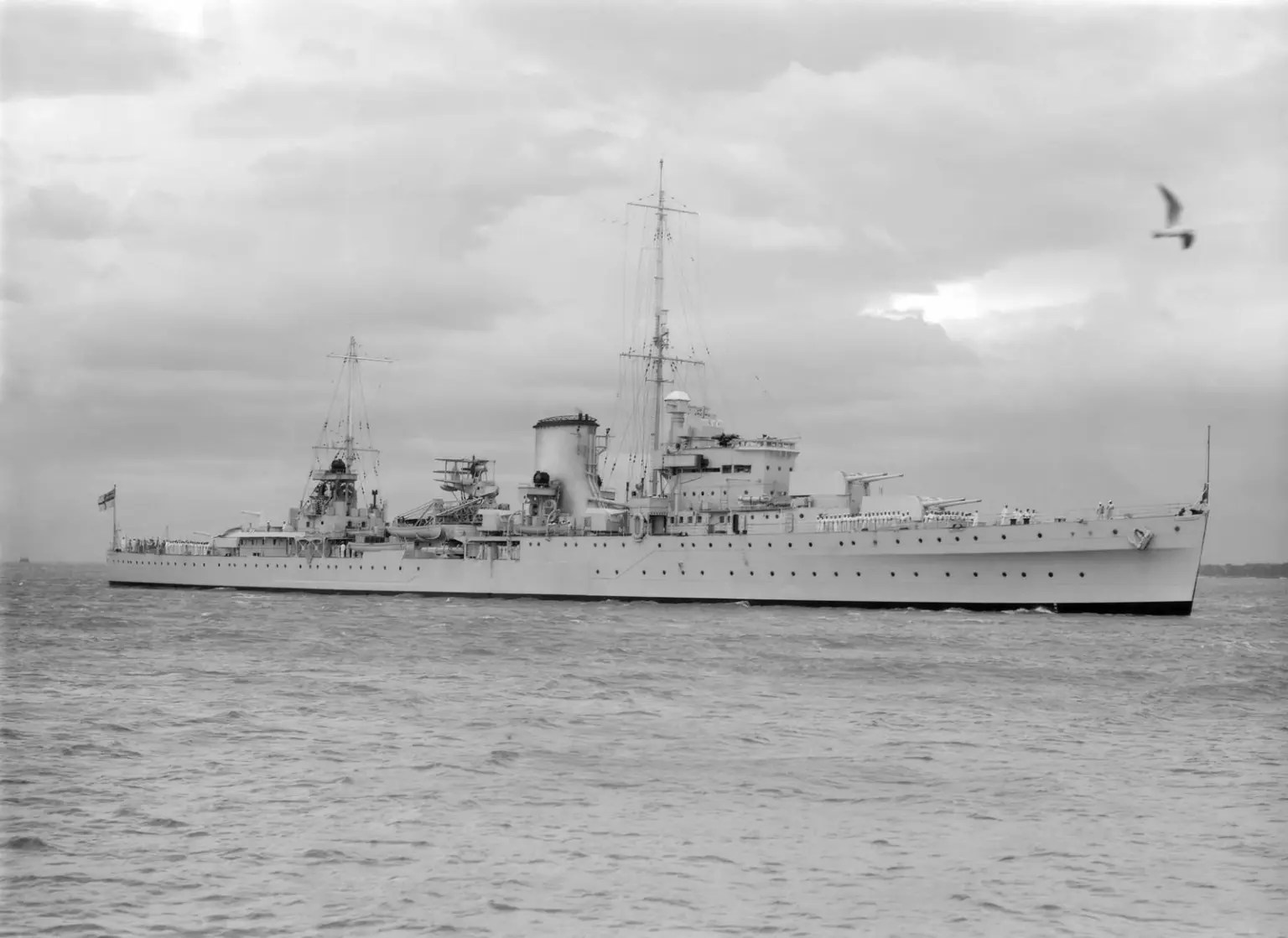
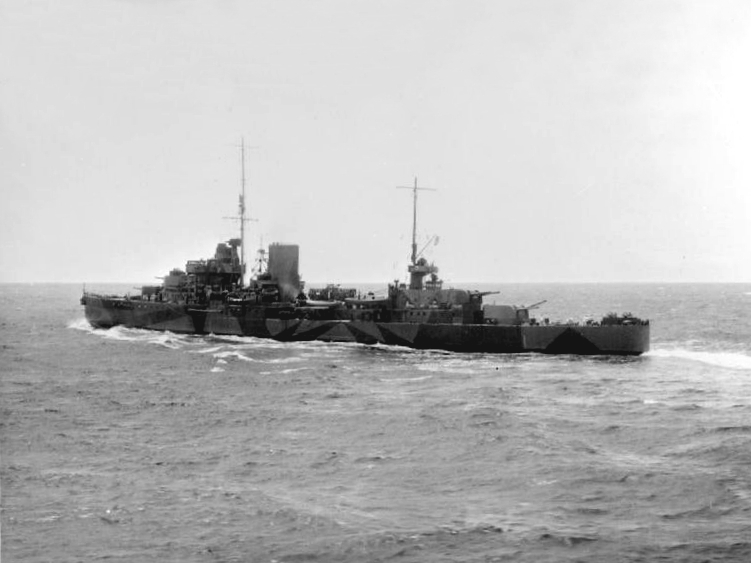
HMNZS Leander (75) was a light cruiser which served with the Royal New Zealand Navy during World War II.

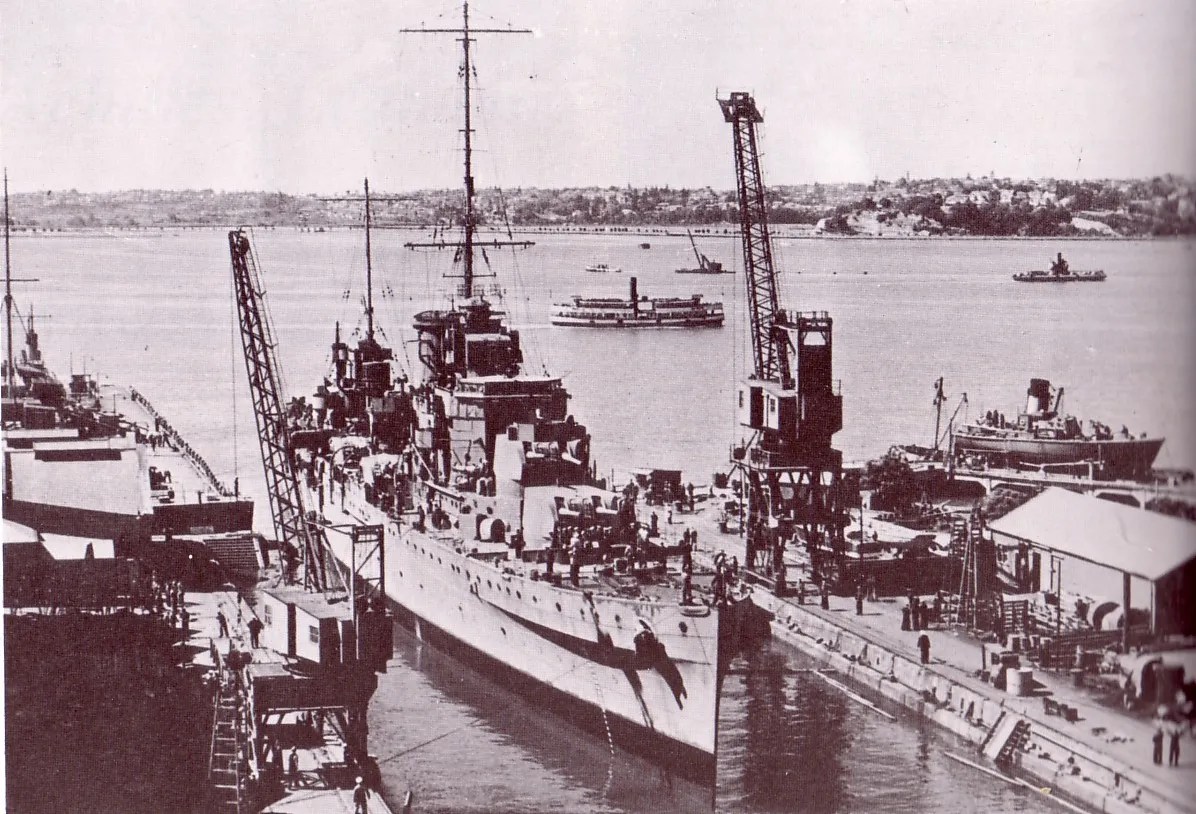
1944: HMNZS LEANDER leaves Calliope Dock, Auckland, after battle damage repairs – HMNZS LEANDER had been hit by a 24-inch Japanese ‘long lance’ torpedo during the night Battle of Kula Gulf in the southwest Pacific on July 13, 1943. She lost 28 men.

She was the lead ship of the Leander class. The ship initially served as HMS Leander in the Royal Navy before her transfer to New Zealand in 1937. In 1945, the ship was returned to the Royal Navy as HMS Leander and was involved in the Corfu Channel incident. The ship was scrapped in 1950.

History

[edit]

Leander was launched at Devonport on 24 September 1931. She was commissioned into the Royal Navy as HMS Leander on 24 March 1933. Along with Achilles she served in the New Zealand Division of the Royal Navy. In August 1937 Leander, on a journey from Europe to New Zealand, carried out an aerial survey of HendersonOeno and Ducie, and on each island a British flag was planted and an inscription was nailed up proclaiming: “This island belongs to H.B.M. King George VI.”[1]

Italian ship Ramb I sinking after the engagement with Leander
A catapult-launched Supermarine Walrus from Leander, ca. 1938, used as a fleet spotter

In World War IILeander served initially in the Pacific and Indian Oceans. Commander Stephen Roskill, in later years the Royal Navy’s Official Historian, was posted as the ship’s executive officer in 1941. In the action on 27 February 1941, she sank the Italian armed merchantman Ramb I near the Maldives, rescuing 113 of her crew and taking slight damage. On 23 March 1941, Leander intercepted and captured the Vichy French merchant Charles L.D. in the Indian Ocean between Mauritius and Madagascar. On 14 April, Leander deployed for support of military operations in Persian Gulf and, on 18 April, joined the aircraft carrier Hermes and the light cruiser Emerald. On 22 April, Leander was released from support duties in the Persian Gulf and took part in search for German raider Pinguin south of the Maldives.

In June 1941, Leander was transferred to the Mediterranean Fleet and was active against the Vichy French during the Syria-Lebanon Campaign. After serving in the MediterraneanLeander returned to the Pacific Ocean in September 1941. In 1941 the New Zealand Division became the Royal New Zealand Navy (RNZN) and she was commissioned as HMNZS Leander in September 1941.

On 13 July 1943, Leander was with Rear Admiral Walden Lee Ainsworth‘s Task Group 36.1 of three light cruisers: Leander and the US ships Honolulu and St. Louis. The task group also included ten destroyers. At 01:00 the Allied ships established radar contact with the Japanese cruiser Jintsu, which was accompanied by five destroyers near Kolombangara in the Solomon Islands. In the ensuing Battle of KolombangaraJintsu was sunk and all three Allied cruisers were hit by torpedoes and disabled. Leander was hit by a single torpedo just abaft ‘A’ boiler room. 26 crew from the boiler room and the No.1 4-inch gun mount immediately above were killed or posted missing.[2] The ship was so badly damaged that she took no further part in the war. She was first repaired in Auckland, then proceeded to a full refit in Boston.[3]

She returned to the Royal Navy on 27 August 1945. In 1946 she was involved in the Corfu Channel Incident. She was scrapped in 1950.

Legacy

[edit]

The superyacht Leander G, owned by Sir Donald Gosling, is named after HMS Leander, the first naval vessel on which he served.[4]

In 2020, Fiji commissioned RFNS Savenaca, a patrol vessel named after Savenaca Naulumatua, a sailor from Fiji who died while serving aboard Leander during the Battle of Kolombangara.[5][6]

See also

[edit]

Castle Class NZ – HMNZS Waima (T33/T349)

HMNZS Waima was one of eight steel New Zealand-built Castle-class trawlers built and commissioned by the Royal New Zealand Navy during World War II.

Background

The vessel was ordered after the New Zealand government, facing a requirement for more minesweepers to operate in home waters, chose the Castle-class design because it was simple enough to be built with the country’s limited ship construction facilities at the time

Operational history
Waima was the eighth of the nine steel minesweepers constructed for the Royal New Zealand Navy (RNZN) and was commissioned on 28 March 1944. the others being Aroha, Awatere, Hautapu, Maimai, Pahau, Waiho, Waipu, and Waikato (never commissioned). She served with the 96th Auxiliary Minesweeping Group, located at Lyttleton.[2] In September 1945, Waima along with the Waiho and Waipu were converted into danlayers, with operations ceasing October 1945 due to coal shortages, resuming in March 1946 with a guaranteed supply of coal for all 3 trawlers with them making up part of the 25th Auxiliary Minesweeping Division, which was formed to sweep the Waitemata Harbour for a final time.[3][2][1]

Waima would be sold to Red Funnel Trawlers, located in Sydney in May 1946, being towed to Australia by the Matai, arriving on 12 September 1946.[3] She would be renamed to Moona, and began trawling that same year, being laid up in 1958 but would temporarily re-enter service in mid-1959 but would be laid up once again in 1960.[3] In 1963, she would be sold to Robin & Co. Ltd, located in Singapore to be scrapped
https://en.wikipedia.org/wiki/HMNZS_Waima

A Waima model at the Port Chalmers Maritime Museum

EX HMNZS Waima as Moona, a fishing trawler in Sydney, Australia

Courtesy of Sydney heritage fleet photos

Courtesy of Sydney heritage fleet photos

Share this:

Castle Class NZ – HMNZS Waiho (T34/T403)

HMNZS Waiho, T34
HMNZS Waiho – Gunnery practice 1940’s
HMNZS Waiho, T34

Does anyone have photos of the trawler HMNZS Waima during her wartime years? ive contacted the NZ naval museum, and NZ Maritime museum and they have nothing, i only have these 2 photos and shes only in the background behind the Waiho. Her pennant numbers were T33 and T349 and she served in Lyttleton.

HMNZS Waiho 612 tons 1944-46

HMNZS Waiho was one of eight steel New Zealand-built Castle-class ships built and commissioned by the Royal New Zealand Navy during World War II. She was the last Castle-class trawler built for any navy.

Background
The vessel was ordered after the New Zealand government, facing a requirement for more minesweepers to operate in home waters, chose the Castle-class design because it was simple enough to be built with the country’s limited ship construction facilities at the time.[1]

Operational history
Waiho was the last of the nine steel minesweepers constructed for the Royal New Zealand Navy and was commissioned on 3 June 1944. the others being Aroha, Awatere, Hautapu, Maimai, Pahau, Waima, Waipu, and Waikato (never commissioned). She served with the 97th Auxiliary Minesweeping Group, located at Auckland.[2]

The day she was commissioned, she ran aground and was towed off after two hours, suffering a twisted rudder and popped rivets.[1][3] In 1944, the Waiho was struck by the Tui.[3] In 1945, she struck the Auckland ferry Makora, with damage to the ferry. [3] In 1946, she was sold to Red Funnel Trawlers, and was towed to Australia by the Matai.[4][3]

She began fishing in 1946, and was laid up in 1958.[3] She was sold for scrap in 1963.
https://en.wikipedia.org/wiki/HMNZS_Waiho

Castle Class NZ – HMNZS Pahau (T28/T351)

HMNZS Pahau underway, 1943

HMNZS Pahau (T28)(T 351)
MS Trawler of the Manuka class
Navy The Royal New Zealand Navy
Type MS Trawler
Class Manuka
Pennant T 351
Built by Stevenson & Cook (Port Chalmers, New Zealand) : New Zealand Railways (Lower Hull, New Zealand)
Ordered Aug 1941
Laid down Nov 1942
Launched 3 Apr 1943
Commissioned 12 Feb 1944
End service
History
Sold in 1946
Commands listed for HMNZS Pahau (T 351)
Commander From To
1 Lt. George David Gray, RNZNVR 10 Jan 1944 early 1945
2 T/Lt. William Harold Keith Mollard, RNZNVR early 1945

HMNZS Pahau alongside HMNZS Matai

Former RNZN ships – Ex HMNZS Matai with HMNZS Pahau under tow from Auckland entering Sydney Harbour

Ex HMNZS Pahau in 1946 while she was operating in Sydney under Arthur Murrell – courtesy Sydney Heritage Fleet

HMNZS Pahau was one of eight steel New Zealand-built Castle-class trawlers built and commissioned by the Royal New Zealand Navy during World War II.

Background[edit]

The vessel was ordered after the New Zealand government, facing a requirement for more minesweepers to operate in home waters, chose the Castle-class design because it was simple enough to be built with the country’s limited ship construction facilities at the time.[1]

Operational history[edit]

Pahau was the fifth of the nine steel minesweepers constructed for the Royal New Zealand Navy and was commissioned on 12 February 1944. the others being ArohaAwatere HautapuMaimaiWaihoWaimaWaipu, and Waikato (never commissioned). She served with the 95th Auxiliary Minesweeping Group, located at Wellington.[2] In March 1946, Pahau would be sold to Arthur. A. Murrel of Sydney along with Awatere[3][4] On 22 May, 1946, while being towed to Australia by the Matai, Pahau would break free from the Matai, becoming adrift.[5] She would be located a few days later and would arrive at Sydney on 28 May 1946.[6][7] In October 1946, Pahau was brought by the Australian Commonwealth Government and was allocated to the UNNRA to rebuild the decimated Chinese fishing industry.[3] She was last seen with the Awatere and Tawhai fishing at Formosa (now Taiwan)

Share this:

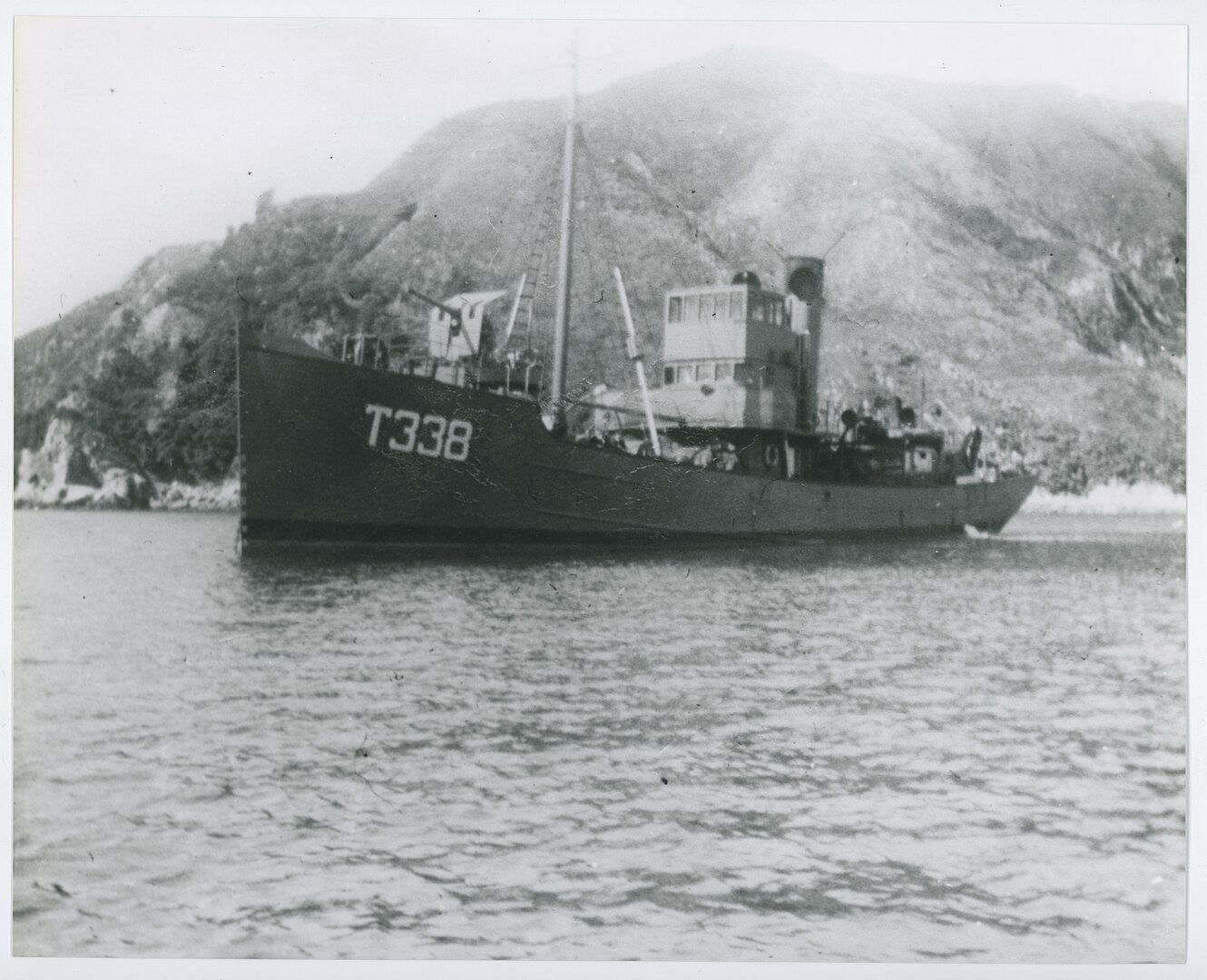
Castle Class NZ – HMNZS Maimai (T27/T338)

HMNZS Maimai (T27) (T338) some pics of the crew – The ship was launched on February 25, 1943 at the Stevenson & Cook shipyard in Dunedin , and entered the Royal New Zealand Navy in 1944. The unit was withdrawn from service in 1946.

HMNZS Maimai (T27) (T338) – New Zealand minesweeper from the period of World War II , one of the thirteen built units of type Castle . The ship was launched on February 25, 1943 at the Stevenson & Cook shipyard in Dunedin , and entered the Royal New Zealand Navy in 1944. The unit was withdrawn from service in 1946.
Maimai served in the RNZN for only two years, initially marked with a side mark T27, then changed to T338 [2] . It was written from the fleet list in 1946 and then sold to the fishing sector.
https://pl.wikipedia.org/wiki/HMNZS_Maimai

Customize buttons

Like this:

HMNZS Maimai (T27) (T338)

  • by John
  • 19 May 2024

HMNZS Maimai was one of eight steel New Zealand-built Castle-class ships built and commissioned by the Royal New Zealand Navy during World War II.

HMNZS Maimai with HMS Indefatigable in the Marlborough Sounds – 1945

HMS Indefatigable with HMNZS Maimai alongside her, Maimai was acting as a store ship for Indefatigable. Photo from Auckland Libraries heritage image collection (PHOTO ID:370_0299_07)

HMNZS Maimai & her crew

Castle Class at HMNZS Cook, Shelly Bay, Wellington

ST Maimai Steaming up Wellington Harbour, 1960s

HMNZS Maimai (T27) (T338)

Maimai being tended to by the Fire Brigade after waste oil in her bilges caught fire.

Maimai being broken up on the Evans bay slipway in 1966, she was broken up in 6 weeks.

Film of Maimai being broken up exists but is yet to be digitized.

HMNZS Maimai was one of eight steel New Zealand-built Castle-class ships built and commissioned by the Royal New Zealand Navy during World War II.

Background[edit]

The vessel was ordered after the New Zealand government, facing a requirement for more minesweepers to operate in home waters, chose the Castle-class design because it was simple enough to be built with the country’s limited ship construction facilities at the time.[1]

Operational history[edit]

Maimai was the fourth of the nine steel minesweepers constructed for the Royal New Zealand Navy and was commissioned on 15 September 1943. the others being ArohaAwatereHautapuPahauWaihoWaimaWaipu, and Waikato (never commissioned). She served with the 95th Auxiliary Minesweeping Group, located at Wellington.[2] In March 1944, Maimai would accidentally fire her port depth charge thrower while berthed at Picton.[3] The unexploded depth charge was recovered four weeks later.[3] On 27 July 1945, she was rammed by Awatere stern-to-stern at Shelly Bay, with minor damage.[3] After the war, Maimai was disarmed but remained in service for ammunition dumping.[3] In 1946, Maimai was purchased by the Maimai Trawling Company Ltd. to be used as a side trawler.[3][2]

In 1947 she caught nearly 100,000 lb (45,000 kg) of fish, being considered a record for four days of fishing at the time.[4] On 28 July 1950, waste oil in Maimai‘s bilges caught fire, but was quickly extinguished by the Wellington Fire Brigade.[5][6] As the years went by, catches got smaller and smaller, with conditions onboard of Maimai deteriorating. [7] And with smaller and efficient fishing vessels being built, it became harder for Maimai to get a crew, with Maimai still sailing without a full crew.[7] At the end of 1966, Maimai was sold for scrap and was scrapped in Wellington by Pacific Scrap Ltd

JCs Royal New Zealand Navy Ships and New Zealand Defence, Also other World Defence Updates

Ships and Defence News Past and Present

Skip to content ↓