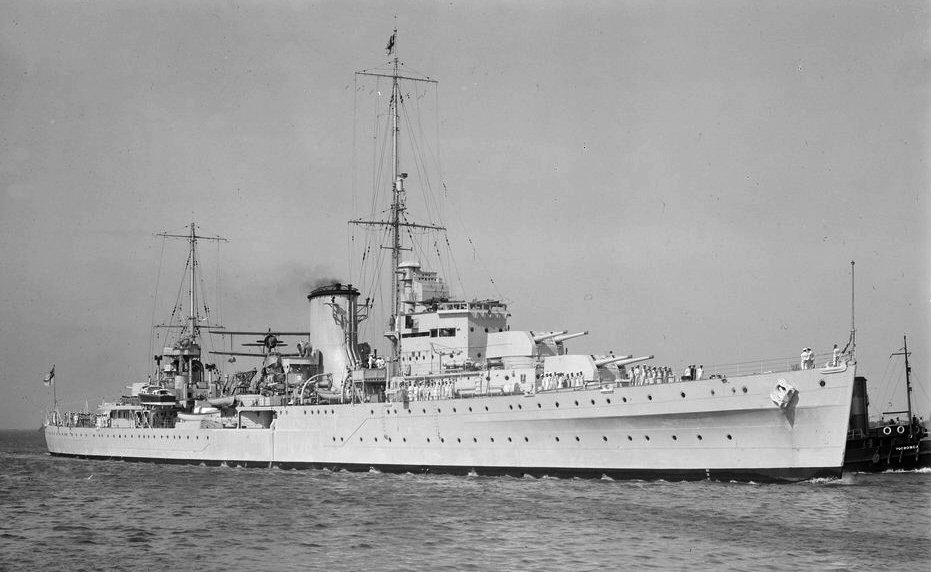
HMNZS/HMAS Echuca HMAS Echuca (J252/M252), named for the town of Echuca, Victoria, was one of 60 Bathurst-class corvettes constructed during World War II, and one of 36 initially manned and commissioned by the Royal Australian Navy (RAN)
RNZN service On 5 March 1952, Echuca and three other Bathurst-class corvettes (HMA Ships Inverell, Kiama, and Stawell) were transferred to the Royal New Zealand Navy (RNZN).[12] She was commissioned into the RNZN in May 1952, and received the prefix HMNZS.[13]
The week ( 24th June, 1957), divers from HMNZS Stawell and Echuca – Bathurst Class Corvettes took part in righting and salvaging Auckland Harbour Board Dredge Hapai. Hapai had capsized and sank off Cheltenham Beach on 24th June, 1957.
Echuca was brought out of the reserve to assist with the salvage, her only service in the RNZN. She was then sold in April 1967 and broken up at the Western Viaduct and Meola Creek.
HMAS Echuca
The corvette remained in service with the RNZN until 1967, although from 1953 she was classified as being in reserve.[1][13] She was sold to Pacific Scrap Limited of Auckland for scrapping[1] on 11 April 1967 https://en.wikipedia.org/wiki/HMAS_Echuca
The image shows the HMAS Echuca, a Bathurst-class corvette that served in the Royal Australian Navy during World War II.
HMAS Echuca
The ship was one of 60 Bathurst-class corvettes built in Australia during the war.
It was commissioned on September 7, 1942, and initially served as an anti-submarine patrol and convoy escort vessel along the eastern Australian coast and in New Guinea waters.
In August 1944, it was ordered to Darwin and attached to the United States Seventh Fleet’s Survey Group.
After the war, it participated in sweeping operations in New Britain and the Solomon Islands before returning to Australia and being paid off into the Reserve Fleet in August 1946.
This year marks a significant milestone for No. 6 Squadron RNZAF, celebrating 20 years since its reestablishment as the Royal New Zealand Navy’s maritime helicopter unit.
21 November, 2025
But as an aviation squadron, its history goes back even further – forming, disbanded and reforming several times, adapting to the changing demands of New Zealand’s military aviation requirements.
First established in February 1942, the Squadron began as an Army cooperation unit flying Vickers and Hawker biplane trainers before converting to Catalina amphibious aircraft a year later. Operating across the Pacific Islands throughout the Second World War, the Catalinas of No. 6 Squadron played a vital role in reconnaissance, search and rescue, and maritime patrol missions.
At the end of hostilities, the Squadron transitioned to the Short Sunderland flying boats, continuing its maritime surveillance role until 1957, when No. 6 Squadron was disbanded and its aircraft transferred to No. 5 Squadron. The Sunderland’s were eventually replaced by the P-3 Orion in 1967, marking a new era in long-range maritime patrol for the Royal New Zealand Air Force.
Meanwhile, the Royal New Zealand Navy was developing its own airborne capability with the purchase of frigates with flight decks. In 1966, HMNZS Waikato became the first RNZN vessel to embark the Westland Wasp anti-submarine helicopter. This changed the role of a combat frigate to include being a platform to deliver Naval Aviation Combat capabilities.
No. 3 Squadron, which had become a dedicated helicopter squadron, operated the Wasp helicopters for the next three decades.
At the time, maintaining the Naval Support Flight (NSF) within 3 Squadron made sense with the number of aircraft and the technical needs to support them leading naturally to finding capacity from within an existing Squadron rather than commissioning a new one. Co-location at Hobsonville also made sense despite the outputs of NSF being very distinct from those provided through Iroquois operations.
When the Wasps retired in 1998, they were replaced by the Kaman SH-2F Seasprite as an interim measure before the new the SH-2G(NZ) were delivered. For the Commander of the Naval Support Flight at the time, Lieutenant Commander Jim Gilmour, the new helicopters were a real pleasure to fly.
“They were an extraordinary leap forward in terms of capability – range and endurance, twin engine, radar, FLIR, ESM, self protection, data link (such as it was) and Anti-ship missiles (Maverick) all made the transition a positive experience,” he said.
With the arrival of the Seasprite, it was obvious that Naval Aviation had matured and expanded significantly.
Scroll to previous imageScroll to next image
When the relocation of Iroquois operations to Ohakea occurred along with the move of the Naval Support Flight from Hobsonville to Whenuapai, it became clear to LTCDR Gilmour, that a new squadron was needed.
“I considered this a reflection of the emergence of a critical strand of Naval combat outputs and deserving of the status and support that a separate entity should bring.”
In 2004, LTCDR Gilmour piloted his last Seasprite flight and concluded his time with the NSF unit taking up the Director Naval Aviation position in Wellington on promotion to Commander. While he moved between these roles, his key objective was to petition the Chief of Air Force at the time to establish a new squadron.
“I spent a great deal of time forming the argument and was proud to convince CAF of its merits and to see the re-establishment of No. 6 Squadron as a dedicated naval aviation unit take place shortly after.”
The re-establishment of the Squadron in October 2005 marked a new chapter in joint Air Force–Navy cooperation, integrating RNZN aircrew with RNZAF maintenance personnel to deliver a seamless maritime aviation capability.
By that stage, five of the SH-2G(NZ) Seasprite variants had joined the fleet and then In 2015, ten ex-Royal Australian Navy SH-2G(I) Seasprites were acquired to replace the NZ type, expanding the Squadron’s capability and reach.
Today, No. 6 Squadron currently supports HMNZ ships Te Kaha, Te Mana, Canterbury and Aotearoa in operations ranging from anti-surface and anti-submarine warfare to search and rescue, surveillance, maritime sustainment and disaster relief.
The 20th anniversary of the Seasprite squadron also coincides with the Government’s recent announcement of the Sikorsky MH-60R Seahawk as the replacement for the Seasprite fleet. This ensures that No. 6 Squadron will continue to deliver world-class maritime helicopter capability well into the future. The transition will enhance interoperability with allies, particularly the Royal Australian Navy, which also operates the MH-60R.
For the Commanding Officer, Commander Alex Trotter, the anniversary is one which arrives during a busy and rewarding period for the unit.
“With a flight deployed on operations in the South China Sea, and the rest of the squadron conducting mountain flying training in the South Island, it’s the perfect example of the wide spectrum of capabilities the squadron provides in diverse operating environments,” he said.
“It’s important we reflect on 20 years of achievements in delivering a warfighting capability to the Royal New Zealand Navy, as well as the myriad of other outputs to various stakeholders within the NZDF and other government agencies. And it’s equally appropriate we recognise our personnel – the sailors, aviators and civilians. Their professionalism, dedication and adaptability remain at the heart of the Squadron’s success.”
The HMNZS Aotearoa | Image: Japan’s defense ministry
The Royal New Zealand navy deployed its largest ship to northeast Asia this month to watch for North Korean violations of U.N. sanctions, according to Japan’s foreign affairs ministry Tuesday.
The HMNZS Aotearoa carried out surveillance operations in “in waters surrounding Japan” from early to mid-November, the ministry said in a press release.
Japan welcomed the vessel’s deployment as part of international efforts to implement U.N. Security Council resolutions (UNSCRs) against North Korea.
“As Japan has also been conducting information gathering activities for vessels suspected of violating the UNSCRs, Japan works closely with relevant countries and international organizations, including New Zealand,” the release said.
In Aug. 2024, the 26,000-ton tanker and sustainment ship patrolled the area to monitor the DPRK’s ship-to-ship transfers in violation of U.N. sanctions for the first time, after its visit to Japan’s Yokosuka Naval Base south of Tokyo.
Earlier this month, Wellington deployed a patrol aircraft to operate out of Japan’s Kadena Air Base, marking the eighth time the aircraft has participated in operations against North Korea’s illegal maritime activities since 2018.
Canada has also sent patrol ships and aircraft to monitor DPRK sanctions evasion from Japan on multiple occassions in recent months.
Pyongyang is widely suspected of exporting coal in defiance of the sanctions and relying on illicit maritime smuggling to obtain oil beyond U.N.-imposed limits. The regime is also accused by the U.S. and other countries of using sanctioned vessels to supply weapons and troops to Russia.
Ship-to-ship transfers by the DPRK have been prohibited under Resolution 2375 since Sept. 2017.
The following year, countries including the U.K., Canada, Australia, France, Germany and Italy have regularly deployed aircraft and vessels to curb the DPRK’s illicit maritime activity.
North Korea officially rejects the international sanctions and condemns them as a U.S.-driven attempt to infringe on its sovereignty.
In the past, findings from these monitoring missions were included in U.N. Panel of Experts reports on DPRK sanctions violations and were reported to the U.N.’s Enforcement Coordination Cell overseeing the sanctions.
However, since Russia vetoed the Panel’s mandate last year, these results have not been publicly revealed, and maritime surveillance findings have also been absent from the first two reports of the Multilateral Sanctions Monitoring Team established to replace the Panel.
The Royal New Zealand Navy sustainment vessel HMNZS Aotearoa and its embarked Seasprite helicopter deployed in late 2025 to monitor United Nations sanctions against North Korea. NEW ZEALAND DEFENCE FORCE
FORUM Staff
Australia, France and New Zealand deployed air and maritime assets to Northeast Asia recently to monitor international sanctions targeting North Korea’s weapons of mass destruction (WMD) programs.
A Royal Australian Air Force P-8A Poseidon patrol aircraft will operate from Japan’s Kadena Air Base as part of the Australian Defence Force’s (ADF) contributions to upholding trade prohibitions on Pyongyang.
“Australia remains committed to enforcing United Nations Security Council sanctions against North Korea until it takes concrete steps towards denuclearisation,” Vice Adm. Justin Jones, the ADF’s joint operations chief, said in October 2025. “Our deployment reinforces Australia’s strong commitment to uphold international law and support the rules-based global order.”
A Royal New Zealand Air Force P8-A Poseidon and the Royal New Zealand Navy sustainment vessel HMNZS Aotearoa also joined the multinational coalition, along with a French Navy Falcon 50M patrol aircraft.
The Australian Defence Force conducts Operation Argos in October 2025. The mission is Australia’s contribution to enforcement of United Nations Security Council sanctions against North Korea. AUSTRALIAN DEFENCE DEPARTMENT
Since North Korea conducted its first nuclear weapon test in 2006, the U.N. Security Council has adopted major resolutions sanctioning the authoritarian regime over its nuclear and missile activities. The sanctions prohibit or limit trade relating to weapons and military equipment, dual-use technologies, industrial machinery, rare-earth minerals, and coal, oil and petroleum products.
A dozen or so nations, including Japan, South Korea, the United Kingdom and the United States, contribute aircraft, ships and personnel to the Enforcement Coordination Cell (ECC). Based at Yokosuka, Japan, under the U.S. Indo-Pacific Command, the coalition identifies smuggling and disrupts black market networks in the East China Sea, Sea of Japan and Yellow Sea.
The EEC is a component of the U.S.-led Pacific Security Maritime Exchange, which formed in 2018 to monitor compliance with the resolutions.
Concerns over sanctions violations have heightened since North Korean dictator Kim Jong Un began sending weapons and thousands of troops to aid Russia’s war against Ukraine. In return, Moscow is believed to have provided Pyongyang with money, oil and technological assistance for its illicit WMD programs.
The Falcon 50M deployment was the sixth by French aircraft for sanctions monitoring since 2019. The crew operated from Okinawa, Japan.
“Japan welcomes these activities from the viewpoint of ensuring effective implementation of the relevant [resolutions] in solidarity with the international community toward the realization of North Korea’s dismantlement of all weapons of mass destruction and ballistic missiles of all ranges in a complete, verifiable, and irreversible manner,” the Foreign Affairs Ministry stated.
“As Japan has also been conducting information gathering activities for vessels suspected of violating the [resolutions], Japan works closely with relevant countries and international organizations, including the French Republic.”
A Royal Australian Air Force P-8A Poseidon aircraft monitors shipping around North Korea in October 2025 for violations of United Nations sanctions against the regime. AUSTRALIAN DEFENCE DEPARTMENT
Under its Operation Argos, the ADF has deployed aircraft and ships to monitor sanctions since the EEC was established and “continues to play a vital role in maintaining peace and security in the Indo-Pacific,” Jones stated.
During its 2024 mission, the HMNZS Aotearoa located four vessels of interest, questioned 62 vessels and broadcast 52 deterrent messages, while conducting nine replenishments at sea to extend partner nation deployments, the New Zealand Defence Force stated.
“Supporting the international rules-based order is a very real statement,” said Cmdr. Rob Welford, the Aotearoa’s commanding officer. “I know I can talk on behalf of everybody aboard the ship when I say we’re looking forward to playing our part again.”
Last month’s red wind warning meant an extended stay in Wellington but not a respite in training for HMNZS Taupo’s trainee watchkeepers.
17 November, 2025
The vessel is two-thirds of the way through its Officer of the Watch ‘Bravos’ commitment, where alternating cohorts of junior warfare officers undertake their sea phase over 16 days, having done the hard yards on the simulator and the coursework at the Navigation Training School.
The latest cohort brought Taupo to Wellington just as an extreme weather system was making itself felt across New Zealand. The initial plan was to arrive early in the week, depart and return, with the trainees undertaking pilotage and navigation training.
However, the deteriorating conditions that kept many Wellingtonians at home meant Taupo’s team opted for a sheltered extended stay in the capital.
Flexibility is a must for naval operations, says Lieutenant Commander Toby Mara, Taupo’s Commanding Officer, especially with a classic Windy Wellington welcome.
“We were handling 50 knots in the Cook Strait and that provided some sporting conditions for entry into Wellington. Taupo has a good power-to-weight ratio and can control its heading quite well, so while the conditions were quite exciting for the students, the more experienced members of the team were confident the ship could handle it.”
Bumpy conditions heading south to Wellington (left), 0.5 calibre training aboard HMNZS Taupo (middle) and Taupo at anchor near Motuihe Island (right).
While it did mean a change of schedule, the team were still able conduct some bumpy pilotage training in a blustery Wellington Harbour during the week.
Earlier in the month Taupo started its latest sea phase from Devonport with an unusual event – operating in company with ROKS Hansando, a visiting helicopter training ship of the Republic of Korea Navy.
Taupo had entered Auckland harbour to ‘escort’ ROKS Hansando out – something that the host nation would typically do on the way into port, but due to Taupo’s availability was not achieved until the exit.
“It’s such a great opportunity to work with another nation. It’s amazing to see that even with a possible language barrier, our communications methods still stand up and we can conduct manoeuvres together.”
HMNZS Taupo escorts Republic of Korean Navy ship Hasando out of Waitemata Harbour.
Variety – and weather – defines Taupo’s vigorous training schedule around New Zealand’s coastline and ports.
Pilotage in and out of Auckland is standard, but previous cohorts this year have conducted training in the Hauraki Gulf, visited Opua in the Bay of Islands, undertaken confined waters navigation (pilotage) through the Motukawao Island group on the western side of the Coromandel and undertaken in-company serials with HMNZS Canterbury.
After Wellington, Taupo encountered Sea State 5 conditions with large beam seas, meaning the ship had to zig-zag up the coast.
“Once again, enriching for new members of the team. The navigation plan had the ship sheltering in Hawke Bay while the worst of the weather passed over the country. We had a stunning anchorage in Anaura Bay (Gisborne District) before heading around East Cape and heading to Auckland. After a weekend break we’ll finish the sea phase – a busy end of year for the Navy’s smallest ship!”